What Kelvin Is Golden Hour, Overcast & Fluorescent?

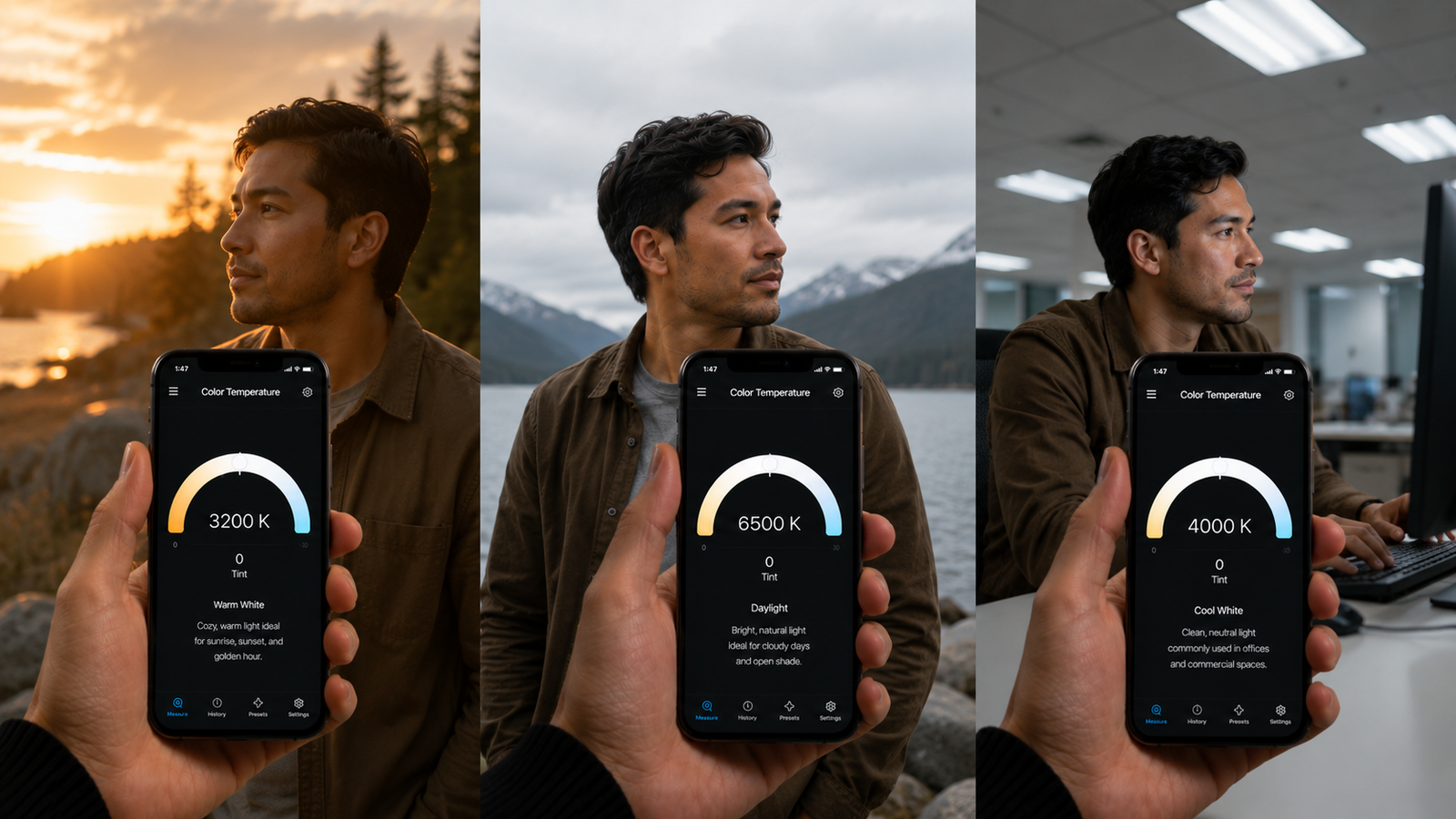
What Kelvin Is Golden Hour, Overcast, and Fluorescent Light?
Every kind of light has a color temperature, and knowing the Kelvin value of common conditions is a shortcut to faster white balance and better-looking photos. Golden hour, an overcast sky, and fluorescent tubes each sit at a very different point on the scale — and once you know roughly where, you can set a starting white balance in seconds instead of guessing.
Here are the quick answers: golden hour is roughly 3,000–4,000K (warm), overcast daylight is around 6,500–7,500K (cool), and fluorescent light is typically 4,000–5,000K with a green tint. Below, this guide breaks each one down along with other common sources, and shows how to confirm the exact value. You can measure any of them with your phone for a precise reading.
📲 Know the exact Kelvin, not just an estimate
Kelvin Light Scale reads the real color temperature of any light — sunlight, sky, or fluorescent — straight from your iPhone, so your white balance starts from fact.
Quick reference chart
| Lighting condition | Approx. Kelvin | Appearance |
|---|---|---|
| Candlelight | ~1,800K | Deep amber |
| Sunrise / sunset | 2,000–3,000K | Warm orange-gold |
| Golden hour | 3,000–4,000K | Warm, soft golden |
| Fluorescent | 4,000–5,000K | Cool white, often green tint |
| Midday sun | 5,000–5,500K | Neutral daylight |
| Overcast sky | 6,500–7,500K | Cool blue-white |
| Open shade / clear blue sky | 8,000–10,000K+ | Strong blue |
These are typical ranges — real conditions vary with weather, time, and location, so a measured value is always more reliable than a chart. You can check the actual number on the spot.
Golden hour: 3,000–4,000K
Golden hour — the period shortly after sunrise and before sunset — gives that warm, soft, flattering light photographers love. The sun is low, its light travels through more atmosphere, and the result is a golden glow that typically measures around 3,000–4,000K. It shifts quickly: closer to the horizon it dips warmer (toward sunset's 2,000–3,000K), and as the sun climbs it cools toward neutral daylight. Because it changes minute by minute, golden hour is the perfect case for measuring as you shoot rather than relying on a fixed setting.
Overcast: 6,500–7,500K
An overcast sky scatters sunlight through clouds, producing soft, even, shadowless light that's cooler than direct sun — usually around 6,500–7,500K, and bluer still in heavy cloud or shade. Cameras left on auto often render overcast scenes too blue and cold. If you want neutral results, set white balance to match the measured temperature; if you want to keep the natural cool mood, leave it. Either way, knowing the value lets you decide on purpose, which you can confirm with a quick reading.
Fluorescent: 4,000–5,000K (with a catch)
Fluorescent tubes usually fall around 4,000–5,000K, but color temperature only tells half the story here. Fluorescent and many LED lights add a green tint that no Kelvin setting removes — it's the classic reason indoor shots under office lighting look slightly sickly. To fix it you correct on the green–magenta (tint) axis as well as setting the right Kelvin. Measuring both the temperature and the tint is the only way to fully neutralize fluorescent light, and you can read both with the app.
💡 Pro tip
“Daylight” isn't one number. Direct midday sun (~5,500K), golden hour (~3,500K), overcast (~7,000K), and open shade (~9,000K) are all “daylight” but span a huge range. Setting your camera to a single “daylight” preset ignores that — measure the actual condition instead.
Why these values matter
Knowing the rough Kelvin of a condition gives you a head start: at golden hour you know to expect warm light, under overcast you anticipate cool, and indoors under fluorescent you remember to watch the tint. That intuition speeds up your setup. But ranges are only starting points — the same “overcast” sky can read 6,500K or 7,800K depending on the clouds. For accurate white balance, measure the specific light in front of you. You can turn an estimate into an exact number in seconds.
✅ The verdict
Golden hour is warm (3,000–4,000K), overcast is cool (6,500–7,500K), and fluorescent is mid-range (4,000–5,000K) but with a green tint to correct. Use these as starting points, then measure the actual light for accurate white balance.
Light is never just “light” — it has a temperature, and these common conditions each have a signature. Learn the ranges to build intuition, but measure the real thing when color accuracy counts. You can read the light around you now.
Measure any light's color temperature
Kelvin Light Scale reads color temperature, tint, lux, and exposure from your iPhone — from golden hour to fluorescent offices. Free to start, with pro metrics when you want them.
Frequently asked questions
What Kelvin is golden hour?
Golden hour light is typically around 3,000–4,000K, giving a warm, soft golden glow. It shifts warmer near the horizon (toward 2,000–3,000K at sunrise and sunset) and cooler as the sun climbs higher, so it changes quickly throughout the period.
What is the color temperature of an overcast sky?
Overcast daylight is usually around 6,500–7,500K, a cool blue-white, and can be bluer still under heavy cloud or in shade. Cameras on auto often render overcast scenes too cold, so setting white balance to the measured value gives more neutral results.
What Kelvin is fluorescent light?
Fluorescent lighting is typically 4,000–5,000K, but it also adds a green tint that color temperature alone doesn't describe. To fully correct fluorescent light you need to fix both the Kelvin and the green–magenta tint.
What is the Kelvin of daylight?
It depends on the condition: midday sun is about 5,000–5,500K, golden hour around 3,500K, overcast roughly 7,000K, and open shade 8,000–10,000K or more. “Daylight” spans a wide range, so a single preset is only an approximation.
Why do my overcast photos look too blue?
Because overcast light is genuinely cool (around 7,000K) and auto white balance can exaggerate it. Set white balance to the measured temperature to neutralize the blue, or leave it if you want to preserve the natural cool, moody feel.
How do I fix the green tint from fluorescent lights?
Setting the right Kelvin isn't enough — you also shift toward magenta on the tint (green–magenta) axis. Measure both the color temperature and the tint, then correct each, in camera or in editing, to remove the green cast.
what kelvin is golden hourovercast color temperaturefluorescent light kelvingolden hour color temperaturedaylight kelvin chartcolor temperature of natural lightovercast white balancefluorescent green tint