What Is Smash Factor in Golf and How Do You Improve It?

What Is Smash Factor in Golf and How Do You Improve It?
By Asaru Labs | Golf Performance | 7 min read
Smash factor is one of the most honest numbers a launch monitor can show you. It does not care how fast you swing. It does not reward effort or intention. It simply measures how efficiently you converted your swing speed into ball speed — and for most amateur golfers, the number reveals a significant amount of distance being left behind at impact.
This guide explains exactly what smash factor is, what a good number looks like for every club, why yours might be lower than it should be, and how to improve it using real data from a golf launch monitor.
See your smash factor on every shot — free.
The Golf Launch Monitor app shows your smash factor, ball speed, club head speed, launch angle, and carry distance on every shot — straight from your iPhone camera, no hardware needed.
What is smash factor?
Smash factor is the ratio of ball speed to club head speed at impact:
Smash Factor = Ball Speed ÷ Club Head Speed
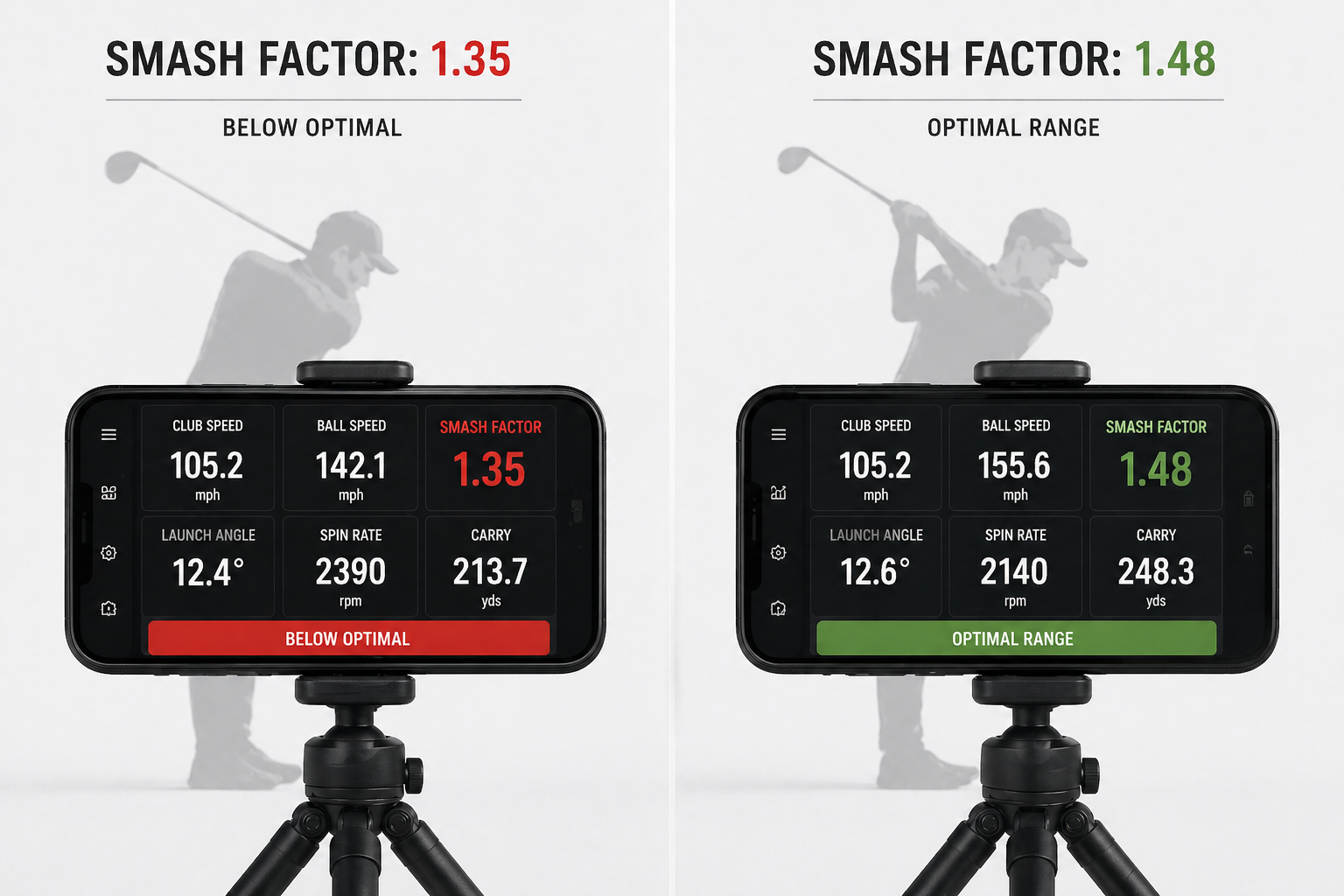
For example: if your club head speed is 100 mph and your ball speed is 148 mph, your smash factor is 1.48.
The number tells you how efficiently energy transferred from the clubhead to the ball at impact. A perfect energy transfer — the theoretical maximum — produces a smash factor of 1.50 for a driver. The closer you are to 1.50, the more of your swing speed is being converted into ball speed. The further below 1.50, the more speed you are wasting through poor contact, off-centre strikes, or mismatched equipment.
Here is why this matters so much in practice: two golfers can swing at exactly the same speed and carry the ball completely different distances, purely because of different smash factors. A golfer with a 95 mph swing and a 1.50 smash factor produces 142.5 mph of ball speed. The same 95 mph swing with a 1.38 smash factor produces only 131 mph of ball speed. That difference — 11.5 mph of ball speed — translates to roughly 23 yards of carry. Twenty-three free yards, simply from striking the ball more efficiently.
What is a good smash factor? Numbers by club
The theoretical maximum smash factor is set by the rules of golf — the USGA limits driver face flexibility in a way that caps smash factor at 1.50. For irons and wedges, the number is naturally lower because of design differences. Here are the targets by club:
| Club | Tour average | Good amateur | Typical amateur | Needs work |
|---|---|---|---|---|
| Driver | 1.49–1.50 | 1.45–1.49 | 1.38–1.44 | Below 1.35 |
| 3-wood | 1.46–1.48 | 1.42–1.46 | 1.35–1.42 | Below 1.32 |
| 5-iron | 1.38–1.40 | 1.33–1.38 | 1.26–1.33 | Below 1.22 |
| 7-iron | 1.33–1.36 | 1.28–1.33 | 1.22–1.28 | Below 1.18 |
| Pitching wedge | 1.23–1.26 | 1.18–1.23 | 1.12–1.18 | Below 1.10 |
Quick check: Open the Golf Launch Monitor app, find your average ball speed and club head speed from your last session, and divide ball speed by club head speed. Where does your number sit in the table above? If you are in the "typical amateur" or "needs work" column, the sections below tell you exactly why and how to fix it.
What does a low smash factor actually tell you?
A low smash factor is almost always a contact quality problem, not a swing speed problem. The three specific things it reveals are:
1. Off-centre strikes
The single biggest driver of low smash factor. The sweet spot of a driver face has a coefficient of restitution (COR) at or near the legal maximum, meaning the face springs back efficiently at impact and transfers energy well. Strikes away from the sweet spot — toward the toe, heel, high, or low — hit a stiffer part of the face that deflects less, absorbs more energy, and transfers less to the ball. A toe strike can reduce smash factor by 0.06–0.10 compared to a perfect centre hit, which at 100 mph of club head speed means losing 6–10 mph of ball speed and 12–20 yards of carry.
2. Gear effect losses
Off-centre strikes also trigger gear effect — the curved face twists at impact, changing the spin axis and redirecting energy away from pure forward momentum. Heel and toe strikes send energy into sidespin. High and low strikes send energy into changed backspin. All of this reduces the efficiency of energy transfer and shows up as a lower smash factor reading.
3. Equipment mismatch
A shaft that is too stiff, too flexible, or poorly fitted for your swing timing can cause the clubface to arrive at impact slightly open or closed, or at a suboptimal angle. This reduces the effective sweet spot contact even when the strike location looks centred. If your smash factor is consistently low despite apparently solid contact, shaft fitting is worth investigating.
The direct relationship between smash factor and distance
To make the stakes concrete, here is what different smash factor levels mean for carry distance at a typical amateur swing speed of 95 mph:
| Smash factor | Ball speed (at 95 mph) | Approx. carry distance | Distance vs. optimal |
|---|---|---|---|
| 1.50 (optimal) | 142.5 mph | 242 yards | — |
| 1.45 | 137.8 mph | 233 yards | −9 yards |
| 1.40 | 133.0 mph | 223 yards | −19 yards |
| 1.35 | 128.3 mph | 212 yards | −30 yards |
| 1.30 | 123.5 mph | 200 yards | −42 yards |
The bottom line: a golfer with a 1.30 smash factor is losing 42 yards to a golfer with the same swing speed and a 1.50 smash factor. No fitness programme, no new shaft, no swing speed training will close that gap until contact quality improves. Smash factor is where that work starts.
How to improve your smash factor: the practical fixes
Fix 1 — Find the centre of the face consistently
This is the highest-leverage improvement available. A 0.05 improvement in smash factor at 95 mph club head speed is worth roughly 10 yards of carry. Here are the most effective ways to improve contact quality:
- Use impact tape or foot powder spray: Spray the face with foot powder or stick impact tape before a session. The mark left by each strike shows you immediately where on the face you are making contact. Most golfers are surprised by how far from centre their typical strike is. Seeing the pattern over 10 shots is more instructive than any amount of video analysis.
- Slow the swing down temporarily: At full speed, the body compensates for poor mechanics and makes off-centre contact feel normal. Drop to 70–80% swing speed and focus entirely on striking the centre of the face. As contact improves, gradually build speed back up. The smash factor at 80% speed will often exceed what you achieve at 100%.
- Narrow your stance slightly: An overly wide stance encourages lateral swaying, which shifts the low point of the swing and makes consistent face contact harder. A stance around shoulder-width for the driver gives you better rotational stability and more repeatable contact.
Fix 2 — Stabilise your head position through impact
One of the most common causes of off-centre contact is head movement during the downswing. Lateral movement toward the target (early extension) moves the club's path and low point, making heel contact more likely. Lateral movement away from the target (hanging back too much) moves the arc outward and promotes toe contact. Keeping your head position stable — not rigidly fixed, but not dramatically shifting — is foundational to consistent sweet spot contact.
Fix 3 — Match your swing to the correct equipment
Equipment that is poorly fitted for your swing can suppress smash factor even with good contact. Key areas to check:
- Shaft flex: A shaft too stiff for your swing speed means the face does not square up properly at impact. A shaft too flexible causes the same problem in the opposite direction. Getting shaft flex right for your swing speed is one of the fastest and cheapest ways to improve smash factor without changing your swing at all.
- Driver loft: A driver with too little loft for your swing speed can reduce smash factor by encouraging a steeper attack angle and lower contact on the face. Make sure your loft setting is appropriate for your speed as covered in the launch angle guide.
- Club length: An overly long driver is harder to control and makes consistent centre contact more difficult. Many fitters find that choking down an inch on the driver immediately improves contact quality and smash factor, even at a slight cost to raw swing speed.
Fix 4 — Build a practice routine around contact, not distance
The biggest obstacle to improving smash factor is practising for distance rather than contact quality. When every swing is a maximum effort to hit the ball as far as possible, the body prioritises speed over precision. The result is inconsistent contact that never improves because the feedback loop — how far the ball went — is too noisy to tell you whether contact quality changed.
A contact-quality practice routine looks like this:
- Use impact tape on the face for every session until your contact pattern shows consistent centre strikes
- Hit at 70–80% effort and focus exclusively on striking the sweet spot
- Check your smash factor in the Golf Launch Monitor app after each shot — not carry distance. Your target is 1.45+ before you worry about distance at all
- Only build back to full speed once your smash factor at 80% is consistently above 1.45
The counterintuitive truth: Many golfers find their carry distance actually increases when they slow down to 80% and focus on contact quality. A 95 mph swing with 1.50 smash produces 142.5 mph of ball speed. A 105 mph swing with 1.35 smash produces only 141.8 mph. The slightly slower, better-struck shot carries further — and it is also more accurate and more consistent.
Smash factor vs. ball speed: which should you focus on?
Smash factor and ball speed are related but tell you different things, and knowing which to focus on depends on where your game is right now.
| Metric | What it tells you | Focus on it when… |
|---|---|---|
| Smash factor | How efficiently you are using the swing speed you already have | Your smash factor is below 1.42 — fixing contact quality is the highest-ROI move available |
| Ball speed | The total output — combines both swing speed and contact efficiency | Your smash factor is already above 1.45 and you want to push distance further through speed training |
The priority order for most amateur golfers: fix smash factor first, then worry about speed. The Golf Launch Monitor app shows you both numbers on every shot, making it easy to see whether your limiting factor is contact quality or raw speed.
THE PAYOFF
Improving smash factor from 1.38 to 1.48 at a 95 mph swing speed adds roughly 19 yards of carry distance — no speed training, no new clubs, no swing rebuild. It is the purest form of free distance in golf, available to any golfer willing to practise contact quality deliberately and measure the results honestly.
Start tracking your smash factor today — free.
Download the Golf Launch Monitor app and see your smash factor, ball speed, club head speed, and carry distance on every shot — straight from your iPhone, no extra hardware needed. Find out exactly how much distance your contact quality is costing you.
Frequently asked questions
What is a good smash factor for an amateur golfer?
For a driver, a smash factor between 1.45 and 1.49 is excellent for an amateur. Most recreational golfers fall between 1.38 and 1.44. Anything below 1.35 is a significant contact quality problem that is worth addressing before any other aspect of distance improvement. The Golf Launch Monitor app shows your smash factor after every shot so you have a real baseline to work from.
Can smash factor exceed 1.50?
Not legally. The USGA and R&A limit the coefficient of restitution (COR) of driver faces in a way that caps the theoretical maximum smash factor at 1.50. Non-conforming drivers can exceed this, but any legal driver is capped at 1.50. For irons and wedges, the maximum is naturally lower due to the design of the face and the intended ball flight.
Why does my smash factor vary so much shot to shot?
Shot-to-shot variation in smash factor almost always reflects inconsistent contact location on the face. Some shots catch the sweet spot, others miss by varying amounts. Consistent smash factor — where the number stays in a tight band across 10 shots — is actually more valuable than a high average with wild variation, because it reflects genuine swing repeatability. Use impact tape to see your contact pattern and identify where the inconsistency is coming from.
Is smash factor the same as coefficient of restitution (COR)?
They are related but not the same. COR is a property of the club face itself — a measure of face springiness determined by the material and construction of the face. Smash factor is a measurement of what actually happened at impact in a specific swing, factoring in strike location, angle of attack, and all other variables. A driver with a high COR gives you the potential for a high smash factor, but only consistent centre contact realises that potential.
Does smash factor matter for irons and wedges?
Yes, but the targets are lower and the priority is different. For irons, smash factor directly affects distance consistency — the same swing producing different smash factors swing to swing means your carry distances are unpredictable, which costs you on approach shots. For wedges, distance consistency matters even more than maximum carry, so a stable, repeatable smash factor is more important than chasing the highest possible number.
Will a new driver improve my smash factor?
A properly fitted driver can improve smash factor modestly — typically 0.02–0.05 — through better face technology, correct shaft flex, and appropriate loft. But if your current smash factor is 1.35 because of off-centre contact, a new driver will not fix that. Equipment improvements are meaningful fine-tuning for golfers already making good contact. For golfers with contact quality issues, the improvement comes from practice and technique, not hardware.
what is smash factor in golfhow to increase smash factorsmash factor golf definitiongood smash factor golfsmash factor by clubimprove golf smash factorgolf launch monitor smash factorball speed club speed ratio golf