What Is Shot Dispersion in Golf and How to Tighten It With Practice

What Is Shot Dispersion in Golf and How to Tighten It With Practice
By Asaru Labs | Golf Performance | 7 min read
Hitting it far is satisfying. Hitting it consistently — knowing roughly where every shot is going to land before you swing — is what actually lowers your score. Shot dispersion is the metric that measures that consistency, and most amateur golfers have a far wider spread than they realise.
This guide explains what shot dispersion is, how to measure it properly, what causes a wide pattern, and the specific practice methods that tighten it — verified with real data from a launch monitor.
Track your shot dispersion after every session — free.
The Golf Launch Monitor app tracks shot dispersion alongside ball speed, launch angle, spin rate, and carry distance — from your iPhone camera, no hardware needed. See exactly how wide your pattern is and watch it tighten as you improve.
What is shot dispersion?
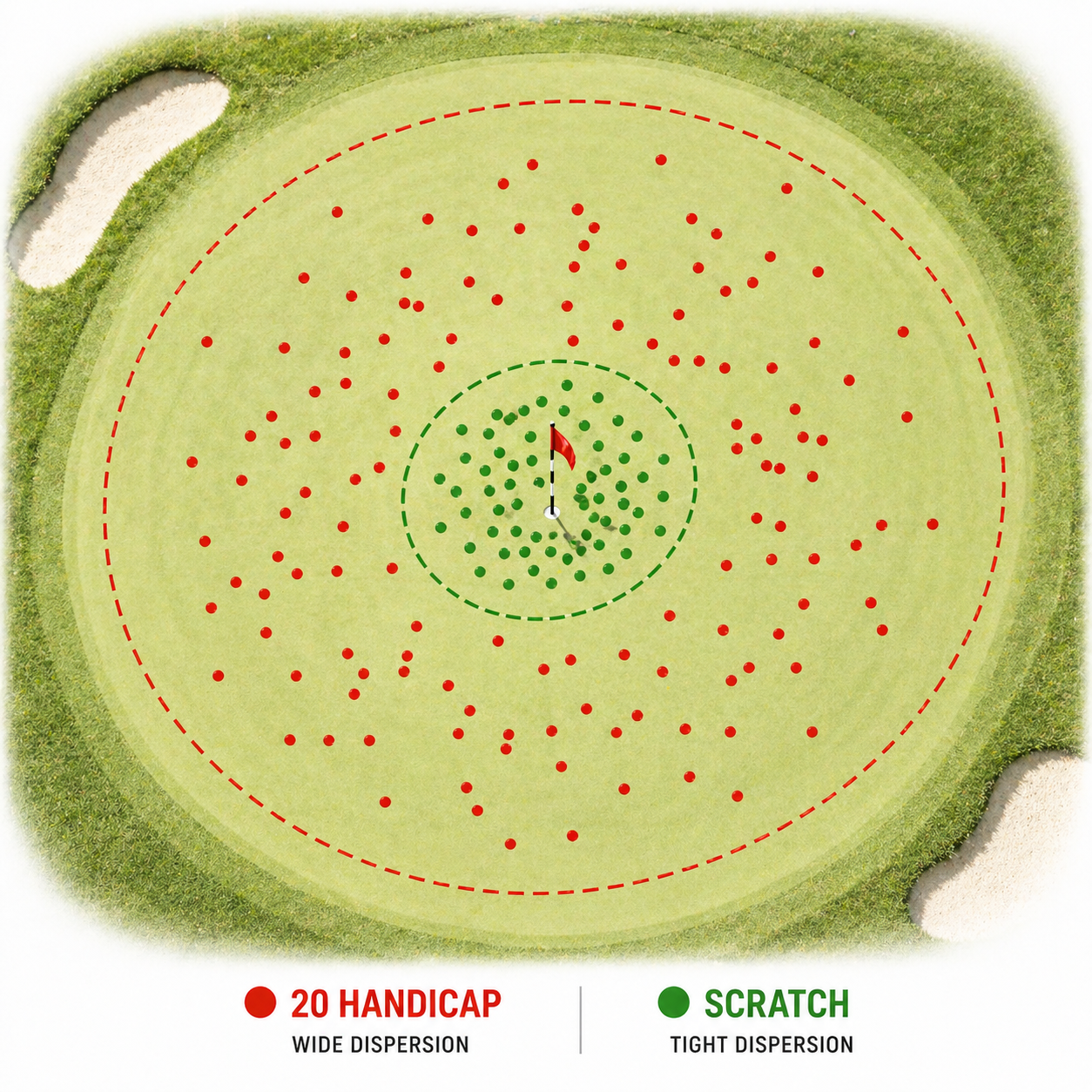
Shot dispersion is the spread of landing positions produced by a series of shots hit with the same club, from the same spot, at the same target. It is usually visualised as an oval or ellipse on a diagram — the cluster of dots showing where multiple shots actually landed relative to where you were aiming.
Every golfer has a dispersion pattern, even tour professionals. The difference between a scratch golfer and a 20-handicapper is not that the scratch golfer always hits it exactly where they aim — it is that their dispersion pattern is much tighter and more predictable. A scratch golfer's 7-iron might land within a 20-yard-wide, 15-yard-deep window 80% of the time. A 20-handicapper hitting the same club might scatter shots across a 50-yard-wide, 40-yard-deep area with no clear pattern at all.
Understanding your dispersion matters in two distinct ways:
- For practice: Dispersion data shows you whether the changes you are making are actually producing more consistent contact, or whether you are just having a good or bad day on feel alone.
- For course management: Knowing your real dispersion pattern lets you aim at the right spot on every hole — not the flag, not the centre of the green, but the spot where even your worst shot in the pattern stays in play.
How to measure shot dispersion properly
To get meaningful dispersion data you need to do three things correctly: use a consistent target, hit enough shots, and record the actual landing positions rather than relying on memory.
What counts as a meaningful sample
Ten shots is the minimum for any useful dispersion measurement. Fewer than ten and you are looking at noise, not a pattern. Twenty shots gives you a much more reliable picture. Fifty shots — spread across two or three sessions — gives you your true baseline dispersion, accounting for natural day-to-day variation in your swing.
Important: Hit your normal swing — do not try harder or be more careful than usual. Dispersion measured from a cautious, "trying to be consistent" swing is not your real pattern. It is the pattern you would need to replicate under pressure on the course, which you cannot. Swing as you normally would and let the data show the honest picture.
Using the Golf Launch Monitor app to track dispersion
The Golf Launch Monitor app automatically records shot dispersion alongside every other metric in your session. After hitting a set of shots, the dispersion view shows the spread of your shots plotted relative to your target line — both lateral spread (left-right) and distance spread (short-long). This gives you a visual pattern immediately, without needing to pace out landing spots or keep notes.
The app also shows you the average carry and the standard deviation of your shots across the session, so you can see not just where your shots go on average but how much they vary around that average.
What a typical dispersion pattern looks like by handicap
| Handicap level | Typical 7-iron lateral spread | Typical 7-iron distance spread | Pattern characteristics |
|---|---|---|---|
| Tour / scratch | 10–18 yards wide | 8–12 yards deep | Tight oval, centred near target, consistent shape |
| 5–10 handicap | 22–30 yards wide | 15–20 yards deep | Recognisable oval, slight directional bias, occasional outlier |
| 10–18 handicap | 35–50 yards wide | 25–35 yards deep | Wider spread, clear directional tendency, distance variation noticeable |
| 18–28 handicap | 50–70+ yards wide | 35–50+ yards deep | Loose, irregular shape — pattern hard to identify from 10 shots |
The numbers in this table are why course management matters so much at higher handicap levels. A 20-handicapper aiming at a flag tucked behind a bunker is often making a mathematically poor decision — their actual dispersion pattern means a significant proportion of shots in that set will find the bunker or worse, even on what feels like a well-struck shot.
The four causes of wide shot dispersion
A wide, unpredictable dispersion pattern almost always has its roots in one of four areas. Most golfers are affected by more than one.
1. Inconsistent contact location on the face
This is the most fundamental cause. If your strike location varies between the heel, toe, centre, high, and low across a set of shots, the gear effect from off-centre strikes produces dramatically different launch directions, spin axes, and ball speeds. The result is a scatter pattern rather than a tight cluster. You can swing on a perfectly consistent path every time and still have wide dispersion if your contact location varies significantly.
2. Variable face angle at impact
Face angle at the moment of impact is the primary driver of where the ball starts its flight. Research using high-speed cameras has confirmed that roughly 75–85% of the ball's initial direction comes from face angle, with swing path making up the remainder. A face angle that varies by 3–4° between shots produces a starting direction spread of around 30–35 yards at 150-yard carry distance. This alone accounts for the majority of lateral dispersion for most amateur golfers.
3. Inconsistent swing path
While face angle dominates starting direction, swing path heavily influences shot shape and curvature. A path that varies between in-to-out and out-to-in from shot to shot produces shots that start in different directions and curve differently — sometimes drawing, sometimes fading, occasionally going straight. This path variability makes dispersion unpredictable rather than just wide, which is harder to account for in course management.
4. Inconsistent strike quality (smash factor variance)
If your smash factor varies significantly shot to shot — some solid strikes mixed with mishits — your carry distance varies considerably even on shots that appear to go in the same direction. Distance dispersion from contact quality variance is one of the most underappreciated sources of poor scoring, because golfers tend to club for their best strike rather than their average strike.
How to tighten shot dispersion: proven practice methods
Method 1 — Measure first, practice second
Before trying to fix your dispersion, you need to know your actual pattern. Hit 20 shots with a 7-iron at a specific target, recording every reading in the Golf Launch Monitor app. Look at the dispersion view. Ask yourself three questions:
- Is my miss predominantly left, right, or both sides equally?
- Is my distance spread larger or smaller than my lateral spread?
- Are there outliers that are dramatically different from the cluster, or is the pattern consistently wide?
The answers tell you exactly which of the four causes above is most responsible for your pattern — and which fix to prioritise.
Method 2 — Impact location training
If your dispersion shows shots going in several different directions with no clear pattern, variable contact location on the face is almost certainly involved. Apply impact tape or foot powder spray to the face and hit 10 shots without looking at the tape between shots. Then examine the contact cluster. If strikes are scattered across the face — some heel, some toe, some centre — you need contact location training before anything else.
The fix: slow-motion impact drills at 50–60% speed, focusing on feeling the centre of the face meeting the ball. Build back to full speed gradually while maintaining that centre-face awareness. Check smash factor in the app as a proxy for contact quality — a rising average smash factor directly confirms your contact is centralising.
Method 3 — Reduce face angle variability with a pre-shot routine
Face angle at impact is heavily influenced by grip pressure, wrist conditions at the top of the backswing, and the amount of tension in your hands and forearms through impact. One of the most effective ways to reduce face angle variability is to build a highly consistent pre-shot routine that standardises your grip, alignment, and tension level before every swing.
Specifically: check your grip pressure is consistent (typically described as holding the club firmly but without tension — a 5 or 6 out of 10), ensure your forearms are relaxed at address, and take the same number of waggles or practice swings before every shot. Consistency before the swing reduces variability during it.
Method 4 — Swing path stabilisation drills
If your dispersion shows a mixture of left and right misses with shots curving in both directions, path variability is likely contributing. Two drills are particularly effective:
- Alignment stick gate drill: Place two alignment sticks in the ground on the inside and outside of your normal swing path, leaving just enough room for the club to pass through at impact. This immediately forces path consistency and provides instant feedback when you deviate.
- Towel under the lead arm drill: Tuck a towel or headcover under your lead arm and keep it there through impact. This promotes a connected, on-plane swing that naturally reduces path variability. If the towel drops, your connection broke and your path deviated.
Method 5 — Block practice vs. random practice
There are two fundamentally different ways to practice and they produce different outcomes for dispersion improvement.
Block practice — hitting the same shot repeatedly — is best for ingraining a specific change. If you are working on a new impact position or a specific path correction, block practice gives you many repetitions of the new movement so your brain can learn it.
Random practice — varying club, target, and shot shape between every swing — is best for transferring improvements into real course performance. Once a change is partially ingrained through block practice, moving to random practice forces your brain to reproduce the correct movement under variable conditions, which is much closer to what you face on the course.
Most amateur golfers do almost exclusively block practice — hitting 30 balls with the same club at the same target. For dispersion improvement that carries onto the course, you need both: block practice to build the pattern, then random practice to make it durable.
Tracking progress: After every range session, export your session data from the Golf Launch Monitor app as a PDF or CSV. Comparing the lateral spread and distance spread across sessions over weeks gives you an objective measure of whether your practice is tightening your pattern — or not. If dispersion is not narrowing after four sessions of focused work, it is time to change the practice method.
Using your dispersion pattern for smarter course management
Even before your dispersion tightens, knowing your real pattern makes you a smarter golfer. Here is how to apply it on the course:
Aim to the middle of your pattern, not the centre of the target
If your dispersion has a consistent directional bias — say, you tend to miss slightly right with your irons — the smart play is to aim one club width left of your intended landing spot, so that your average shot lands on target and even a slightly right miss stays in play. Golfers who aim at the flag with a right-biased dispersion pattern are systematically setting themselves up for right misses into trouble.
Account for your full pattern width when choosing targets
Before hitting any shot, ask: if my worst realistic shot in my current pattern lands, where does it finish? If the answer is out of bounds, in water, or in a bunker you cannot escape, you are taking on more risk than your dispersion supports. A layup or a safer target line that keeps even a poor shot in play is nearly always the percentage play, especially under pressure when dispersion tends to widen.
Know how pressure changes your pattern
Dispersion on the range is almost always tighter than dispersion on the course. Pressure increases muscle tension, disrupts timing, and narrows focus — all of which widen your pattern. A realistic approach is to add 20–30% to your range dispersion when planning shots on the course, particularly on important holes or in competitive rounds.
THE SCORING PAYOFF
Research tracking amateur golfers who began using dispersion data for course management found an average reduction of 3–5 strokes per round — without any improvement in swing mechanics at all. Simply aiming at the right target given your real pattern, rather than the aspirational target based on your best shot, is one of the highest-return improvements available to any golfer above a 10 handicap.
Start tracking your shot dispersion today — free.
Download the Golf Launch Monitor app and measure your real dispersion pattern at the range. See exactly how wide your spread is, track it narrowing over time, and use the data to make smarter decisions on the course — all from your iPhone, no extra hardware needed.
Frequently asked questions
What is shot dispersion in golf?
Shot dispersion is the spread of landing positions produced when you hit multiple shots with the same club at the same target. It is usually shown as an oval or cluster on a diagram. Every golfer has a dispersion pattern — the goal is to make it as tight and predictable as possible. The Golf Launch Monitor app tracks and displays your dispersion pattern automatically after every session.
What causes wide shot dispersion?
The four main causes are: inconsistent contact location on the face (gear effect from varying strikes), variable face angle at impact (the primary driver of lateral spread), inconsistent swing path (which changes shot shape and curvature), and variable strike quality (which creates distance scatter even on shots going in a consistent direction). Most golfers with wide dispersion have elements of all four.
How many shots do I need to measure dispersion accurately?
A minimum of 10 shots is needed to see a pattern — but 20 gives a much more reliable picture. Fewer than 10 shots is mostly noise. For a true baseline dispersion that accounts for natural day-to-day swing variation, aim for 40–50 shots spread across two or three sessions with the same club.
Can I tighten my dispersion without taking lessons?
Yes, significantly. Contact training with impact tape, grip pressure and routine consistency work, and path drills can all be done independently and verified with launch monitor data. Many golfers tighten their dispersion meaningfully through structured self-practice before any formal instruction. That said, a lesson from a good coach who can see your impact data will almost always accelerate the process.
Does shot dispersion matter more than distance?
For most amateur golfers, yes. Strokes Gained analysis consistently shows that approach shot proximity — which is heavily determined by dispersion — has more impact on scoring than driving distance for golfers above a 5 handicap. A golfer who hits it 20 yards shorter but in a much tighter pattern will typically outscore a longer, less consistent player at the same handicap level.
How do I use shot dispersion data on the course?
Know your average miss direction and pattern width for each club. When planning a shot, aim at the spot where your average shot lands on target — accounting for any directional bias — and confirm that your worst realistic miss stays in a playable position. Never aim at a target where your pattern's worst miss puts the ball in an unplayable or severely penalising position, regardless of how much you want to attack the flag.
what is shot dispersion golfhow to improve shot dispersiontighten shot dispersiongolf dispersion patternreduce shot scatter golfconsistent golf shotsgolf launch monitor dispersionshot pattern golf practice