What Is a Good Vibration Reading? mm/s Explained Simply

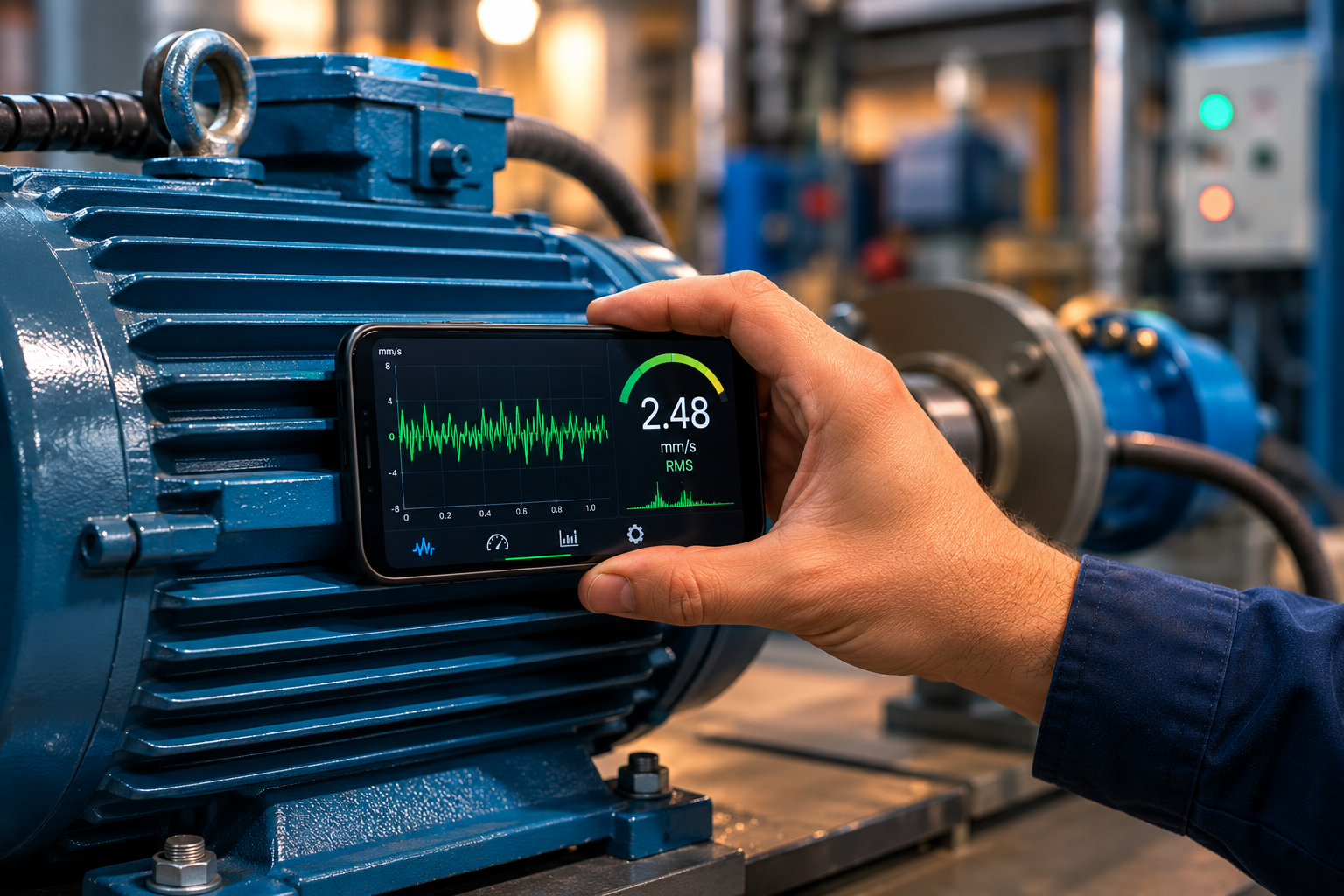
What Is a Good Vibration Reading? mm/s Explained Simply
You took a vibration reading, you are looking at a number in millimetres per second (mm/s), and you just want to know one thing: is that good or bad? Here is the simple version. For most rotating machines, a reading under about 2.8 mm/s RMS is good, 2.8–4.5 mm/s means keep watching it, and above 4.5 mm/s usually means something needs attention. The lower the number, the smoother and healthier the machine.
That rule of thumb gets you 80% of the way there. But “good” truly depends on what you are measuring and how big it is, and there is a second method — comparing against the machine’s own baseline — that works even when no official standard applies. This guide explains both in plain language, no engineering degree required. If you just want to start measuring, the free Vibration Detector Sensor app shows your live reading in mm/s on any iPhone.
Not sure if your reading is good? Measure and see
Get a live mm/s RMS value in seconds and compare it to the simple bands below. No external sensor, no setup.
What does mm/s actually mean?
mm/s stands for millimetres per second — it is the speed at which the surface is vibrating back and forth. It is called vibration velocity, and it is the most common way to describe how rough a machine is running. A higher mm/s value means more vibration energy, which translates to more stress on bearings, seals and structures over time.
You will usually see it written as “mm/s RMS.” RMS just means the reading is averaged in a way that reflects the sustained energy of the vibration rather than a single momentary spike — which is exactly what matters for long-term wear. The accelerometer-based meter displays this RMS value live so you do not have to do any maths.
What counts as a good vibration reading?
For a typical industrial machine, here is the simplest possible severity guide:
| Reading (mm/s RMS) | Verdict | What to do |
|---|---|---|
| Under 2.8 | Good | Healthy. Note it as a baseline and carry on. |
| 2.8 – 4.5 | Watch | Not an emergency, but investigate and keep checking. |
| Over 4.5 | Act | Plan a repair. Find the cause before it fails. |
These bands come from the international ISO standard for medium-sized machines, and they are a safe default when you do not know the exact specification. Take a quick reading with the sensor app and you can place any machine into one of these three buckets immediately.
Why “good” depends on the machine
A perfectly healthy small office fan and a perfectly healthy 500 kW industrial blower do not vibrate at the same level — and both can be “good.” In general:
- Small, precise machines (small motors, spindles, instruments) should read very low — often well under 1.8 mm/s.
- Medium industrial machines (15–300 kW motors, pumps, compressors) follow the table above — under 2.8 mm/s is good.
- Large or flexibly mounted machines (big fans, turbines on spring isolators) are allowed to vibrate more — good can extend to 3.5 mm/s or higher.
This is why the same 3.0 mm/s reading can be a warning sign on a small motor and totally fine on a large turbine. If you want the exact safe numbers for your specific equipment type, our detailed guide on the acceptable vibration levels for motors, pumps and fans breaks them down machine by machine.
The method that works without any standard: baseline and trend
What if your machine has no official limit, or you have no idea which category it falls into? There is a universal trick the professionals rely on: compare the machine to itself over time.
Measure the machine when you know it is running well and record that number — that is your baseline. From then on, what matters is not the absolute value but the change. A reading that has doubled from its baseline is a clear warning, even if the raw number still looks modest. A machine sitting steadily at the same value, even a slightly higher one, is usually fine.
✓ The golden rule: A good reading is low and stable. A reading that is climbing — even slowly — is the real warning sign, often weeks before anything sounds or feels wrong. Log your readings so you can see the trend, not just today’s snapshot.
This is exactly why session logging matters. The Vibration Detector Sensor app saves each reading and lets you export the history to CSV, so a slow climb from 1.5 to 3.0 mm/s over a month becomes obvious instead of invisible.
How to take a reading that you can actually trust
A good number is only meaningful if you measure it properly. Three quick rules:
- Measure on something solid. Press the phone firmly and flat against the bearing housing or motor body — not on a loose guard or sheet-metal cover, which will exaggerate the reading.
- Measure under normal running conditions. Full load, normal speed, warmed up. A reading at idle is not comparable to one under load.
- Measure the same way every time. Same spot, same direction, same conditions — consistency is what makes your baseline and trend meaningful.
Follow those three rules and the live value on the vibration meter becomes a genuinely useful health indicator.
Turn your phone into a vibration meter — free
Live RMS & peak readings in mm/s, a frequency spectrum, session logging and CSV export. Build a baseline today and always know whether your reading is good.
► Get Vibration Detector Sensor on the App Store | Explore the app →
Note: A smartphone accelerometer is excellent for screening, trending and learning, but it is not a substitute for a certified, calibrated vibration analyser when compliance-grade measurements are required.
Frequently Asked Questions
What is a good vibration level in mm/s?
For most medium-sized rotating machines, a good vibration level is under about 2.8 mm/s RMS. Readings of 2.8–4.5 mm/s are worth watching, and anything above 4.5 mm/s usually calls for investigation. Smaller, precise machines should read lower, while large or flexibly mounted machines can be healthy at higher values.
Is lower vibration always better?
Generally yes — lower vibration means less stress on bearings and seals and a longer service life. The most important thing, though, is stability: a low reading that is slowly climbing is a bigger concern than a slightly higher reading that stays constant.
What is a normal vibration reading for a motor?
A healthy medium motor typically reads under 2.8 mm/s RMS at the bearing housing. Small motors should be lower still. The best reference point is the motor’s own baseline taken when it was running well — a significant rise from that baseline is the clearest sign of a developing problem.
How do I know if a vibration reading is bad without a standard?
Compare the machine to itself. Record a baseline reading when it is running normally, then watch for change over time. A reading that has roughly doubled from baseline is a reliable warning sign even when no formal limit exists for that machine.
Why does the same reading mean different things on different machines?
Because acceptable vibration scales with machine size and mounting. A large, heavy, flexibly mounted machine naturally vibrates more than a small precise one, so the same mm/s value can be fine on one and a warning on the other. Always judge a reading in the context of the machine.
Can I measure vibration in mm/s with my phone?
Yes. Modern smartphones have a built-in three-axis accelerometer that can report overall RMS velocity in mm/s, which is ideal for screening and trend monitoring. A phone app does not replace a calibrated analyser for compliance work, but it is more than enough to tell whether a reading is good, worth watching, or a problem.
iso 20816 vs 10816difference between iso 20816 and 10816what replaced iso 10816iso 20816-3 vibration limitsiso 7919 vs 10816is iso 10816 still validiso 20816 publication datenew vibration standardwhat is a good vibration reading mm/sgood vibration levelnormal vibration reading motoris my vibration reading badvibration mm/s meaningacceptable vibration readinghow to judge vibrationvibration baseline trend