Optimal Launch Monitor Numbers for Every Club — Driver Through Wedge

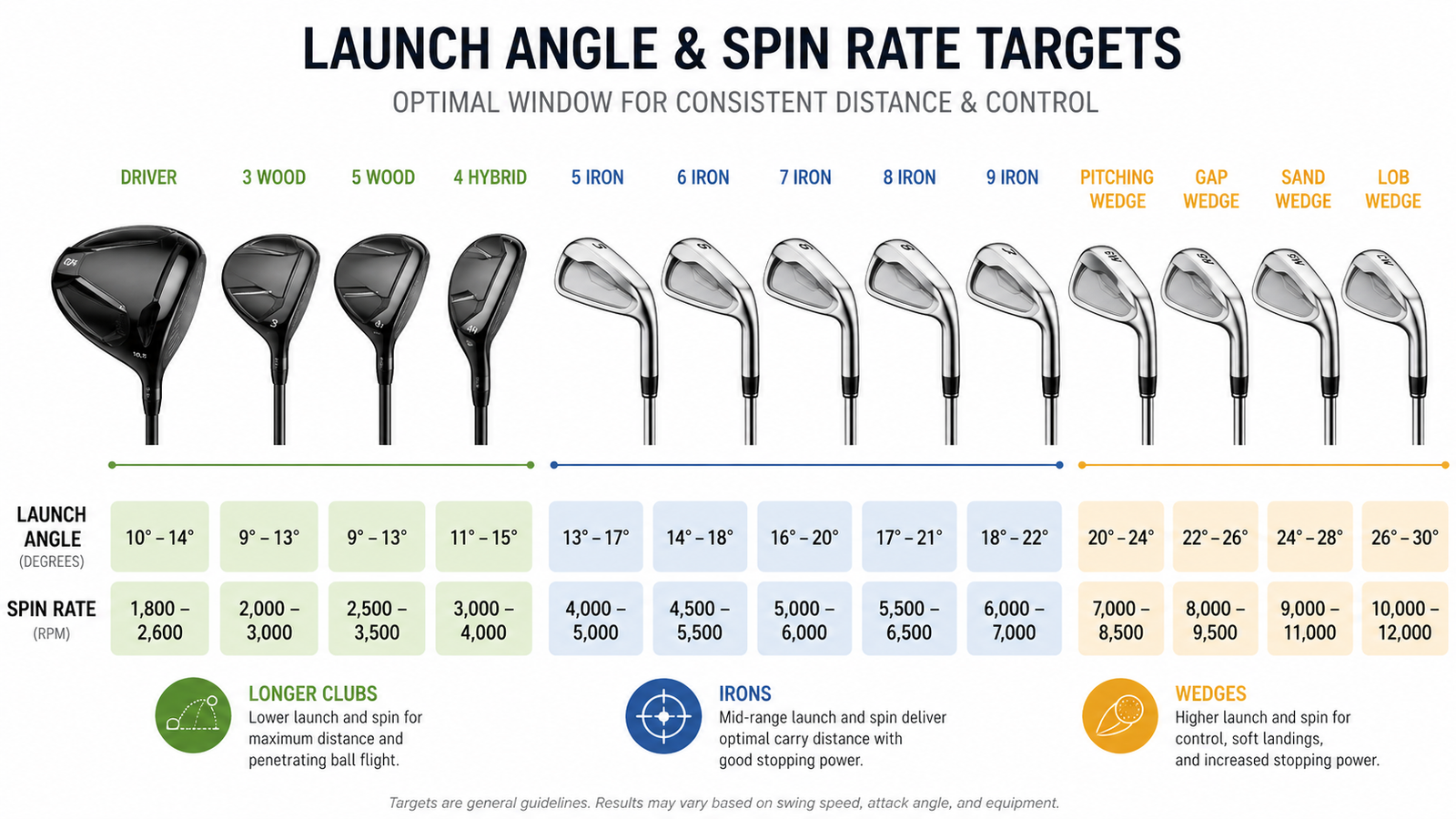
Optimal Launch Monitor Numbers for Every Club — Driver Through Wedge
By Asaru Labs | Golf Performance | 9 min read
A launch monitor gives you data on every shot. But data without context is just numbers. To use your launch monitor effectively you need to know what your numbers should be — what launch angle, spin rate, ball speed, and smash factor to target for each club in your bag, and how those targets shift based on your swing speed.
This is that reference guide. It covers optimal launch monitor numbers for every club from driver through wedge, explains how the numbers interact, and gives you a framework for diagnosing which gaps are costing you the most distance and consistency.
Measure your numbers against these targets — free.
The Golf Launch Monitor app shows your launch angle, spin rate, ball speed, smash factor, and carry distance on every shot from your iPhone camera — no hardware needed. Compare your real numbers to the targets in this guide and find your biggest opportunity for improvement.
How to use this guide
Every set of targets in this guide is built around one principle: optimal numbers are the combination of launch angle and spin rate that produces maximum carry distance and predictable ball flight for a given club and swing speed. They are not arbitrary standards — they come from the physics of ball flight, the geometry of club design, and the data from thousands of amateur and professional launch monitor sessions.
To use this guide effectively:
- Find your swing speed bracket in the driver section — this anchors your expectations for every other club
- Measure your actual averages using the Golf Launch Monitor app (10+ shots per club)
- Identify the metric furthest outside its target range — that is your highest-priority fix
- Use the "common fault" notes for each club to diagnose the likely cause
Important: These targets are for solid, representative strikes — not your absolute best shots or your worst mishits. Measure your average across 10–15 normal swings for each club. A single exceptional reading tells you what is possible. An average tells you what is real.
Driver — the highest-leverage club for distance improvement
Driver numbers have the widest variation by swing speed of any club in the bag, because the interaction between launch angle, spin rate, and ball speed is most sensitive at driver loft ranges. Getting driver numbers right is typically where amateur golfers leave the most distance on the table.
Optimal driver numbers by swing speed
| Swing speed | Launch angle | Spin rate | Smash factor | Potential carry |
|---|---|---|---|---|
| Under 75 mph | 14°–17° | 2,600–3,200 rpm | 1.42–1.48 | 140–165 yards |
| 75–85 mph | 13°–16° | 2,400–3,000 rpm | 1.43–1.48 | 165–200 yards |
| 85–95 mph | 12°–15° | 2,200–2,800 rpm | 1.44–1.49 | 200–230 yards |
| 95–105 mph | 11°–14° | 2,000–2,600 rpm | 1.45–1.49 | 230–265 yards |
| 105–115 mph | 10°–13° | 1,800–2,400 rpm | 1.46–1.50 | 265–300 yards |
| 115+ mph | 9°–12° | 1,700–2,200 rpm | 1.47–1.50 | 300+ yards |
Most common fault: Too low a launch angle (8°–10°) combined with too high a spin rate (3,200–4,000 rpm) — both caused by the same root problem: a downward angle of attack at impact. The fix is raising tee height and moving the ball forward in the stance to promote a slightly upward strike through the ball.
Second most common fault: Smash factor below 1.40 — indicating off-centre contact that is robbing ball speed regardless of swing speed. A golfer at 95 mph with a smash factor of 1.35 produces only 128 mph of ball speed. The same golfer with a 1.47 smash factor produces 140 mph of ball speed — roughly 24 more yards of carry — with zero increase in swing speed.
Fairway woods — 3-wood and 5-wood
| Club | Launch angle | Spin rate | Smash factor | Typical carry (avg amateur) |
|---|---|---|---|---|
| 3-wood | 9°–14° | 3,000–4,000 rpm | 1.40–1.46 | 175–215 yards |
| 5-wood | 10°–15° | 3,500–4,500 rpm | 1.38–1.44 | 160–200 yards |
Key note for fairway woods: Fairway woods are often hit with a slightly downward or neutral angle of attack from the turf, unlike the driver which benefits from a slightly upward strike. Trying to hit up on a 3-wood from the fairway produces thin contact and loss of distance. The goal is a shallow, sweeping strike that catches the ball at or just before the bottom of the swing arc.
Most common fault: Launch angle too high (above 16°) from a scooping, upward attempt at impact — resulting in a high, ballooning shot that loses distance. A neutral or very slightly downward strike produces the mid-trajectory that fairway woods are designed for.
Hybrids
| Club | Launch angle | Spin rate | Smash factor | Typical carry (avg amateur) |
|---|---|---|---|---|
| 2-hybrid / 17–19° | 11°–16° | 3,500–4,500 rpm | 1.36–1.42 | 185–215 yards |
| 3-hybrid / 19–22° | 13°–18° | 4,000–5,000 rpm | 1.34–1.40 | 165–200 yards |
| 4-hybrid / 22–25° | 15°–20° | 4,500–5,500 rpm | 1.32–1.38 | 150–185 yards |
Key note for hybrids: Hybrids are designed to be struck with a slightly downward attack angle — more like an iron than a fairway wood, but shallower than a steep iron descent. The wider sole forgives a range of attack angles, but the best results come from a slightly descending, sweeping strike that takes a shallow divot or brushes the turf.
Long irons — 3-iron and 4-iron
| Club | Launch angle | Spin rate | Smash factor | Typical carry (avg amateur) |
|---|---|---|---|---|
| 3-iron | 12°–17° | 4,000–5,000 rpm | 1.33–1.39 | 175–205 yards |
| 4-iron | 13°–18° | 4,500–5,500 rpm | 1.33–1.39 | 160–192 yards |
Most common fault: Launch angle too low (below 11°) from a steep, downward attack angle and excessive shaft lean. Long irons require a descending blow to compress the ball, but too steep an attack delofts the face significantly and kills carry. The divot should be shallow and begin just ahead of the ball position — not deep and behind it.
Mid irons — 5-iron, 6-iron, 7-iron
These are the workhorses of most amateur golfers' bags and the clubs where consistent launch and spin numbers matter most for approach shot control.
| Club | Launch angle | Spin rate | Smash factor | Typical carry (avg amateur) |
|---|---|---|---|---|
| 5-iron | 14°–18° | 4,500–5,500 rpm | 1.32–1.38 | 150–182 yards |
| 6-iron | 15°–19° | 5,000–6,000 rpm | 1.30–1.37 | 138–168 yards |
| 7-iron | 17°–21° | 5,500–7,000 rpm | 1.28–1.34 | 125–155 yards |
Most common fault (mid irons): Launch angle too low (13°–15° with a 7-iron when it should be 17°–21°) from excessive shaft lean and steep angle of attack. Ball position too far back in the stance is a frequent contributing cause. The fix is moving the ball one ball-width forward toward centre, reducing excessive forward lean, and ensuring the divot starts at or just ahead of the ball rather than behind it.
Modern iron loft warning: Many modern game-improvement irons have significantly stronger lofts than traditional irons. A "7-iron" from a current game-improvement set may have the loft of a traditional 5-iron — meaning its launch angle and spin rate targets are naturally lower than the classic benchmarks. Always measure your actual numbers with the Golf Launch Monitor app rather than assuming your iron matches a standard loft chart.
Short irons — 8-iron and 9-iron
| Club | Launch angle | Spin rate | Smash factor | Typical carry (avg amateur) |
|---|---|---|---|---|
| 8-iron | 19°–24° | 6,500–8,000 rpm | 1.24–1.30 | 112–140 yards |
| 9-iron | 22°–27° | 7,000–8,500 rpm | 1.22–1.28 | 98–126 yards |
Key note for short irons: Short irons should produce a mid-to-high ball flight with enough spin to check and stop on greens. If your 8-iron or 9-iron is flying low and running out on landing, spin rate is too low — usually caused by weak, glancing contact or a very thin strike. If shots are flying too high and stopping dead immediately, spin rate is excessive — often from a flippy, scooping release that adds loft and spin simultaneously.
Wedges — pitching wedge through lob wedge
Wedge numbers are where distance control matters most. The goal is not maximum carry but predictable, consistent carry — knowing exactly how far each wedge goes on a full swing, and how far it goes at 50%, 75%, and 100% swing length.
| Club | Launch angle | Spin rate | Smash factor | Typical carry (avg amateur) |
|---|---|---|---|---|
| Pitching wedge (44–48°) | 25°–30° | 7,500–9,500 rpm | 1.18–1.26 | 88–120 yards |
| Gap / approach wedge (49–52°) | 27°–33° | 8,000–10,000 rpm | 1.14–1.22 | 75–105 yards |
| Sand wedge (54–56°) | 30°–37° | 8,500–11,000 rpm | 1.10–1.18 | 62–90 yards |
| Lob wedge (58–64°) | 34°–42° | 9,000–12,000 rpm | 1.06–1.14 | 50–75 yards |
Key note for wedges: High spin rate is desirable for wedges — unlike the driver where lower spin is almost always better, wedge spin rate provides the stopping power that makes approach shots controllable. A pitching wedge with only 5,000 rpm of spin will land and run like a mid-iron, making it difficult to hold greens. Good wedge contact produces a high, steep ball flight that stops quickly after landing.
Most common fault (wedges): Inconsistent carry distance from inconsistent contact quality — smash factor that varies significantly between shots. A wedge session where smash factor ranges from 1.10 to 1.25 will produce carries ranging from 80 to 105 yards even on identical swing lengths. Consistent wedge performance requires consistent, centred contact more than anything else.
The complete reference chart
Here is the full set of targets in a single reference table for easy comparison across the bag:
| Club | Launch angle | Spin rate | Smash factor | Carry (avg amateur) |
|---|---|---|---|---|
| Driver (95 mph) | 12°–15° | 2,200–2,800 | 1.44–1.49 | 215–245 yards |
| 3-wood | 9°–14° | 3,000–4,000 | 1.40–1.46 | 175–215 yards |
| 5-wood | 10°–15° | 3,500–4,500 | 1.38–1.44 | 160–200 yards |
| 3-hybrid | 13°–18° | 4,000–5,000 | 1.34–1.40 | 165–200 yards |
| 4-iron | 13°–18° | 4,500–5,500 | 1.33–1.39 | 160–192 yards |
| 5-iron | 14°–18° | 4,500–5,500 | 1.32–1.38 | 150–182 yards |
| 6-iron | 15°–19° | 5,000–6,000 | 1.30–1.37 | 138–168 yards |
| 7-iron | 17°–21° | 5,500–7,000 | 1.28–1.34 | 125–155 yards |
| 8-iron | 19°–24° | 6,500–8,000 | 1.24–1.30 | 112–140 yards |
| 9-iron | 22°–27° | 7,000–8,500 | 1.22–1.28 | 98–126 yards |
| Pitching wedge | 25°–30° | 7,500–9,500 | 1.18–1.26 | 88–120 yards |
| Gap wedge (50–52°) | 27°–33° | 8,000–10,000 | 1.14–1.22 | 75–105 yards |
| Sand wedge (54–56°) | 30°–37° | 8,500–11,000 | 1.10–1.18 | 62–90 yards |
| Lob wedge (58–64°) | 34°–42° | 9,000–12,000 | 1.06–1.14 | 50–75 yards |
How to find your biggest opportunity for improvement
Once you have measured your averages with the Golf Launch Monitor app, compare each number to the targets above. The metric that is furthest outside its target range for your swing speed is almost always your highest-priority fix — because it represents the largest gap between where you are and where you should be.
Here is a quick diagnostic guide based on the most common findings:
| What your data shows | Most likely cause | First fix to try |
|---|---|---|
| Driver launch too low AND spin too high | Downward angle of attack | Raise tee height, move ball forward one ball-width |
| Smash factor below 1.40 with driver | Off-centre contact | Apply impact tape to find contact pattern, then adjust tee height or path |
| Iron launch below the target range | Excessive shaft lean or steep attack | Move ball forward, reduce forward shaft lean at address |
| Iron launch above the target range | Flippy, scooping release | Focus on firm lead wrist through impact, ensure weight transfers forward |
| Wedge carry distance highly inconsistent | Variable contact quality | Focus on consistent ball position and centred contact; use impact tape to confirm |
| All clubs: ball speed below target for club speed | Low smash factor across the bag | Contact quality training — slow-motion impact work, gate drills, impact tape |
THE IMPROVEMENT SEQUENCE
Work through the bag in this order: fix your smash factor first (contact quality) because it affects every club simultaneously. Then fix your driver launch angle and spin rate (the highest-return single-club improvement). Then calibrate your iron carry distances. Finally, tighten your wedge consistency. Each fix compounds — better contact quality makes every subsequent adjustment more effective.
Compare your numbers to these targets today — free.
Download the Golf Launch Monitor app and spend one range session measuring your launch angle, spin rate, smash factor, and carry distance for each club. Compare your averages to the targets in this guide and find your biggest improvement opportunity — all from your iPhone, no hardware needed.
Frequently asked questions
What is the optimal launch angle for a driver?
Optimal driver launch angle depends on your swing speed. For most amateur golfers swinging at 85–95 mph, the ideal range is 12°–15°. Slower swingers (under 85 mph) benefit from a higher launch of 13°–16°, while faster swingers (above 105 mph) produce more distance with a lower, more penetrating 10°–13°. The Golf Launch Monitor app shows your launch angle on every drive so you can compare directly to your target range.
What is the ideal spin rate for a driver?
For an average amateur golfer swinging at 85–95 mph, the optimal driver spin rate is between 2,200 and 2,800 rpm. Above 3,200 rpm at that speed, the ball balloons and loses carry. Below 1,800 rpm, it knuckles and drops early. Spin rate targets decrease as swing speed increases — faster swingers need less spin because their ball speed generates sufficient lift without it.
What should my 7-iron launch angle be?
The optimal 7-iron launch angle for most amateur golfers is between 17° and 21°. Below 15° suggests excessive shaft lean or too steep an angle of attack at impact. Above 23° typically indicates a flippy release that is adding loft through a scooping motion. Both faults produce shorter carry distance and less consistent distance control than the target window.
Why does smash factor decrease with higher-lofted clubs?
Smash factor decreases as loft increases because more loft directs energy upward rather than forward. A driver is designed to maximise forward energy transfer — hence a maximum smash factor of 1.50. A lob wedge's loft inherently sends much of the energy skyward, so its effective smash factor ceiling is around 1.14. This is normal physics, not a flaw in technique or equipment. Always compare smash factor against the expected range for the specific club, not against driver benchmarks.
Do these numbers apply to women golfers as well?
The launch angle and spin rate targets in this guide apply across genders — the optimal physics of ball flight are the same regardless of who is hitting the shot. The key variable is swing speed. A female amateur golfer swinging at 70–75 mph should use the targets for that speed bracket (under 75 mph for driver), not the average male amateur targets. Carry distances will be proportionally lower, but the optimal launch and spin relationships remain the same.
How do I know if my iron lofts match standard benchmarks?
Modern game-improvement irons are often 2–4° stronger in loft than traditional irons, meaning their optimal launch angle and spin rate targets are slightly lower than the classic benchmarks. The most reliable approach is to measure your actual numbers with the Golf Launch Monitor app and compare them to what your specific clubs are designed to produce, rather than assuming they match a standard loft chart. If in doubt, a loft gauge at a golf shop can tell you your exact lofts in 5 minutes.
optimal launch angle by clubideal spin rate chart golfoptimal golf launch monitor numberslaunch angle and spin rate by clubideal ball speed by club golfgolf launch monitor benchmarksoptimal driver numbersiron launch angle spin rate chart