Motor Vibration Limits by RPM: Speed-Based Guide

Motor Vibration Limits by RPM: A Speed-Based Guide
Here is a fact that surprises a lot of people searching for motor vibration limits by RPM: the standard velocity limits in mm/s do not change with motor speed. A “good” reading for a 1,800 RPM motor and a 3,600 RPM motor is the same number in mm/s RMS, because vibration velocity was specifically chosen as a metric that normalises across speed. So why does RPM keep coming up?
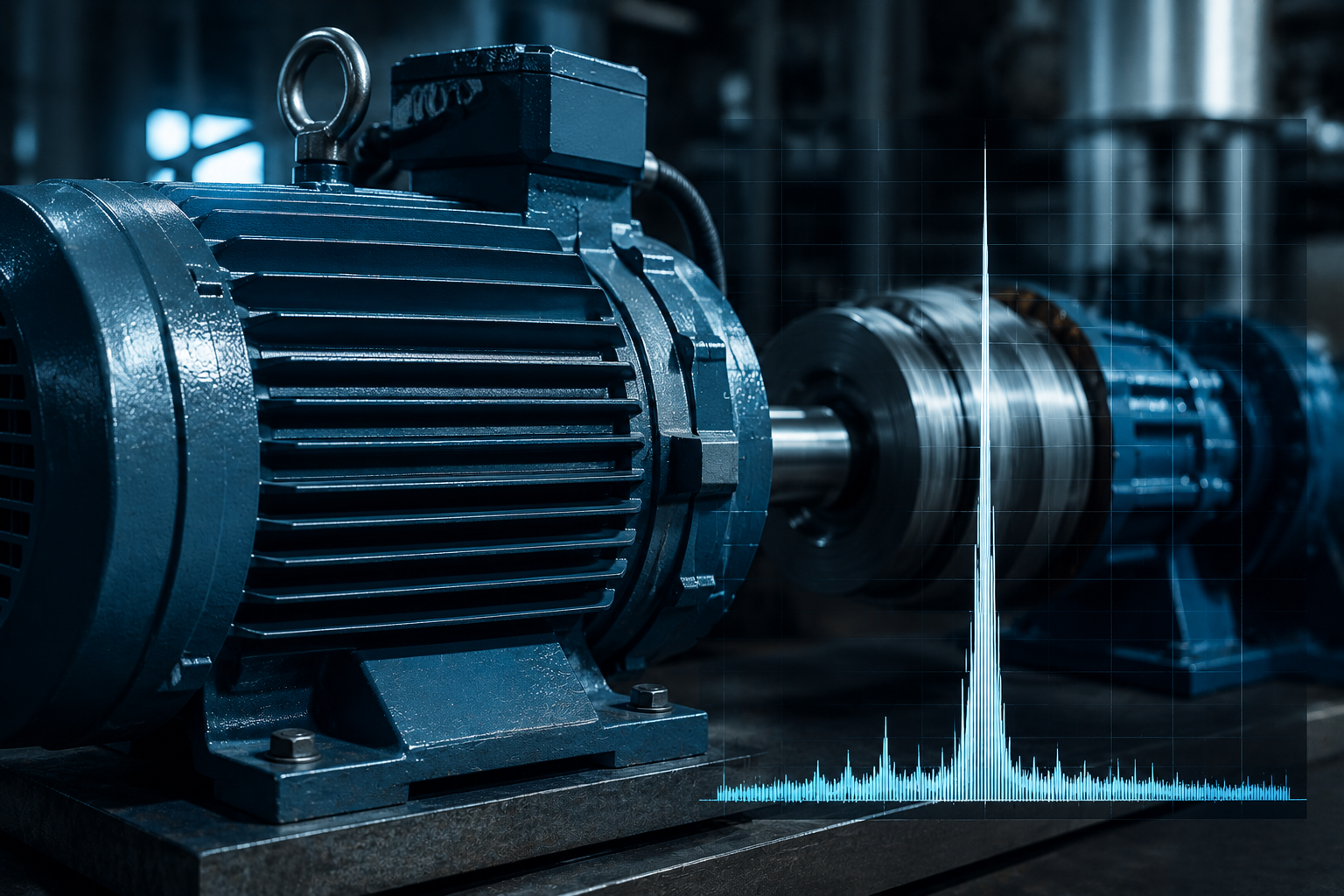
Because RPM matters in two real ways that the headline velocity number hides: it sets the frequency where your main vibration appears (which is the key to diagnosis), and it changes the picture entirely if you measure in displacement instead of velocity. This guide untangles all three. To follow along with your own motor, the Vibration Detector Sensor app shows live velocity, peak and the frequency spectrum so you can see the RPM relationship directly.
See your motor’s 1× RPM peak live
Measure velocity in mm/s and watch the frequency spectrum light up at your motor’s running speed — the fastest way to spot imbalance or misalignment.
The velocity limit is the same at any RPM
Under ISO 10816-3 (and its successor ISO 20816-3), motor vibration is judged on overall RMS velocity in mm/s, and the zone boundaries depend on the motor’s power and mounting — not its speed. For a typical 15–300 kW motor on a rigid base, the limits are:
| Zone | Velocity (mm/s RMS) | Condition |
|---|---|---|
| A / B | up to 2.8 | Good to acceptable |
| C | 2.8 – 4.5 | Unsatisfactory — investigate |
| D | above 4.5 | Dangerous — act |
A 1,200 RPM motor and a 3,600 RPM motor of the same size are both judged against these identical numbers. That is the whole point of using velocity. You can confirm where your motor sits by reading the live mm/s value with the accelerometer tool, regardless of how fast it spins.
Where RPM does matter: the 1× frequency
RPM sets the frequency of your motor’s fundamental vibration. The relationship is simple: frequency in Hz = RPM ÷ 60. This “1× running speed” peak is where imbalance shows up, and its multiples reveal other faults. Here are the common synchronous motor speeds and their 1× frequencies:
| Motor speed (RPM) | 1× frequency (Hz) | Typical motor (60 Hz supply) |
|---|---|---|
| 3,600 | 60 | 2-pole |
| 1,800 | 30 | 4-pole |
| 1,200 | 20 | 6-pole |
| 900 | 15 | 8-pole |
Knowing your 1× frequency turns a raw spectrum into a diagnosis. If the biggest peak is at 1×, you are looking at imbalance; a strong peak at 2× points to misalignment or a bent shaft; high-frequency content suggests bearing wear. Open the spectrum view in the vibration sensor app, find the dominant peak, and divide by your 1× frequency to see which multiple it is.
Where RPM really changes things: displacement limits
If you measure vibration in displacement (microns or mils) rather than velocity, RPM matters enormously. The reason is physics: for a given velocity, displacement is inversely proportional to frequency. A slow machine moving at the same mm/s velocity is physically swinging much further per stroke than a fast one.
That is why displacement-based limits are speed-dependent — a low-speed motor is allowed more microns of movement than a high-speed motor at the same health level. Velocity sidesteps this entirely, which is the main reason modern standards default to mm/s. For low-speed motors (below roughly 600 RPM), velocity readings can also understate the problem, and analysts often switch to displacement or extend the low-frequency range.
Rule of thumb by metric: Use displacement for low-speed machines (below ~600 RPM), velocity for the broad mid-range (the everyday default), and acceleration (g) for high-speed machines and high-frequency faults like bearing and gear defects.
New-motor limits: the NEMA reference
For brand-new motors tested at the factory, North American buyers often reference NEMA MG-1, which sets no-load acceptance limits. As an approximate guide, a new motor on a rigid mount should fall under roughly 0.12 in/s peak velocity (about 3 mm/s peak), with a slightly higher allowance on resilient mounts. Note two things: these are peak values, not RMS like ISO, and they apply to unloaded factory tests, not a motor working in the field. For in-service field judgement, the ISO velocity zones above are the practical reference, and you can capture them anytime with the phone-based meter.
Putting it together for your motor
The workflow is straightforward: measure overall velocity in mm/s and judge it against the power-and-mount zones (RPM does not shift those); then use the 1× frequency to interpret what any high reading means. Speed is your diagnostic key, not your pass/fail threshold. A 3,600 RPM motor reading 4.0 mm/s with a dominant 60 Hz peak is telling you it is in Zone C because of imbalance — and the sensor app shows you both halves of that story at once.
Measure velocity and read the RPM peak — in one app
Live RMS & peak in mm/s, a dominant-frequency spectrum that shows Hz and RPM, session logging and CSV export. Everything you need to apply motor vibration limits at any speed.
► Get Vibration Detector Sensor on the App Store | Explore the app →
Note: A smartphone accelerometer is well suited to screening and trending in the mid-frequency range, but it is not a substitute for a certified, calibrated analyser — particularly for very low-speed machines or high-frequency bearing diagnostics.
Frequently Asked Questions
Do motor vibration limits change with RPM?
The standard velocity limits in mm/s RMS do not change with RPM — they depend on the motor’s power and mounting. RPM matters for diagnosis (it sets the frequency of the main vibration peak) and for displacement-based limits, which do scale with speed, but the everyday velocity pass/fail threshold stays the same across speeds.
What is the acceptable vibration level for an 1,800 RPM motor?
For a medium 1,800 RPM motor on a rigid mount, under 2.8 mm/s RMS is good, 2.8–4.5 mm/s warrants investigation, and above 4.5 mm/s needs action — the same thresholds that apply to a 3,600 RPM motor of the same size. Its imbalance peak will appear at 30 Hz (1,800 ÷ 60).
How do I convert RPM to vibration frequency?
Divide the speed by 60: frequency in Hz equals RPM divided by 60. So a 3,600 RPM motor has a 1× frequency of 60 Hz, and an 1,800 RPM motor sits at 30 Hz. This 1× frequency is where imbalance shows up in the spectrum.
Why is vibration measured in velocity instead of displacement?
Velocity stays roughly constant across the frequency band where most machine faults occur, so a single mm/s limit is meaningful at any speed. Displacement, by contrast, changes with frequency for the same energy, which would force different limits for every RPM — velocity avoids that complication.
What vibration metric should I use for low-speed motors?
For motors below about 600 RPM, velocity can understate the problem, so analysts often use displacement (microns or mils) or extend the low-frequency measurement range. Velocity remains the default for the broad mid-speed range, and acceleration is preferred for high-speed machines and bearing-defect frequencies.
Can a phone measure motor vibration at high RPM?
Yes, within limits. A smartphone accelerometer comfortably captures the mid-frequency range covering most motor running speeds and their first harmonics, making it suitable for measuring overall velocity and identifying the 1× peak. For very high-frequency bearing diagnostics a dedicated analyser is preferable.
motor vibration limits by rpmmotor vibration limits1800 rpm motor vibrationrpm to vibration frequencyvibration velocity vs displacementnema mg-1 motor vibration1x rpm vibrationmotor vibration by speed