Kelvin to Mired Conversion: Formula and Full Chart

Kelvin to Mired Conversion (and Mired to Kelvin)
If you work with color-correction gels or precise white balance, you've probably seen lighting filters rated not in Kelvin but in mired. It looks cryptic at first, but mired is just a different way of expressing color temperature — one that happens to be far more useful for predicting what a filter will actually do. The conversion is a single tidy formula in both directions.
This guide explains what a mired is, gives you the Kelvin–mired formula and a full conversion chart, and shows why photographers and gaffers reach for mired in the first place. If your app reports mired alongside Kelvin, you can read both values directly on your iPhone and skip the math entirely.
📲 Kelvin and mired, side by side
Kelvin Light Scale reads color temperature and offers mired values for precision workflows — ideal for matching gels and dialing in filters.
What is a mired?
Mired stands for micro reciprocal degrees — sometimes written “mirek” (micro reciprocal kelvin). It's defined as one million divided by the color temperature in Kelvin. So a 5,000K light is 200 mired, and a 10,000K light is 100 mired. Notice that higher Kelvin gives lower mired: the two scales run in opposite directions. That reciprocal relationship is exactly what makes mired so handy, as the next sections show. You can confirm the relationship on any reading from the app.
The conversion formula
| To convert | Formula |
|---|---|
| Kelvin → mired | mired = 1,000,000 ÷ Kelvin |
| Mired → Kelvin | Kelvin = 1,000,000 ÷ mired |
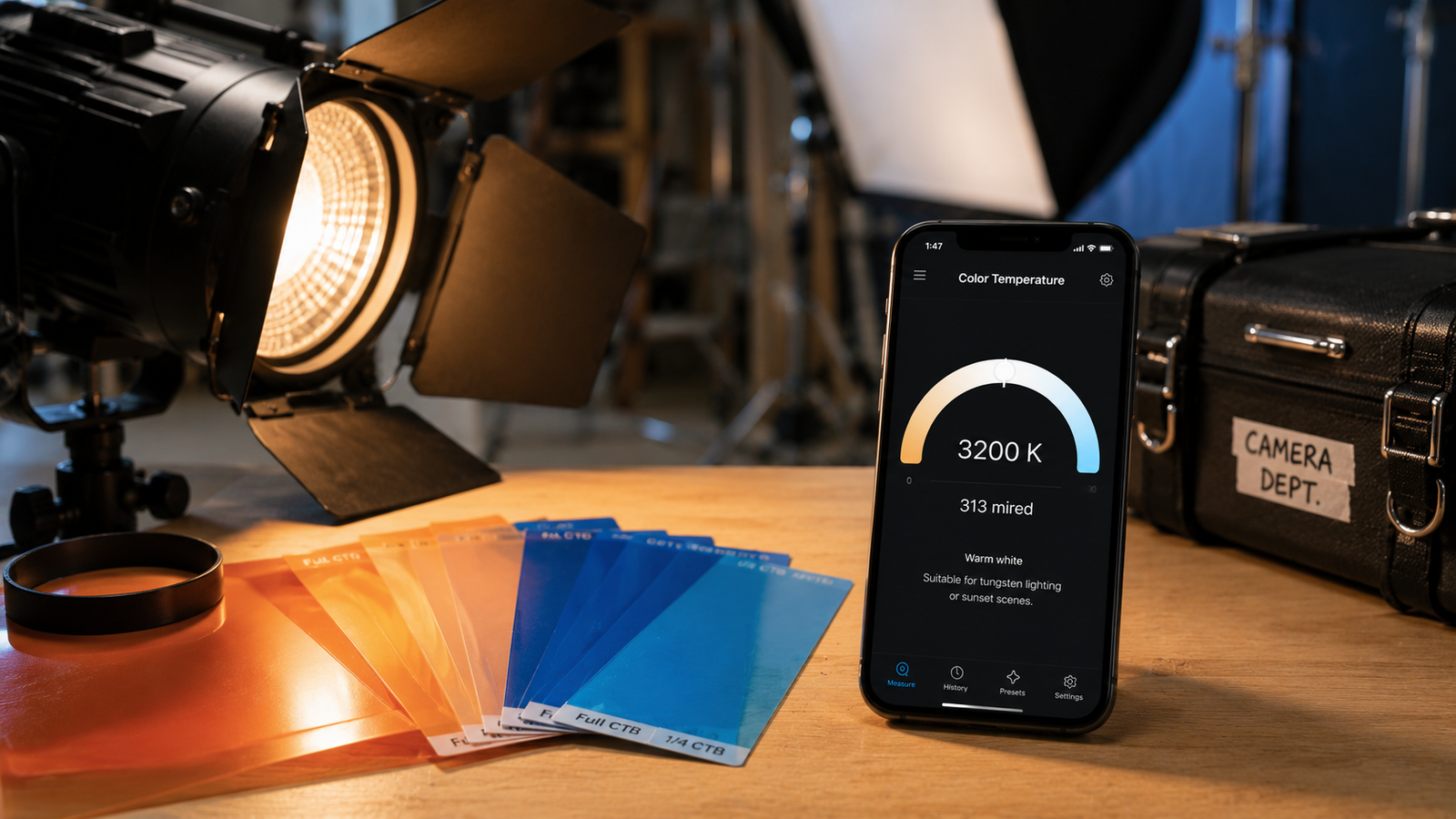
The formula is symmetrical — the same operation works both ways. A 3,200K tungsten source is 1,000,000 ÷ 3,200 ≈ 313 mired. Take any reading from your phone and one division gives you the other unit.
Kelvin to mired chart
Here are the mired equivalents for common color temperatures:
| Kelvin | Mired | Typical source |
|---|---|---|
| 2,000K | 500 mired | Candle / sunrise |
| 2,700K | 370 mired | Warm white bulb |
| 3,200K | 313 mired | Tungsten |
| 4,000K | 250 mired | Neutral white |
| 5,000K | 200 mired | Daylight white |
| 5,500K | 182 mired | Midday sun |
| 6,500K | 154 mired | Overcast / D65 |
| 10,000K | 100 mired | Blue sky |
Why photographers use mired
Here's the catch with Kelvin: equal Kelvin steps are not equal visual steps. The shift from 3,000K to 3,100K is very noticeable, but 9,000K to 9,100K is almost invisible — the same 100K means wildly different things at different points on the scale. Mired fixes this. A given mired shift produces roughly the same visual color change no matter where you start, which makes it perceptually uniform.
Mired is also additive: stack two filters and you can simply add their mired shifts. That's why color-correction gels are rated in mired shift rather than Kelvin — it lets you predict and combine them with simple arithmetic. When you measure a source in mired with the app, choosing the right gel becomes addition instead of guesswork.
Mired shift and color-correction filters
Lighting gels are labeled by the mired shift they apply. Warming filters (CTO, color temperature orange) add positive mired; cooling filters (CTB, color temperature blue) subtract mired. To convert a tungsten light to daylight, for instance, you subtract mired with a CTB; to warm a daylight source to tungsten, you add mired with a CTO.
| Goal | Filter type | Mired effect |
|---|---|---|
| Warm the light (toward orange) | CTO | Adds mired (+) |
| Cool the light (toward blue) | CTB | Subtracts mired (−) |
As a rough example, a full CTO gel adds roughly +131 mired, which takes a 5,500K daylight source down to about 3,200K tungsten — though exact values vary by manufacturer. Measure first, then pick the gel whose mired shift bridges the gap.
💡 Pro tip
Do your filter math in mired, not Kelvin. “I need to go from 182 to 313 mired, so I need about +131 mired of CTO” is simple addition. The same problem stated in Kelvin (5,500K to 3,200K) gives no hint of which gel to grab.
Reading mired on your phone
- Open a color-temperature app that supports mired and allow camera access.
- Measure the source off a white or gray surface to read its color temperature.
- Note the mired value the app reports, or convert from Kelvin with 1,000,000 ÷ K.
- Calculate the shift you need to reach your target, and choose the matching gel.
✅ The verdict
Mired = 1,000,000 ÷ Kelvin, and the same formula runs both ways. Because mired is perceptually uniform and additive, it's the unit to use whenever you're matching sources or stacking color-correction filters.
Kelvin tells you the color of a light; mired tells you how to change it. Once you're comfortable converting between the two, gel selection and white-balance matching stop being trial and error. Measure your source, do the simple division, and work in whichever unit the job needs — you can start measuring now.
Measure color temperature in Kelvin and mired
Kelvin Light Scale reads color temperature, tint, lux, and exposure from your iPhone, with mired values for precision filter and gel work. Free to start, with pro metrics when you need them.
Frequently asked questions
How do you convert Kelvin to mired?
Divide one million by the color temperature in Kelvin: mired = 1,000,000 ÷ Kelvin. For example, 5,000K is 1,000,000 ÷ 5,000 = 200 mired. The same formula converts mired back to Kelvin.
What does mired stand for?
Mired stands for micro reciprocal degrees. It expresses color temperature as one million divided by the Kelvin value, which makes color shifts perceptually uniform and easier to work with than raw Kelvin.
Why do photographers use mired instead of Kelvin?
Equal Kelvin steps don't produce equal visual changes, but equal mired steps roughly do, so mired is perceptually uniform. Mired is also additive, which means filter shifts can be added together — that's why color-correction gels are rated in mired.
How many mired is 3200K?
3,200K is about 313 mired (1,000,000 ÷ 3,200 ≈ 312.5). This is the standard tungsten color temperature used in film and studio lighting.
What is mired shift on a lighting gel?
Mired shift is how much a gel changes the color temperature, in mired. Warming gels (CTO) add mired; cooling gels (CTB) subtract it. You add the gel's mired shift to your source's mired value to find the result.
Does a higher Kelvin mean a higher or lower mired?
Lower. Mired is the reciprocal of Kelvin, so as color temperature rises, the mired value falls. A 10,000K blue sky is only 100 mired, while a 2,000K candle is 500 mired.
kelvin to mired conversionmired to kelvinwhat is a miredmired shift gelcolor temperature to miredmired formula photographyCTO CTB miredmicro reciprocal degrees