ISO 10816-3 Group 1 vs Group 2: Classify a Machine

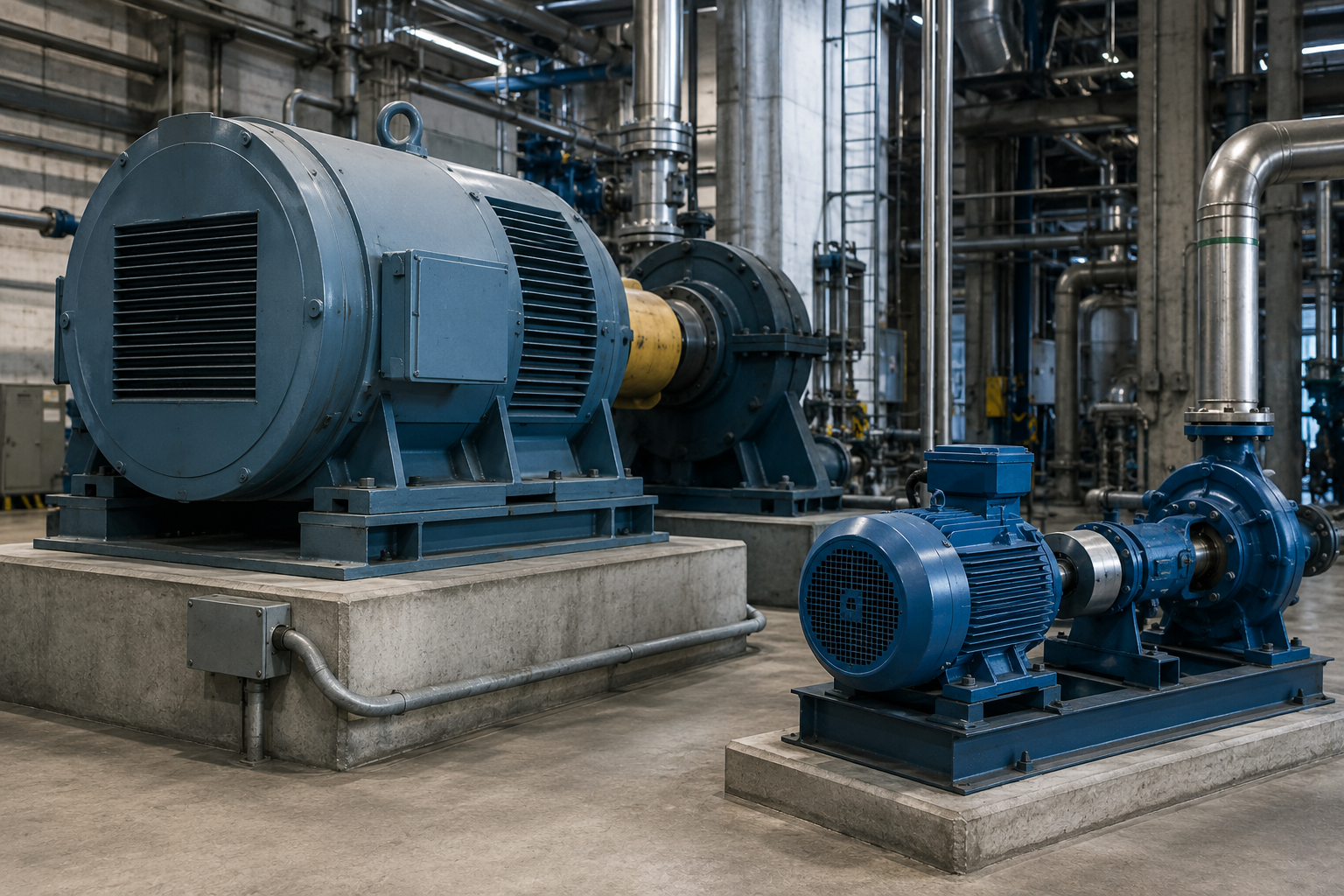
ISO 10816-3 Group 1 vs Group 2: How to Classify Your Machine
Before you can judge a machine’s vibration against ISO 10816-3, you have to answer one question: is it a Group 1 or a Group 2 machine? Get this wrong and you will read your mm/s value against the wrong limits. The short answer: Group 1 is large machines — rated power above 300 kW, or electrical machines with a shaft height of 315 mm or more. Group 2 is medium machines — rated power above 15 kW up to 300 kW, or electrical machines with a shaft height between 160 mm and 315 mm.
That single classification shifts every zone boundary, because larger machines are allowed to vibrate more. This guide shows you exactly how to place your machine in the right group, with worked examples — and once you know the group, you can read your live mm/s value straight off the Vibration Detector Sensor app and judge it correctly.
Know your group, then measure
Classify your machine with the criteria below, then take a live mm/s reading and match it to the right Group 1 or Group 2 limits — straight from your iPhone.
Why machine grouping exists
ISO 10816-3 covers a huge range of industrial machines — from a 20 kW pump motor to a 5 MW compressor train. A single set of limits could not fairly judge both, because a large, heavy machine naturally carries more vibration energy without being in danger. So the standard splits machines by size and construction, using rated power and shaft height as the dividing line, and then applies different mm/s thresholds to each group. Whatever your machine, you capture the actual reading the same way — with an accelerometer or the phone-based vibration meter.
Group 1 defined
Group 1 covers large machines. A machine falls into Group 1 if it meets either of these:
- Rated power above 300 kW (and up to 50 MW), or
- It is an electrical machine with a shaft height H ≥ 315 mm.
These machines normally run on sleeve (fluid-film) bearings and cover a broad range of operating speeds. Think large compressors, big drive motors and major turbomachinery.
Group 2 defined
Group 2 covers medium-sized machines. A machine is Group 2 if it meets either of these:
- Rated power above 15 kW and up to 300 kW, or
- It is an electrical machine with a shaft height 160 mm ≤ H < 315 mm.
These typically use rolling-element bearings and run above 600 RPM. The large majority of everyday plant motors, pumps and fans fall here. You can read any of them with the sensor app and apply the Group 2 limits below.
Group 1 vs Group 2 side by side
Here is the full comparison — classification criteria first, then the limits that follow from them:
| Criterion | Group 1 (large) | Group 2 (medium) |
|---|---|---|
| Rated power | Above 300 kW (to 50 MW) | 15 kW to 300 kW |
| Shaft height (electrical machines) | H ≥ 315 mm | 160 mm ≤ H < 315 mm |
| Typical bearings | Sleeve (fluid-film) | Rolling-element |
And the resulting zone boundaries in mm/s RMS velocity (the A/B/C/D limits scale up for the larger group):
| Group & support | A/B | B/C | C/D |
|---|---|---|---|
| Group 2 — Rigid | 1.4 | 2.8 | 4.5 |
| Group 2 — Flexible | 2.3 | 4.5 | 7.1 |
| Group 1 — Rigid | 2.3 | 4.5 | 7.1 |
| Group 1 — Flexible | 3.5 | 7.1 | 11.0 |
Notice the overlap: a Group 1 rigid machine and a Group 2 flexible machine share the same numbers (2.3 / 4.5 / 7.1). That is why getting both the group and the support type right matters — the two factors combine to set your limits.
How to figure out which group your machine is in
Use power first; fall back to shaft height for electrical machines. Two quick examples:
- 90 kW pump motor on a concrete base. 90 kW is between 15 and 300 kW → Group 2. Concrete base → rigid. Limits: 1.4 / 2.8 / 4.5.
- 450 kW compressor motor on a steel frame. 450 kW is above 300 kW → Group 1. Steel frame → likely flexible. Limits: 3.5 / 7.1 / 11.0.
Once you have the group and support, the rest is a single measurement. Take the live mm/s reading with the vibration sensor app and drop it into the matching row.
What about pumps? (Groups 3 and 4)
The 2009 edition of ISO 10816-3 also defined Groups 3 and 4 specifically for pumps with multi-vane impellers (separate vs integrated drivers). The newer ISO 20816-3 removed those pump-specific groups and now treats pumps as standard rotating equipment by power, while dedicated pump guidance lives in ISO 10816-7. In practice, for a pump driven by a motor in the 15–300 kW range, Group 2 limits are a safe working reference, which you can apply directly from a reading on the accelerometer meter.
✓ Quick tip: If a machine sits right on a boundary — say a 300 kW motor — classify it conservatively into the smaller group (Group 2). The tighter limits give you an earlier warning, which is exactly what you want from condition monitoring.
Measuring once you know the group
Classification is the thinking part; the measurement takes seconds. Press your phone firmly against the bearing housing under normal running load, read the RMS velocity in mm/s, and compare it to your group’s row. The Vibration Detector Sensor app also logs each reading and exports to CSV, so you can track a machine against its group limits over time rather than relying on a single snapshot.
Classify, measure, decide — from your phone
Live RMS & peak in mm/s, a frequency spectrum, session logging and CSV export. Once you know your machine’s group, the app gives you the number to judge it.
► Get Vibration Detector Sensor on the App Store | Explore the app →
Note: A smartphone accelerometer is well suited to screening and trending, but it is not a substitute for a certified, calibrated vibration analyser when compliance-grade measurements are required.
Frequently Asked Questions
What is the difference between Group 1 and Group 2 in ISO 10816-3?
Group 1 is large machines — rated power above 300 kW, or electrical machines with a shaft height of 315 mm or more — typically on sleeve bearings. Group 2 is medium machines rated 15–300 kW, or with a shaft height between 160 and 315 mm, typically on rolling-element bearings. Group 1 is allowed higher vibration limits.
How do I know if my motor is Group 1 or Group 2?
Check rated power first: above 300 kW is Group 1, and 15–300 kW is Group 2. For electrical machines you can also use shaft height — 315 mm or more is Group 1, while 160 to under 315 mm is Group 2. If a machine sits on the boundary, classify it into the smaller group for safety.
What is shaft height in machine classification?
Shaft height is the distance from the centreline of the shaft to the bottom of the machine’s feet, defined per ISO 496. It serves as a size proxy for electrical machines: 315 mm or more places a machine in Group 1, while 160 to under 315 mm places it in Group 2.
Do Group 1 and Group 2 have different vibration limits?
Yes. Larger Group 1 machines are permitted higher mm/s values at each zone boundary. For example, on a rigid mount the B/C boundary is 2.8 mm/s for Group 2 but 4.5 mm/s for Group 1, reflecting that bigger machines carry more vibration energy without being in danger.
Which group do pumps fall into?
The 2009 ISO 10816-3 had dedicated pump groups (3 and 4), but the newer ISO 20816-3 removed them and treats pumps as standard rotating equipment by power, with detailed pump guidance in ISO 10816-7. For a typical motor-driven pump in the 15–300 kW range, Group 2 limits are a reasonable working reference.
What if my machine is under 15 kW?
Machines below 15 kW fall outside the scope of ISO 10816-3 Groups 1 and 2. They are commonly assessed using the older Class I severity bands as practical guidance, where good is roughly below 0.71 mm/s and the alarm threshold is around 4.5 mm/s.
iso 10816-3 group 1 vs group 2machine vibration classificationgroup 1 group 2 vibrationshaft height 315mm classificationiso 10816-3 groupswhich vibration grouprated power machine groupmedium vs large machine vibration