How to Improve Your Golf Launch Angle Using Real Shot Data

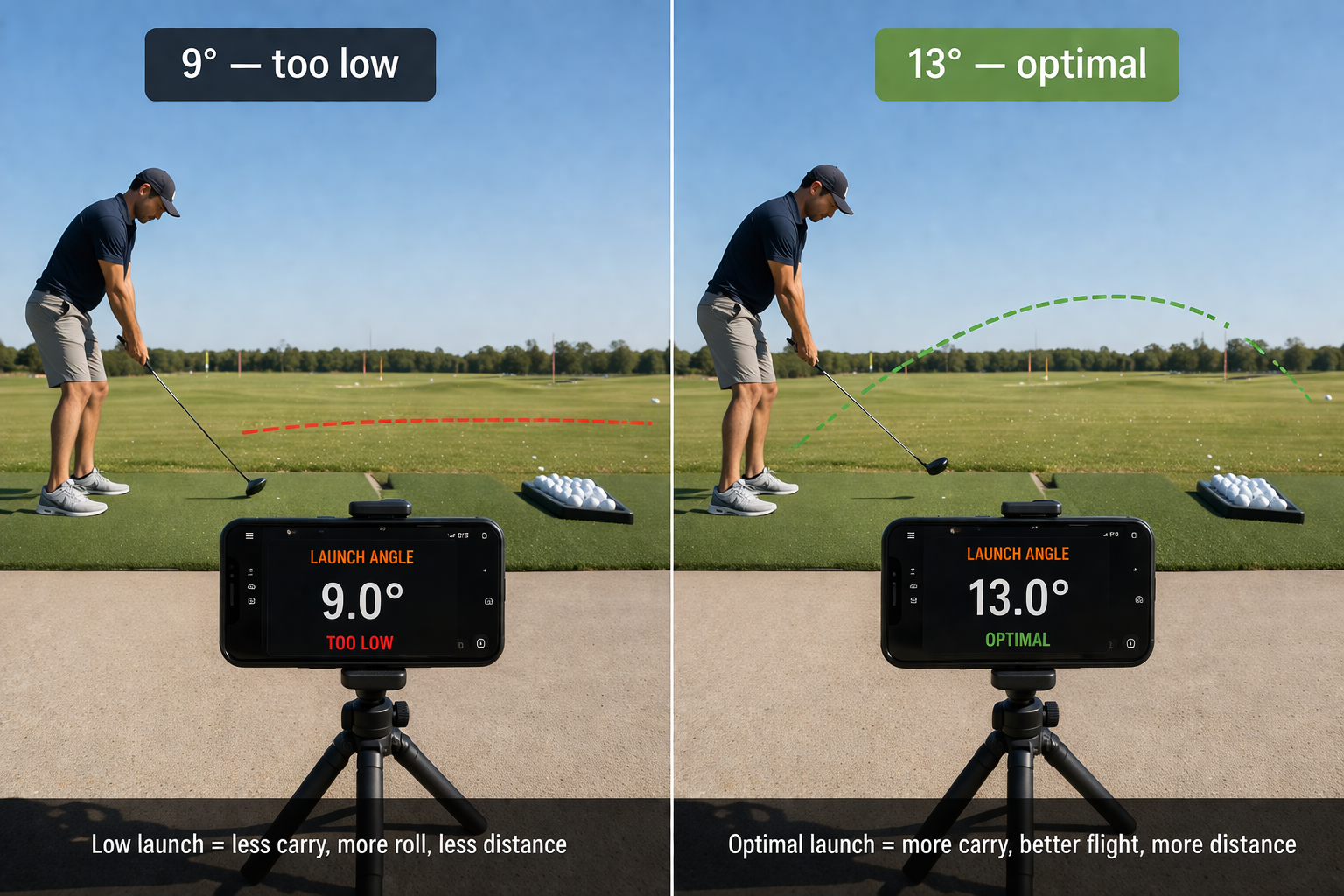
How to Improve Your Golf Launch Angle Using Real Shot Data
By Asaru Labs | Golf Performance | 8 min read
Most amateur golfers lose 20–40 yards of carry not because they swing too slowly, but because the ball leaves the clubface at the wrong angle. Launch angle is one of the most impactful numbers in golf — and one of the most fixable once you can actually see it.
This guide explains what launch angle is, what your number should be for every club in the bag, the most common faults that push it out of range, and exactly how to fix them using real shot data from a launch monitor.
See your launch angle in real time — free.
The Golf Launch Monitor app shows your launch angle, ball speed, spin rate, and carry distance on every shot — straight from your iPhone camera, no hardware needed. Bring real data to your next range session and start fixing the right things.
What is launch angle and why does it matter so much?
Launch angle is the vertical angle at which the ball leaves the clubface immediately after impact, measured in degrees. A launch angle of 0° would mean the ball travels perfectly horizontal along the ground. A 90° launch angle would mean it shoots straight up. In reality, a well-struck driver launches somewhere between 10° and 16°, depending on your swing speed.
Why does it matter so much? Because launch angle — working together with ball speed and spin rate — determines your entire ball flight. Get it right and you maximise carry distance, achieve a predictable trajectory, and give the ball the right descent angle to hold a green. Get it wrong and you can lose 20–40 yards of carry even with a fast swing, or hit high, weak shots that balloon and fall short.
The critical insight most golfers miss: launch angle and spin rate are linked. They are both produced by the same impact variables — dynamic loft, angle of attack, and strike location. You cannot fix one without understanding the other. This is why real shot data from a launch monitor is so much more useful than feel alone — it shows you both numbers simultaneously, so you can see exactly what is happening at impact.
Optimal launch angle by club: what your numbers should be
Every club in the bag has an optimal launch window — a range where launch angle and spin work together to produce maximum carry and control. Here are the target ranges for an average amateur golfer:
| Club | Optimal launch angle | Ideal spin rate (rpm) | Common amateur fault |
|---|---|---|---|
| Driver | 10°–16° | 2,000–2,800 | Too low (8°–10°) with too much spin |
| 3-wood | 9°–14° | 3,000–4,000 | Too high — scooping at impact |
| 5-iron | 14°–18° | 4,500–5,500 | Too low from excessive shaft lean |
| 7-iron | 17°–21° | 5,500–7,000 | Too low (13°–15°) from steep attack |
| 9-iron | 22°–27° | 7,000–8,500 | Too high from flipping wrists |
| Pitching wedge | 25°–30° | 7,500–9,500 | Inconsistent — varies shot to shot |
How to use this table: Pull up your last session in the Golf Launch Monitor app and find your average launch angle for each club. Compare it to the ranges above. If your driver is launching at 9° and spinning at 3,400 rpm, you have a clear, fixable problem — and the sections below tell you exactly how to fix it.
Optimal driver launch angle by swing speed
The driver deserves special attention because the optimal launch angle shifts significantly with swing speed. Slower swingers need to launch the ball higher to maximise carry; faster swingers can afford a lower, more penetrating launch because they generate enough speed to keep the ball airborne.
| Driver swing speed | Optimal launch angle | Optimal spin rate | Potential carry |
|---|---|---|---|
| Under 75 mph | 14°–17° | 2,600–3,200 | 140–165 yards |
| 75–85 mph | 13°–16° | 2,400–3,000 | 165–195 yards |
| 85–95 mph | 12°–15° | 2,200–2,800 | 195–225 yards |
| 95–105 mph | 11°–14° | 2,000–2,600 | 225–260 yards |
| 105–115 mph | 10°–13° | 1,800–2,400 | 260–295 yards |
| 115+ mph | 9°–12° | 1,700–2,200 | 295+ yards |
The Golf Launch Monitor app gives you both your swing speed and launch angle on every shot, so you can compare your readings against this table immediately and know exactly whether your launch angle is in the right window for your speed.
The three root causes of a bad launch angle
Launch angle problems almost always trace back to one of three things happening at impact. Understanding which one is affecting your shots tells you exactly what to work on.
1. Angle of attack (AoA) — are you hitting up or down?
Angle of attack is the direction the clubhead is moving at impact — either downward (negative AoA) or upward (positive AoA). It is one of the biggest drivers of launch angle.
- Driver: You want a slightly positive AoA (+2° to +5°), meaning the club is moving upward through the ball. This raises launch angle and reduces spin — the combination that produces maximum distance. Most amateurs hit down on the driver (negative AoA), which crushes launch angle and spikes spin.
- Irons: You want a negative AoA (hitting down and through the ball), which creates the compression and controlled spin that irons are designed for. Too steep a descent produces excessive spin and too low a launch. Too shallow produces weak, high shots with no stopping power.
2. Dynamic loft — how much loft are you actually delivering?
Dynamic loft is the actual loft of the club at the moment of impact — which is almost always different from the loft printed on the club. Excessive forward shaft lean reduces dynamic loft and kills launch angle. A flippy, scoopy release adds dynamic loft and produces a high, spinny, distance-robbing ball flight.
If your launch monitor data shows your 7-iron launching at 13° when it should be 17–21°, you are almost certainly delivering too little dynamic loft through too much shaft lean. If it is launching at 25°+, you are adding loft through a late flip.
3. Strike location on the face — where are you actually hitting it?
The face is curved both vertically and horizontally. Strikes away from centre create gear effect, which changes both launch angle and spin axis. On a driver:
- Low on the face: Reduces launch angle, increases spin — the worst combination for distance
- High on the face: Increases launch angle, reduces spin — generally adds carry
- Toe strikes: Higher launch, less spin, draw bias
- Heel strikes: Lower launch, more spin, fade bias
How to diagnose which fault you have: If your launch angle is consistently low AND spin is high — it is usually angle of attack (hitting down on the driver) or low-face contact. If launch is consistently low AND spin is also low — it is dynamic loft (too much shaft lean at impact). The Golf Launch Monitor app shows you both launch angle and spin rate on every shot, making this diagnosis fast and clear.
How to fix a launch angle that is too low (driver)
This is the most common issue for amateur golfers. A driver launching under 10° with over 3,000 rpm of spin is leaving 20–40 yards on the table. Here are the fixes, in order of priority:
Fix 1 — Move the ball forward in your stance
For driver, the ball should be opposite your lead heel or just inside it. Many amateurs play it too far back, which encourages a downward strike. Moving the ball forward naturally encourages the slightly upward strike that raises launch and reduces spin. This is the fastest, easiest adjustment available — try it before anything else.
Fix 2 — Raise your tee height
Tee the ball so roughly half the ball sits above the top of the driver face. A low tee encourages a steep, downward strike. A higher tee invites the upward angle of attack that produces optimal launch conditions. Most golfers tee the ball far too low.
Fix 3 — Add spine tilt away from the target at address
A slight tilt of your spine away from the target (trail shoulder lower than lead shoulder) at address pre-sets a shallow, upward attack angle into the ball. Without this tilt, the body naturally squares up and the club arrives at impact on a steeper, downward path.
Fix 4 — Check your weight distribution at impact
Unlike iron shots — where you want weight transferred aggressively to the lead side — the driver benefits from keeping slightly more weight on the trail side through impact. Driving all your weight forward encourages a steep, downward strike. Stay "behind the ball" slightly through impact.
Measure the fix, not just the feel: Apply one change at a time and hit 8–10 shots per adjustment. Watch your launch angle in the Golf Launch Monitor app after each change. A fix that feels different but does not move the launch angle number has not actually changed your impact conditions — keep adjusting.
How to fix a launch angle that is too high (driver)
High launch is less common but just as damaging to distance, especially when paired with low spin (the ball balloons and falls out of the sky) or high spin (floaty, weak shots that go nowhere in the wind).
Fix 1 — Move the ball slightly back in your stance
Even one ball-width back from its normal position encourages a slightly more neutral or downward attack angle, which reduces dynamic loft and brings launch down.
Fix 2 — Lower your tee height
Drop the tee until only a quarter of the ball sits above the clubface. This naturally promotes a slightly steeper, more descending strike that reduces launch angle.
Fix 3 — Reduce driver loft if fitted correctly
If your swing already produces a solid angle of attack but your launch is consistently high across all ball positions, your driver loft may be too high for your swing speed. Check the swing speed / launch angle table above — if your speed puts you in the 95–105 mph range, a 10.5° driver will almost certainly launch too high. A 9° head may suit you better.
How to fix launch angle with irons
Iron launch problems are almost always about dynamic loft and angle of attack — specifically, too much shaft lean (low launch) or a flippy release (high launch with inconsistent spin).
If your irons launch too low
- Check ball position — it should be in the centre of your stance for mid-irons, slightly back for short irons
- Reduce excessive forward shaft lean at address — your hands should be ahead of the ball at impact, but not dramatically so
- Focus on hitting the ball first, then the turf — the divot should start at or just ahead of the ball position, not behind it
If your irons launch too high
- Check for early release or "flipping" — where the wrists break down before impact, adding loft to the club
- Focus on keeping the lead wrist flat (or slightly bowed) through impact rather than cupping
- Make sure you are not hanging back on your trail side — transferring weight to the lead side through impact naturally delofts the club and lowers launch
Using your launch monitor data to track improvement
The reason real shot data changes practice so dramatically is simple: it gives you immediate feedback on whether what you just did actually moved the right numbers. Without a launch monitor, you are judging your swing by feel and ball flight — both of which are unreliable, especially when you are in the middle of making a change.
Here is a simple data-driven practice routine for improving launch angle:
- Baseline session: Hit 10 shots with your driver, recording launch angle and spin rate for each. Calculate your average. This is your starting point.
- Identify your gap: Compare your average to the target range for your swing speed in the table above. Note whether you are too low, too high, or in the window but with the wrong spin rate.
- Apply one fix: Choose the single most likely fix from the sections above. Apply it and hit another 10 shots.
- Compare: Did the average launch angle move toward the target range? Did spin rate move in the right direction? If yes, lock in the change. If the numbers barely moved, the issue is likely a different root cause — try the next fix.
- Repeat weekly: Export your session data from the Golf Launch Monitor app as a PDF or CSV after each session. Comparing sessions week over week shows you your rate of improvement and stops you from regressing without realising it.
THE PAYOFF
A golfer swinging at 95 mph with a driver launching at 9° and 3,400 rpm of spin typically carries around 210 yards. The same golfer, same swing speed, with a 13° launch and 2,400 rpm of spin carries around 240 yards. That is 30 yards of free distance — no fitness training, no new driver, no swing overhaul. Just fixing the launch angle using real data.
Start measuring your launch angle today — free.
Download the Golf Launch Monitor app and bring real data to your next session. See your launch angle, spin rate, ball speed, and carry distance on every shot — from your iPhone, no hardware needed.
Frequently asked questions
What is a good launch angle for a driver?
For most amateur golfers, the optimal driver launch angle is between 12° and 15°. Slower swingers (under 85 mph) benefit from launching higher — up to 16° or 17° — to maximise carry. Faster swingers (over 105 mph) can produce more distance with a slightly lower, more penetrating launch of 10°–13°. The Golf Launch Monitor app shows your launch angle on every drive so you know exactly where you stand.
Why is my driver launch angle too low?
The most common causes are: hitting down on the ball (negative angle of attack), ball position too far back in the stance, tee height too low, or low-face contact that reduces dynamic loft at impact. In most cases, moving the ball forward and raising tee height produces an immediate improvement you can verify with launch monitor data.
Can I improve launch angle without changing my swing?
Yes, significantly. Ball position, tee height, and driver loft setting are all equipment or setup adjustments that directly change your launch angle without requiring any swing change. Many golfers gain 10°–15° of additional launch from setup changes alone before touching swing mechanics.
What happens if my launch angle is too high?
A launch angle that is too high — especially when paired with low spin — produces a "ballooning" trajectory where the ball climbs steeply, loses forward momentum, and falls almost straight down. This kills carry distance and is particularly damaging in wind. The fix is usually a lower tee, a ball position slightly further back, or a lower-lofted driver head.
Does launch angle affect iron distance as much as driver distance?
Yes, though the optimal iron launch angle is different from the driver. Irons are designed to be hit with a slightly downward strike that produces a mid-to-high launch with enough spin to stop the ball. A 7-iron launching below 15° is almost always losing carry and stopping power. A 7-iron launching above 23° is likely being hit with a flippy release that produces inconsistent contact.
How do I know if my launch angle improved?
The only reliable way to know is to measure it. Hit a baseline set of 10 shots, apply your chosen fix, and hit another 10. Compare the average launch angle and spin rate between the two sets. The Golf Launch Monitor app records every shot in a session and shows your averages, making this before-and-after comparison straightforward.
how to improve golf launch angleoptimal driver launch angle by swing speedgolf launch angle chartideal launch angle golfdriver launch angle tipslaunch angle too low golfgolf launch monitor dataimprove golf distance with launch angle