How to Find Your True Carry Distance for Every Club in the Bag

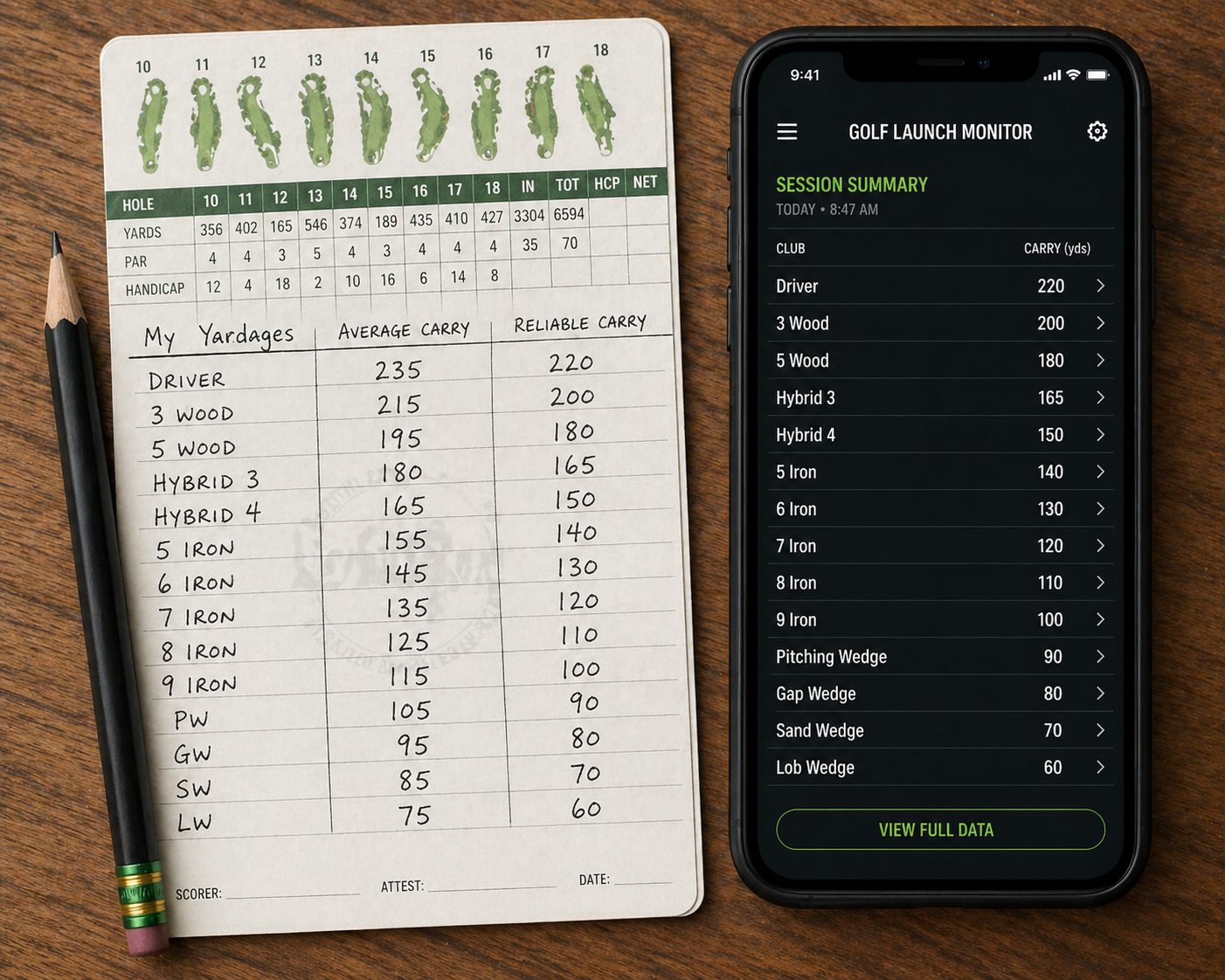
How to Find Your True Carry Distance for Every Club in the Bag
By Asaru Labs | Golf Performance | 7 min read
Ask most golfers how far they hit their 7-iron and they will tell you a number — usually their best shot from a perfect lie with the wind at their back. That is not their carry distance. That is their aspirational distance. And the gap between the two is costing them multiple strokes per round without them even realising it.
This guide explains exactly how to find your true carry distance for every club in your bag using real data, why the number most golfers believe is wrong, and how to use accurate distances to immediately make better decisions on the course.
Measure your true carry distance on every shot — free.
The Golf Launch Monitor app records carry distance, ball speed, launch angle, and spin rate on every shot from your iPhone camera — no hardware needed. Hit a set of shots with each club and get your real average distances in a single range session.
Why most golfers are wrong about their distances
Research consistently shows that amateur golfers overestimate their club distances — particularly their longer irons and driver — by an average of 10–20 yards. There are three main reasons this happens:
They remember their best shots
Human memory is selective. After a round or a range session, the shots that stick in the memory are the pure ones — the flush 7-iron that flew right at the flag, the driver that found the centre of the fairway 250 yards out. The topped shots, the heels, the ones that came up 20 yards short — those fade. Over time, the mental yardage for each club drifts toward the best shot ever hit with it, not the average shot.
They measure total distance, not carry
On a flat range with firm ground, a ball can roll out 15–25 yards beyond where it lands. If you are pacing to where the ball finished — or reading a GPS yardage to that point — you are measuring total distance, not carry. On a soft course, a bunker carry, or a shot over water, only carry matters. Using total distance as your yardage will consistently leave you short of your target.
They hit off perfect range conditions
Most golfers measure their distances from a flat range mat, hitting a fresh ball with no pressure. Course conditions are different: uneven lies, tight fairway grass, softer ground, and the psychological weight of a real shot all affect how the ball actually flies. Range distances almost always run slightly longer than real course performance.
The consequence: A golfer who believes their 8-iron carries 155 yards but actually carries 138 yards will consistently leave approach shots 15+ yards short of the green — and not understand why. Over 18 holes, this adds up to multiple bogeys that look like bad luck but are actually a yardage calibration problem.
What true carry distance actually is
Your true carry distance for a given club is the average carry of your typical, representative swings — not your best shots, not your worst, but the number that describes where your ball lands in the air across a realistic sample of strikes.
There are two versions of this number worth knowing:
- Average carry: The mean carry distance across all shots in your sample, including mishits. This is the number to use for planning shots where missing short has the same penalty as missing long — for example, a mid-iron to an open green.
- Reliable carry: A slightly conservative figure — roughly the 70th percentile of your carries — representing the distance you can expect to achieve on a solid but not perfect strike. This is the number to use when a short miss is worse than a long miss: shots over water, bunker carries, approach shots where short means a difficult up-and-down.
The Golf Launch Monitor app records carry distance on every shot and shows you both your average and your spread across a session, making it straightforward to identify both numbers without any manual calculations.
How to measure your true carry distance at the range: step by step
What you need
- Your iPhone with the Golf Launch Monitor app downloaded
- A compact tripod — a small flexible tripod works perfectly and fits in your bag pocket
- Your own golf balls where the range allows, or the best range balls available
- One full bag session — plan for 10–15 shots per club you want to calibrate
Step 1 — Set up correctly
Position your iPhone on the tripod 6–8 feet directly behind the ball along your target line, in landscape orientation at hip height. The camera needs a clear, stable view of the impact zone and the first portion of ball flight. A shaky or misaligned phone produces inaccurate carry numbers — spend 60 seconds getting the setup right before you hit the first ball.
Step 2 — Warm up first
Do not start recording carry distances from your first swing of the day. Hit 15–20 balls to warm up before you begin your calibration session. Cold muscles produce shorter, less representative shots. Your carry distances should reflect what you produce in the middle of a round, not at the very start.
Step 3 — Hit 10–15 shots per club with your normal swing
This is the most important instruction in this entire guide: swing normally. Do not try harder, do not be more careful, do not "compress it" more than usual. Swing as you would on the course. If you hit a shot you know was a bad strike, you can note it — but do not delete it from your sample. Mishits happen on the course too, and your true average should include them.
Step 4 — Work through the bag systematically
Start from your shortest club and work upward, or divide the session across multiple visits. Trying to do the full bag in one session can lead to fatigue affecting your later readings. A better approach is two or three focused sessions:
- Session 1: Wedges and short irons (PW, GW, SW, 9-iron, 8-iron)
- Session 2: Mid irons and long irons (7-iron, 6-iron, 5-iron, 4-iron)
- Session 3: Fairway woods, hybrids, and driver
Step 5 — Record and review your averages
After each set of shots, review the session data in the app. Note your average carry for that club. Also note your shortest carry and your longest — the range between them tells you how consistent your distance control is with that club. A 7-iron that averages 155 yards but ranges from 135 to 175 yards tells a very different story than one that averages 155 yards and ranges from 148 to 162 yards.
Step 6 — Export and build your distance chart
Use the Golf Launch Monitor app's PDF or CSV export to save each session. Once you have data for the full bag, build a simple personal distance chart — average carry, reliable carry (subtract 5–8% from the average), and spread range for each club. Write it down, save it in your phone, or put it on a yardage card. This chart is one of the most valuable pieces of information you can carry onto a golf course.
Average carry distance benchmarks by club
These are typical carry distances for male amateur golfers at different swing speed levels. They are useful reference points — but your personal measured data from the Golf Launch Monitor app should always override these benchmarks once you have collected it.
| Club | Slow swing (75–85 mph driver) | Average swing (85–100 mph driver) | Fast swing (100–115 mph driver) |
|---|---|---|---|
| Driver | 165–190 yards | 200–230 yards | 240–275 yards |
| 3-wood | 150–175 yards | 185–210 yards | 215–250 yards |
| 5-wood / hybrid | 135–158 yards | 165–190 yards | 195–225 yards |
| 4-iron / 4-hybrid | 125–145 yards | 150–175 yards | 180–210 yards |
| 5-iron | 115–135 yards | 140–162 yards | 165–195 yards |
| 6-iron | 105–125 yards | 130–152 yards | 155–182 yards |
| 7-iron | 95–115 yards | 120–142 yards | 145–170 yards |
| 8-iron | 85–105 yards | 110–130 yards | 132–158 yards |
| 9-iron | 75–95 yards | 98–118 yards | 120–145 yards |
| Pitching wedge | 65–85 yards | 88–108 yards | 110–132 yards |
| Gap wedge | 55–75 yards | 76–96 yards | 98–118 yards |
| Sand wedge | 45–65 yards | 64–84 yards | 85–105 yards |
Note on modern irons: Many modern game-improvement irons are significantly stronger-lofted than traditional irons. A "7-iron" from a modern game-improvement set may have the loft of a traditional 5-iron. This means your actual distances may be longer than the table suggests — another reason to measure rather than assume.
Club gapping: the hidden problem your distance data reveals
Once you have measured your true carry distance for every club, lay the numbers out in order from shortest to longest. Ideally, the gap between consecutive clubs should be roughly 10–15 yards throughout the bag. This spacing gives you a club for virtually every distance you face on the course.
Most amateur golfers discover one or two significant gaps — typically between a long iron and a fairway wood, or somewhere in the mid-iron range — where two consecutive clubs carry almost the same distance. This is a club gapping problem, and it creates yardage dead zones where no club in the bag is the right choice.
Common gapping problems and solutions
| Gapping problem | What it looks like in your data | Typical solution |
|---|---|---|
| Long iron / fairway wood gap | 3-wood carries 205 yards, 4-iron carries 175 yards — 30-yard gap with nothing in between | Add a hybrid or 5-wood to fill the gap |
| Wedge dead zone | PW carries 115 yards, SW carries 85 yards — no club for 86–114 yards | Add a gap wedge (48–52°) to cover the middle yardage |
| Clubs too close together | 7-iron and 8-iron both carry 135 yards — duplicate club in the bag | Check loft with a loft gauge; consider bending lofts or replacing one club |
Without measuring your true carry distances with a launch monitor, gapping problems are nearly impossible to identify. You simply notice that certain distances always feel awkward — you are always between clubs — without knowing why. Real data reveals the exact gap and makes the solution obvious.
How to use your true carry distances on the course
Having accurate distances is only useful if you actually apply them during a round. Here is how to put the data to work immediately:
Use carry distance, not total distance, for all planning
When your GPS or rangefinder gives you a yardage, that number is to the flag or a specific point on the hole — it is a carry target. Use your measured carry distance for each club to select the right one. Do not add roll to the calculation unless the ground is unusually firm or you are intentionally running the ball in.
Club to your reliable carry, not your average carry
For approach shots where coming up short has a penalty — a bunker short of the green, water in front of a hole, a steep false front — use your reliable carry figure (roughly 5–8% below your average). This accounts for the natural variation in your ball striking and the tendency for course conditions to play slightly longer than the range.
Know your full-swing minimum
Your shortest full-swing iron is a critical piece of information. Many golfers try to make half-swings with their shortest iron for mid-range shots — which produces inconsistent distances and poor contact. Know the carry distance of a 50%, 75%, and 100% swing with your two most-used wedges. These are the scoring clubs and the yardages matter most in the range of 50–120 yards.
Re-measure every three to four months
Your swing changes over time — through lessons, fitness changes, new equipment, or simply natural development. Carry distances that were accurate six months ago may be meaningfully off today. A 20-minute range session with the Golf Launch Monitor app is enough to update your full bag chart. Make it a quarterly habit.
THE SCORING PAYOFF
A study tracking amateur golfers who calibrated their yardages using launch monitor data found an average improvement of 2–4 strokes per round in approach shot proximity — without any change in swing mechanics. Simply knowing your real carry distances, and using them instead of aspirational ones, is one of the fastest and cheapest scoring improvements available to any golfer above a 5 handicap.
Measure your true carry distances today — free.
Download the Golf Launch Monitor app and spend one range session building your real distance chart for every club. Ball speed, carry distance, and full session data — from your iPhone, no hardware needed. Stop guessing your yardages and start using the numbers that are actually yours.
Frequently asked questions
What is the difference between carry distance and total distance in golf?
Carry distance is how far the ball flies through the air before it hits the ground. Total distance includes carry plus roll after landing. For most course management decisions — particularly anything involving a carry over a hazard, bunker, or water — only carry distance matters. The Golf Launch Monitor app measures and records carry distance directly on every shot.
How many shots do I need to find my true carry distance?
A minimum of 10 shots per club gives you a usable average. Fifteen shots is better, and 20 shots gives you a very reliable baseline. Make sure to swing normally — including the inevitable mishits — so that the average reflects your real performance rather than just your best shots.
Why do most golfers overestimate their distances?
Three main reasons: they remember their best shots rather than their average, they measure total distance including roll rather than carry, and they hit off flat range mats under ideal conditions rather than the varied lies and pressure of real play. Launch monitor data cuts through all three sources of error by giving you an objective carry number on every shot.
How far should I hit my 7-iron?
For an average male amateur golfer swinging at 85–100 mph with the driver, a typical 7-iron carry is 120–142 yards. But the number that matters is your specific measured distance — which may be 10 yards shorter or longer depending on your swing and equipment. Use the Golf Launch Monitor app to measure your actual average rather than relying on a benchmark.
What is club gapping and why does it matter?
Club gapping is the distance spacing between consecutive clubs in your bag. Ideally, each club should carry 10–15 yards more than the next shortest club, giving you a club for every yardage you face. When two clubs carry nearly the same distance, you have a gap somewhere else in the bag where no club fits well. Measuring your true carry distances is the only reliable way to identify and fix gapping problems.
How often should I re-measure my club distances?
Every three to four months is a good baseline. Also re-measure after getting new equipment, after a significant swing change from a lesson, or after a noticeable shift in your distances on the course. A 20-minute session with the Golf Launch Monitor app is enough to update your full bag chart with fresh, accurate data.
how to find your true club distancetrack carry distance at rangetrue carry distance golfgolf club distance chartaverage carry distance by clubmeasure golf club distancegolf launch monitor carry distanceclub gapping golf