How to Find the Kelvin of a Light Bulb (Easy Guide)

How to Find the Kelvin of a Light Bulb
You bought a replacement bulb, screwed it in, and suddenly one lamp looks yellow while the other looks blue. The culprit is almost always color temperature — the Kelvin (K) rating that tells you whether a bulb glows warm and golden or cool and white. The trouble is that “Kelvin” rarely appears in plain numbers on the front of the box, so a lot of people never learn how to find it.
This guide shows you every way to find the Kelvin of a light bulb: reading the packaging, decoding label terms like “soft white,” checking the bulb base and product specs, and measuring an unlabeled bulb directly. If yours is already installed with no box in sight, you can measure its Kelvin in seconds with your phone — but let's cover all the options.
📲 No box, no label? Just measure it
Kelvin Light Scale reads any bulb's color temperature straight from your camera — perfect for installed or unlabeled bulbs you can't identify any other way.
Where the Kelvin rating is usually printed
If you still have the bulb or its packaging, the Kelvin value is almost always there — you just have to know where to look. Check these spots in order:
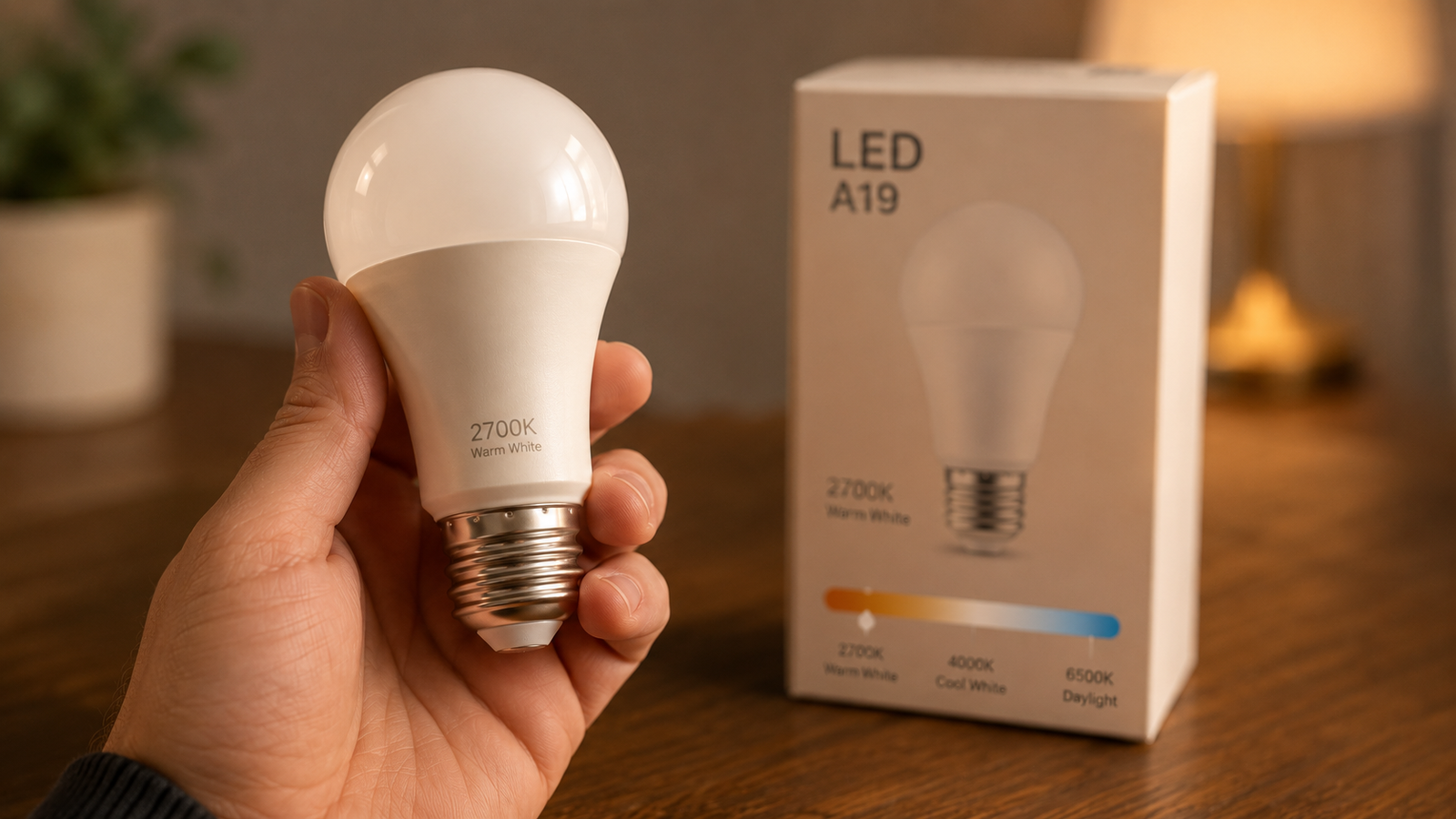
- The box or packaging: Look for a number followed by “K,” such as 2700K or 5000K, usually near the lumens and wattage. It is sometimes shown on a small warm-to-cool slider graphic.
- The bulb base or glass: Many LED bulbs have the color temperature etched or printed directly on the base or near the threads.
- The lighting facts label: In the US, the “Lighting Facts” panel lists “Light Appearance” with the exact Kelvin value.
If you find a number with a K after it, that is your answer. If all you see is a word like “soft white,” the next section translates it for you. And if there's no marking at all, you can always read the bulb's actual output directly.
Decoding common label terms
Manufacturers often print a marketing name instead of a Kelvin number. These names are fairly consistent across brands, so you can usually translate them to an approximate Kelvin range.
| Label on the box | Approx. Kelvin | Appearance |
|---|---|---|
| Soft White / Warm White | 2,700–3,000K | Warm, golden, cozy |
| Bright White / Neutral | 3,500–4,100K | Clean, neutral white |
| Cool White | 4,000–4,500K | Slightly bluish white |
| Daylight | 5,000–6,500K | Crisp, bright blue-white |
These are guidelines, not guarantees — two bulbs both labeled “soft white” can still differ by a few hundred Kelvin between brands. That is exactly why, when an exact match matters, it helps to measure each bulb yourself rather than trust the label.
What if the bulb has no label or box?
This is the most common real-world situation: the bulb is already installed, the box went out with the recycling months ago, and there is nothing printed on the base. You cannot look the Kelvin up because you do not know what the bulb is. The only way to find out is to measure the light it actually produces.
A phone color-temperature app does this directly. It reads the light reflected off a neutral surface and reports the Kelvin value, no packaging required. You can point your phone at the lit bulb and have your answer before you would have finished searching for the model number.
How to find the Kelvin of an installed bulb, step by step
- Turn the bulb on and let it warm up for about a minute so the color stabilizes.
- Open a color-temperature app and allow camera access.
- Hold a sheet of white paper so it is lit only by that bulb.
- Aim the camera at the paper, not at the bulb itself, and fill the frame with the white surface.
- Read the Kelvin value once it settles, and compare it to the chart above to name the bulb type.
That is the whole process. Once you have done it once, you can identify any mystery bulb in your home in under a minute.
💡 Pro tip
Always measure the light bouncing off white paper, never aim straight at the bulb. Pointing at the source overwhelms the camera and skews the reading warmer or cooler than the bulb truly is.
Checking the model number and manufacturer specs
If the bulb has a readable model number on its base, you can look it up on the manufacturer's website or the retailer's product page, where the Kelvin rating is listed in the specifications. This is reliable for branded bulbs but useless for generic or worn bulbs whose markings have faded — another case where a direct reading from the app is faster and works regardless.
Quick reference for common bulbs
| Bulb type | Typical Kelvin |
|---|---|
| Traditional incandescent | ~2,700K |
| Halogen | ~3,000K |
| “Soft white” LED | 2,700–3,000K |
| “Daylight” LED | 5,000–6,500K |
| Standard fluorescent tube | 3,500–4,100K |
✅ The verdict
If the bulb is labeled, read the box or base. If it is installed, unlabeled, or you are trying to match two bulbs exactly, measure the light directly with a phone app — it is the only method that works no matter what.
Finding the Kelvin of a light bulb is simple once you know the three places it hides: the packaging, the label terminology, and the light itself. When the first two fail you, the third never does — just point your phone and read it.
Identify any bulb's Kelvin in seconds
Kelvin Light Scale reads color temperature, lux, and exposure straight from your iPhone — no box, no model number needed. Free to start, with pro tools when you want them.
Frequently asked questions
How do I find the Kelvin of a light bulb?
Check the packaging or the bulb base for a number followed by “K” (like 2700K), or translate a label term such as “soft white” using a Kelvin chart. If the bulb is installed or unlabeled, shine it on white paper and read the color temperature with a phone app.
What Kelvin is “soft white” or “warm white”?
Soft white and warm white bulbs are typically 2,700K to 3,000K, producing a warm golden glow similar to a traditional incandescent bulb. They are popular for living rooms and bedrooms.
What Kelvin is a “daylight” bulb?
Daylight bulbs usually fall between 5,000K and 6,500K, giving a crisp, bright blue-white light that mimics midday sun. They suit offices, garages, and task areas.
Where is the color temperature printed on a light bulb?
Look on the box near the lumens and wattage, on the “Lighting Facts” panel under “Light Appearance,” or etched on the bulb's base or glass. It appears as a number with a K, such as 4000K.
How can I tell the Kelvin of a bulb that has no label?
The only reliable way is to measure the light it produces. Turn it on, hold white paper under it, and use a color-temperature app to read the Kelvin value directly — no packaging or model number required.
Why do two bulbs labeled the same look different?
Marketing names like “soft white” cover a range, so two bulbs can both be “soft white” yet differ by a few hundred Kelvin between brands. Measuring each one lets you match them precisely — within about 200K usually looks identical.
how to find the kelvin of a light bulblight bulb color temperaturewhat kelvin is soft whitedaylight bulb kelvinfind color temperature of bulbdecode light bulb labelsmeasure bulb kelvinmatch light bulbs color