How to Convert Lux to Lumens: Formula and Examples

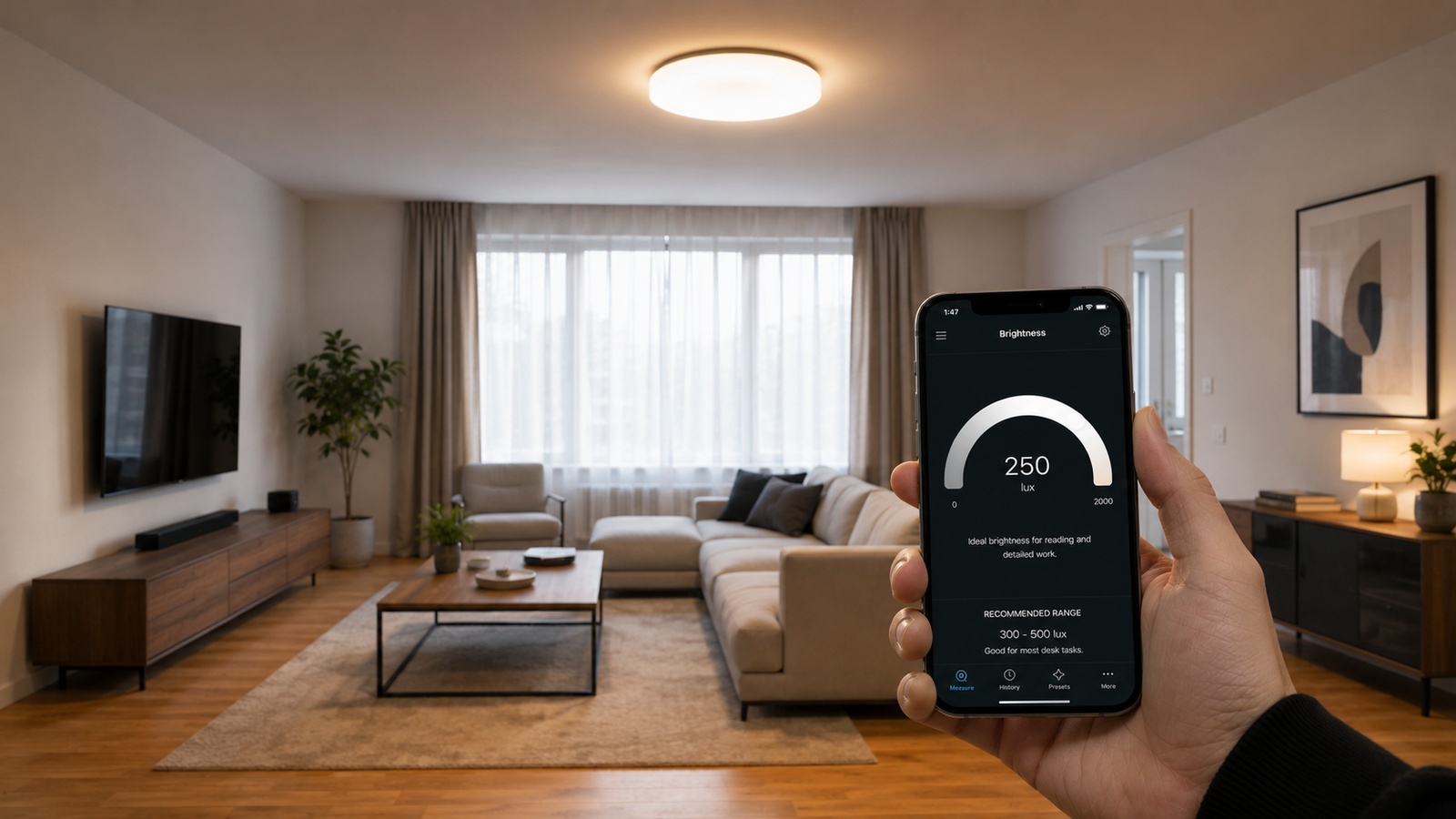
How to Convert Lux to Lumens (and Why It's Not One-to-One)
People often expect lux and lumens to convert as cleanly as lux and foot-candles — multiply by a fixed number and you're done. They don't, and understanding why is the key to getting it right. Lux and lumens measure two different things, and turning one into the other requires a piece of information many guides leave out: the area the light covers.
This guide explains the real relationship, gives you the formula and worked examples, and shows the practical version most people actually want — how many lumens it takes to light a room. To get the lux figure you start from, you can measure lux with your phone and plug it into the math below.
📲 Measure the lux, then do the math
Kelvin Light Scale reads lux straight from your iPhone — the starting point for any lux-to-lumens estimate once you know the area.
Lux vs lumens: what each measures
Lumens measure luminous flux — the total amount of visible light a source produces, regardless of where it goes. Lux measures illuminance — how much of that light actually lands on a given surface, per square meter. One lux equals one lumen spread over one square meter. So lumens describe the bulb's output, while lux describes the result on your desk. That distinction is exactly why you can't convert between them without knowing how much area the light is spread across, which you can pair with a reading from a lux meter.
Why you can't convert directly
The same bulb produces wildly different lux depending on conditions. Put a 1,000-lumen bulb in a tiny closet and the lux is high; put it in a large hall and the lux drops, even though the bulb's lumen output never changed. Distance, room size, reflectivity, and how the light is focused all affect lux. So “X lux = Y lumens” is meaningless on its own — you must specify the area. Once you do, the conversion is simple, and you can measure the lux yourself to feed it.
The formula
| To find | Formula |
|---|---|
| Lumens | lumens = lux × area (in m²) |
| Lux | lux = lumens ÷ area (in m²) |
This works when the light is spread fairly evenly across the area you're considering. It's the basic, practical relationship behind every lux-to-lumens estimate. Take your measured lux, multiply by the area in square meters, and you have an approximate lumen figure for that surface.
Worked examples
Say you measure 300 lux on a desk surface that's about 1.5 m². The light reaching that desk is 300 × 1.5 = 450 lumens. For a whole room: if a 12 m² room reads 200 lux at floor level, that's 200 × 12 = 2,400 lumens landing on the floor. Note this is the light reaching the surface, which is less than the bulb's rated output, because some light hits walls, ceiling, and furniture along the way.
How many lumens to light a room
The most useful version of this calculation runs in reverse: you pick a target lux for the space, multiply by the room area, and get the lumens you need. Here's a quick guide at common target levels (light reaching the work plane):
| Room area | At 150 lux | At 300 lux | At 500 lux |
|---|---|---|---|
| 10 m² (~108 ft²) | 1,500 lm | 3,000 lm | 5,000 lm |
| 15 m² (~161 ft²) | 2,250 lm | 4,500 lm | 7,500 lm |
| 20 m² (~215 ft²) | 3,000 lm | 6,000 lm | 10,000 lm |
These are the lumens that need to reach the surface, so in practice you'll want somewhat more bulb output to account for losses. Measuring the actual lux you achieve with the app tells you whether your bulbs are getting there.
Estimating a bulb's total lumens from a lux reading
You can roughly estimate a source's total output if you treat it as radiating evenly in all directions. Measure the lux at a known distance, then use: lumens ≈ lux × 4π × distance² (distance in meters). At 1 meter, a reading of 100 lux implies roughly 1,257 lumens of total output.
Treat this as a ballpark only. Real bulbs don't emit equally in every direction — most focus light forward or downward — so this method overestimates for directional sources. It's useful for a rough sanity check, not a spec sheet. For the input reading, you'll still measure lux first.
💡 Pro tip
Always work in square meters for these formulas, since lux is defined per square meter. If your area is in square feet, divide by 10.764 first to convert to square meters — otherwise your lumen figure will be off by a factor of ten or more.
Start by measuring the lux
- Open a lux meter app and allow access to your phone's sensors.
- Read the lux at the surface you care about, sensor facing the light.
- Measure the area in square meters that the light covers.
- Multiply lux by area to estimate the lumens reaching that surface.
✅ The verdict
Lumens = lux × area (m²). There's no fixed lux-to-lumens factor, because lux depends on how the light is spread — you must know the area. Measure the lux, supply the area, and the conversion is straightforward.
Once you stop expecting a single magic number and start thinking in terms of area, lux and lumens make perfect sense together: one is the output, the other is the result. Measure the lux you're getting, factor in the space, and you can size lighting with confidence. You can take your first lux reading now.
Measure lux, estimate lumens
Kelvin Light Scale reads lux, color temperature, and exposure from your iPhone — the accurate starting point for any lux-to-lumens calculation. Free to start, with pro tools when you need them.
Frequently asked questions
How do you convert lux to lumens?
Multiply the lux value by the area in square meters: lumens = lux × area. For example, 300 lux over a 1.5 m² desk is 450 lumens reaching that surface. You can't convert without knowing the area, because lux depends on how the light is spread.
Is there a fixed lux-to-lumens conversion factor?
No. Unlike lux and foot-candles, lux and lumens measure different things — illuminance versus total output — so there's no single multiplier. The conversion always depends on the area the light covers.
How many lumens do I need to light a room?
Multiply your target lux by the room area in square meters. A 15 m² room at 300 lux needs about 4,500 lumens reaching the work plane, and somewhat more bulb output to cover losses to walls and ceiling.
What is the difference between lux and lumens?
Lumens measure the total light a source emits; lux measures how much of that light lands on a surface, per square meter. Lumens describe the bulb, lux describes the result on your desk or floor.
Why is my lux low even with a high-lumen bulb?
Because the lumens are spread over a large area or lost to distance, reflection, and direction. A high-lumen bulb in a big or dark room can still give low lux. Measuring the lux at the surface shows what's actually arriving.
Do I use square feet or square meters for the lux-to-lumens formula?
Square meters, because lux is defined as lumens per square meter. If your area is in square feet, divide by 10.764 to convert to square meters before applying the formula.
how to convert lux to lumenslux to lumens formulalux vs lumens differencehow many lumens to light a roomlumens lux area calculationconvert lux to lumenslumens per square meterlux to lumens estimate