How Many Lux Do You Need? Lighting Levels per Room

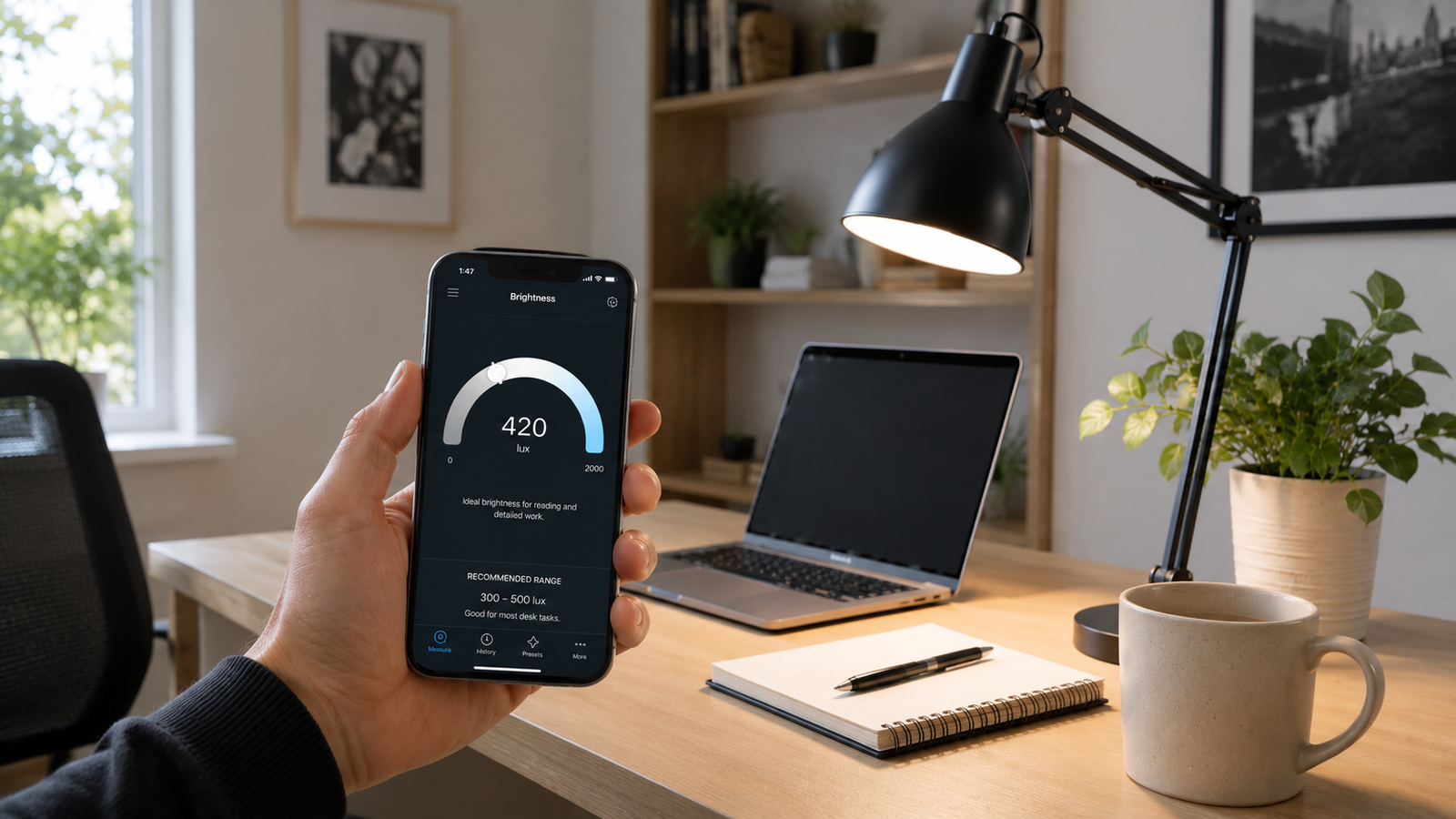
How Many Lux Do You Need? Lighting Levels for Every Room
Walk into a room that feels gloomy, or one that's harshly over-lit, and you're experiencing the wrong lux level. Lux measures how much light actually lands on a surface, and every space — a home office, a reading nook, a kitchen counter, a garage workbench, a bathroom mirror — has a sweet spot. Too little causes eye strain and fatigue; too much wastes energy and creates glare.
This guide gives you the recommended lux range for the rooms people ask about most, explains why each differs, and shows how to check whether your own lighting measures up. You don't have to guess — you can measure the lux in any room with your phone and compare it to the targets below.
📲 Check your room's brightness in seconds
Kelvin Light Scale reads lux straight from your iPhone, so you can see exactly how bright a space is and whether it hits the recommended level.
What is lux, quickly?
Lux (lx) is the unit of illuminance — one lux equals one lumen of light spread over one square meter. It describes the light reaching a surface, not the light a bulb produces, which is why two rooms with identical bulbs can have very different lux depending on room size, wall color, and fixture placement. That's also why measuring the actual surface matters more than reading a bulb's spec sheet. You can read the real number with a lux meter app at the exact spot you care about.
Recommended lux at a glance
| Space / task | Recommended lux | Roughly (foot-candles) |
|---|---|---|
| Home office (desk) | 300–500 lux | ~30–50 fc |
| Reading | 300–500 lux | ~30–50 fc |
| Kitchen (general) | 300 lux | ~30 fc |
| Kitchen (countertop task) | 500–750 lux | ~50–75 fc |
| Garage (general) | 300 lux | ~30 fc |
| Garage / workbench | 500–1,000 lux | ~50–100 fc |
| Bathroom (general) | 150–300 lux | ~15–30 fc |
| Bathroom (mirror / grooming) | 500–750 lux | ~50–75 fc |
Home office
A home office desk is generally comfortable around 300–500 lux at the work surface. Below that, screens and paperwork strain your eyes; well above it, glare off monitors becomes a problem. Aim for even light across the desk rather than one bright pool, and position task lighting to avoid casting your own shadow on what you're working on. Measure at the desktop, not at the ceiling — that's where the light has to do its job. A quick reading with the app tells you instantly if you're in range.
Reading
Reading benefits from focused task light in the 300–500 lux range at the page, with the higher end suiting small print or older eyes. The key is contrast control: a bright page in an otherwise dark room is harder on the eyes than a page lit against gentle ambient light. A dedicated reading lamp aimed at the page, plus modest room lighting, hits the mark. You can confirm the level on the page itself using a lux measurement.
Kitchen
Kitchens need two layers. General ambient lighting around 300 lux keeps the room comfortable, but the countertops — where you chop, measure, and cook — want 500–750 lux of task lighting. Under-cabinet lights are the usual fix, since overhead fixtures alone leave your own shadow on the counter. Measure both the room center and the counter surface; people are often surprised the counter falls short even when the room feels bright. Check each zone with a phone lux reading.
Garage and workshop
A garage used for parking is fine around 300 lux, but the moment it becomes a workshop the bar rises sharply. Detailed work at a bench — tools, fasteners, fine cuts — calls for 500–1,000 lux, and precision tasks can want more. Shadows are the enemy here, so combine bright general lighting with a dedicated task light over the bench. Dark walls and floors soak up light, so a garage often needs more output than a similar-sized finished room. Confirm your bench level with an actual measurement rather than assuming.
Bathroom
General bathroom lighting sits comfortably around 150–300 lux, but the mirror is a special case: shaving, makeup, and grooming want 500–750 lux, ideally from lighting beside the mirror rather than only above it, so your face isn't lit from a single harsh angle. Measure at face height in front of the mirror, which is where the light actually needs to perform. A fast lux check at the mirror shows whether you need to add side lighting.
💡 Pro tip
Always measure lux at the task surface — the desk, the page, the counter, the bench, the mirror — not in the middle of the room or at the ceiling. The number that matters is the one where your eyes are actually working.
How to measure the lux in your room
- Open a lux meter app and allow access to your phone's sensors.
- Go to the task surface — place the phone where the work happens.
- Face the sensor toward the light, the way the surface receives it.
- Read the lux value and compare it to the chart above.
- Take a few readings across the area and average them, since light is rarely even.
If you're below target, add task lighting or a brighter bulb; if you're far above with glare, diffuse or redirect it. Either way, you can measure before and after to confirm the change worked.
✅ The verdict
Match the light to the task: 300–500 lux for offices and reading, 500–750 for kitchen counters and bathroom mirrors, up to 1,000 for a workbench. The only way to know you've hit it is to measure the surface itself.
Good lighting isn't about flooding a room — it's about putting the right amount of light where you actually use it. Measure your key surfaces, adjust, and your eyes will thank you. Start by checking your most-used room with a quick lux reading.
See if every room hits the right level
Kelvin Light Scale measures lux, color temperature, and exposure from your iPhone — check any surface in seconds. Free to start, with pro tools when you need them.
Frequently asked questions
How many lux do I need for a home office?
A home office desk is typically comfortable at 300–500 lux measured at the work surface. Below that range causes eye strain, while much higher levels can create glare on screens. Measure at the desktop, not the ceiling, to know your real level.
How many lux is good for reading?
Around 300–500 lux at the page works well, with the higher end better for small print or older eyes. Use a focused reading lamp plus gentle ambient light so the page isn't bright against a dark room.
How many lux does a kitchen need?
About 300 lux for general kitchen lighting and 500–750 lux on countertops where you prepare food. Under-cabinet task lighting is the usual way to reach the higher level on the counter.
How many lux for a garage or workshop?
A garage used for parking is fine around 300 lux, but a workshop bench needs 500–1,000 lux for detailed work. Dark walls and floors absorb light, so garages often need more output than similar-sized rooms.
How many lux should a bathroom be?
General bathroom lighting of 150–300 lux is comfortable, while the mirror area wants 500–750 lux for grooming. Lighting beside the mirror is better than overhead-only, which casts harsh shadows on the face.
How do I measure lux at home?
Use a lux meter app on your phone. Place the device at the task surface with the sensor facing the light, read the value, and take a few readings to average. Compare the result to the recommended level for that space.
how many lux for a home officelux levels for readingkitchen lighting luxgarage workshop lux levelsbathroom lux recommendationrecommended lux per roomhow to measure lux at homelux meter app