How Many Foot-Candles for Workshop, Classroom, Retail

How Many Foot-Candles for a Workshop, Classroom, or Retail Space?
In the United States, lighting designers measure how much light reaches a surface in foot-candles (fc) — one lumen spread over one square foot. Get the level right and a workshop is safe and precise, a classroom keeps students focused, and a retail floor makes products look their best. Get it wrong and you have eye strain, accidents, or merchandise that looks dull.
This guide gives the recommended foot-candle levels for workshops, classrooms, and retail spaces, with a quick-reference chart and the simple math to convert to lux. To check your own space, you can measure the light level with your phone and compare it to the targets below.
📲 Measure the light, then convert
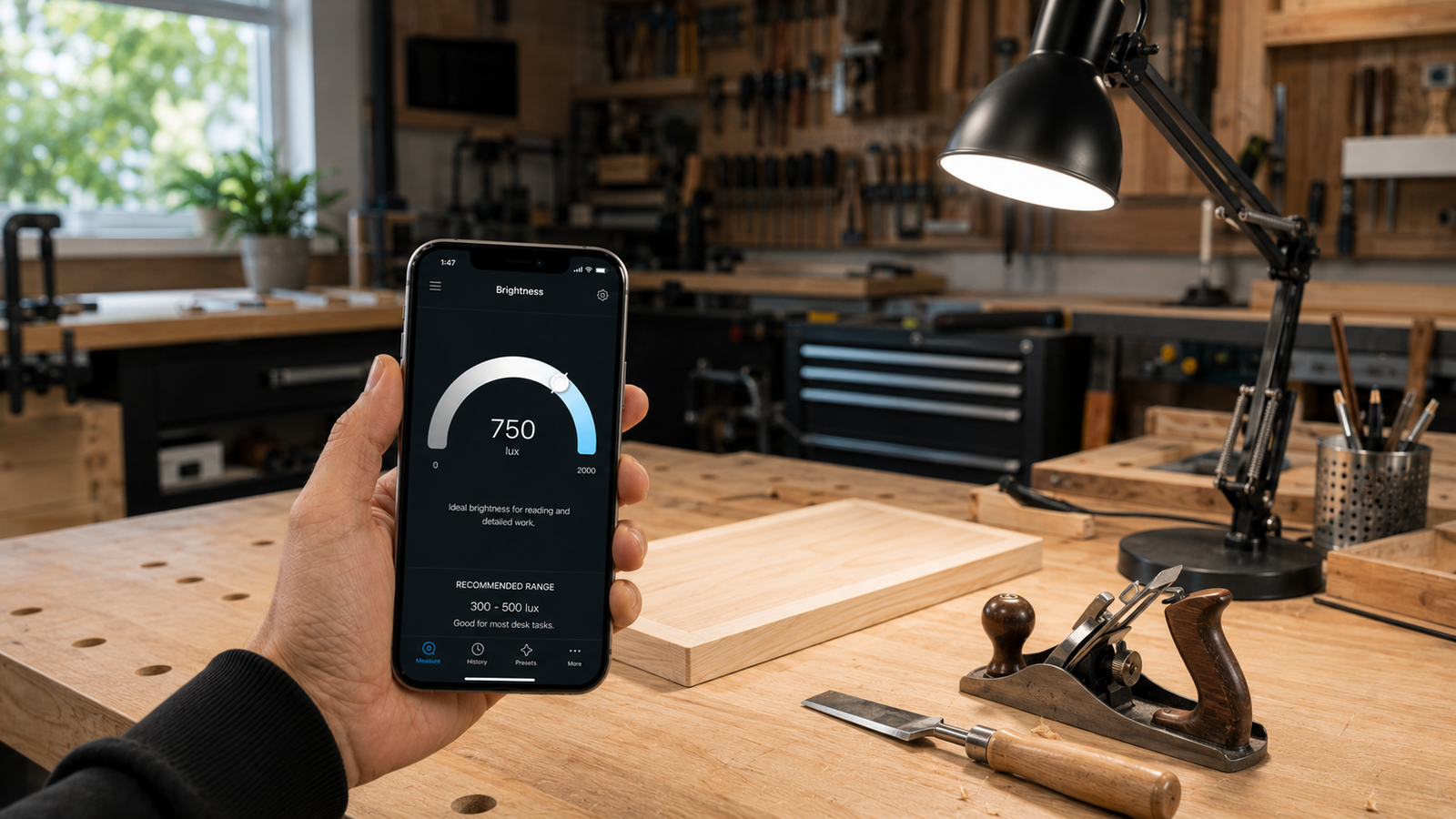
Kelvin Light Scale reads lux straight from your iPhone — divide by 10.76 and you have foot-candles. Check any bench, desk, or display in seconds.
Foot-candles and lux: the quick version
Both units measure illuminance — the light landing on a surface — just in different area units. A foot-candle is one lumen per square foot; a lux is one lumen per square meter. Because there are about 10.76 square feet in a square meter, 1 foot-candle equals roughly 10.76 lux. The US uses foot-candles while most of the world uses lux, so being able to convert between them is essential for reading any chart. Most phone meters report lux, which you then convert — you can take the lux reading and divide by 10.76.
Recommended foot-candle levels
| Space / task | Foot-candles | Approx. lux |
|---|---|---|
| Workshop (general) | 30–50 fc | ~300–500 lux |
| Workshop (detailed bench work) | 75–100 fc | ~750–1,000 lux |
| Classroom (general) | 30–50 fc | ~300–500 lux |
| Classroom (board / detailed) | 50–70 fc | ~500–750 lux |
| Retail (general sales floor) | 30–50 fc | ~300–500 lux |
| Retail (feature displays / showroom) | 50–100 fc | ~500–1,000 lux |
Workshop
General movement and assembly in a workshop are fine around 30–50 fc, but the bench is where the bar rises. Detailed tasks — fine measuring, machining, inspection, soldering — want 75–100 fc, and the most exacting precision work can call for more. Shadows are a real hazard here, so combine bright, even general lighting with dedicated task lights over each bench. Dark walls, machinery, and floors absorb a lot of light, so a workshop usually needs more output than its square footage alone suggests. Confirm the bench level with an actual measurement rather than assuming the overheads are enough.
Classroom
Modern classrooms target roughly 30–50 fc across general seating so students can read printed material and screens comfortably without strain. The board or presentation wall and any detailed work areas benefit from a step up toward 50–70 fc. Even distribution matters as much as the level — a room that's bright at the front and dim at the back disadvantages students in the shadows. Glare control on screens and boards is equally important. You can measure several desks to check the room is even from front to back.
Retail
Retail lighting does double duty: it has to be functional and it has to sell. A general sales floor works at 30–50 fc, enough for shoppers to move and browse comfortably. Feature displays, end caps, and showroom merchandise are deliberately brighter — 50–100 fc — to draw the eye and make products pop against the surrounding floor. That contrast between ambient and accent lighting is what guides customers and highlights what you want to sell. Measuring both the floor and the displays lets you set that contrast intentionally; you can check each zone as you design it.
💡 Pro tip
In retail, the ratio between display and ambient light matters more than either number alone. A feature display lit two to three times brighter than the surrounding floor naturally pulls the eye — measure both to dial in the contrast.
Converting foot-candles and lux
The conversion is straightforward and worth memorizing:
| To convert | Do this | Example |
|---|---|---|
| Lux → foot-candles | Divide by 10.76 | 500 lux ÷ 10.76 ≈ 46 fc |
| Foot-candles → lux | Multiply by 10.76 | 50 fc × 10.76 ≈ 538 lux |
For quick mental math, many people round to “1 fc ≈ 10 lux,” which is close enough for a first estimate. When you take a reading with the app, this is all the math you need to compare against any US foot-candle chart.
How to measure your space
- Open a lux meter app and allow access to your phone's sensors.
- Place the phone at the work surface — bench, desk, or display shelf — sensor facing the light.
- Read the lux value and divide by 10.76 to get foot-candles.
- Compare to the chart for that space and task.
- Sample multiple points to check uniformity, then average them.
✅ The verdict
Aim for 30–50 fc for general workshop, classroom, and retail areas, stepping up to 75–100 fc for detailed bench work and feature displays. Measure the surface in lux, divide by 10.76, and compare to the chart.
Whether you're lighting a workbench, a classroom, or a sales floor, the right foot-candle level is well established — the only question is whether your space actually hits it. Find out by taking a reading and converting; you can measure your space now.
Check your foot-candle levels today
Kelvin Light Scale measures lux, color temperature, and exposure from your iPhone — read the level, convert to foot-candles, and compare to the chart. Free to start, with pro tools when you need them.
Frequently asked questions
How many foot-candles do you need for a workshop?
General workshop areas need 30–50 foot-candles, while detailed bench work such as fine measuring, machining, or inspection wants 75–100 foot-candles. Add task lighting over each bench, since overhead fixtures alone usually leave shadows on the work.
How many foot-candles should a classroom have?
Modern classrooms target about 30–50 foot-candles across general seating, stepping up toward 50–70 foot-candles at the board or for detailed work. Even distribution from front to back matters as much as the level itself.
How many foot-candles for a retail store?
A general retail sales floor works at 30–50 foot-candles, while feature displays and showroom merchandise are brighter at 50–100 foot-candles to draw attention. The contrast between display and ambient light is what guides shoppers' eyes.
How do you convert foot-candles to lux?
Multiply foot-candles by 10.76 to get lux, or divide lux by 10.76 to get foot-candles, because one foot-candle equals about 10.76 lux. For a rough estimate, you can round to 1 foot-candle ≈ 10 lux.
What is the difference between foot-candles and lux?
Both measure how much light falls on a surface. A foot-candle is one lumen per square foot (used mainly in the US), while a lux is one lumen per square meter (used in most of the world). One foot-candle equals roughly 10.76 lux.
How do I measure foot-candles with my phone?
Use a lux meter app to read the illuminance at the surface, then divide the lux value by 10.76 to get foot-candles. Place the phone at the work surface with the sensor facing the light, and take several readings to check for even coverage.
how many foot-candles for a workshopclassroom foot-candle levelsretail lighting foot-candlesworkshop lighting requirementsfoot-candles to lux conversionrecommended foot-candle chartmeasure foot-candles with phoneretail display lighting