How Accurate Is a Phone Accelerometer for Vibration?

How Accurate Is a Phone Accelerometer for Vibration?
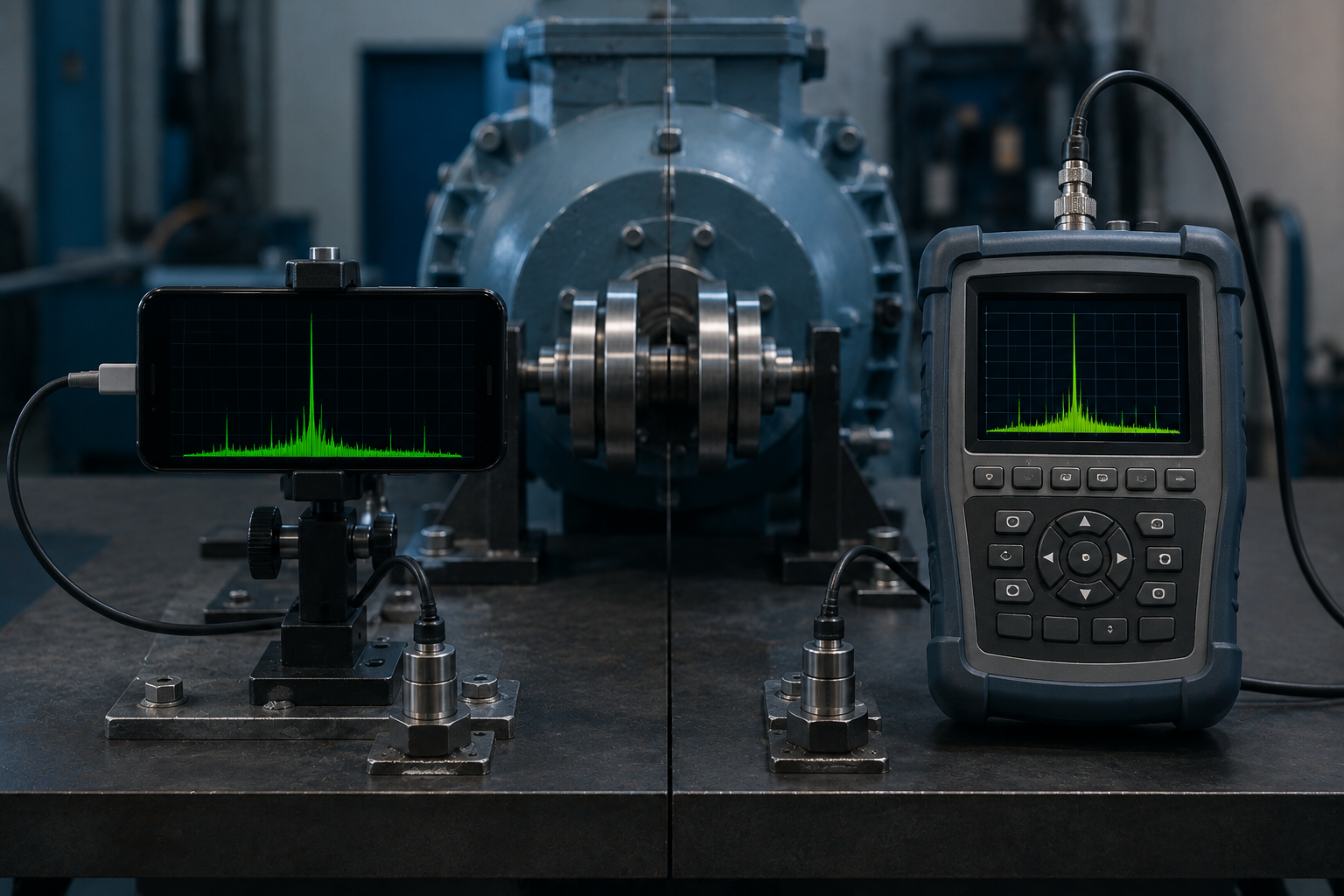
Before you trust a vibration reading from your phone, it is fair to ask how accurate that little built-in sensor really is. The honest answer has two halves. For identifying frequencies — finding the dominant vibration peak, working out running speed, spotting imbalance — a phone is genuinely accurate: independent studies comparing phone accelerometers against laboratory reference sensors have identified structural natural frequencies to within roughly 1–3%. For measuring tiny amplitudes with calibrated precision, it is weaker, because a phone’s sensor has lower sensitivity and a higher noise floor than a professional accelerometer.
In plain terms: a phone is accurate enough for screening, trending and diagnosis, but it is not a calibrated laboratory instrument. This guide explains exactly where the accuracy is strong, where it falls short, and how to get the most reliable readings. To put it to the test yourself, the free Vibration Detector Sensor app shows live RMS, peak and frequency data from your phone’s accelerometer.
See your phone’s accuracy for yourself
Take a live reading, watch the frequency spectrum lock onto the dominant peak, and judge the accuracy with your own machine.
What’s inside your phone
Your phone uses a MEMS (micro-electro-mechanical system) accelerometer — the same class of sensor that handles screen rotation and step counting. It measures acceleration along three axes, typically with a selectable range up to a few g, and can usually be sampled at up to around 100 Hz through the operating system. That sample rate is important: it sets the highest frequency the phone can faithfully capture at roughly 50 Hz (the Nyquist limit, half the sample rate). The accelerometer-based meter reads this sensor and converts the raw signal into the velocity and spectrum values you see.
How accurate is it, really?
The most useful way to think about accuracy is to separate frequency from amplitude.
Frequency accuracy is high. Researchers have used iPhones to extract the natural frequencies of bridges and footbridges and found them to match a dense network of laboratory accelerometers within about 1–3%. Since diagnosis depends on where the peaks sit (running speed, twice running speed, and so on), this is exactly the accuracy that matters most for finding faults like imbalance and misalignment.
Amplitude accuracy is moderate. A phone’s MEMS sensor has relatively low sensitivity and higher output noise than a research-grade accelerometer, so very small vibrations can disappear into the noise. The absolute mm/s number is reliable enough for screening and, crucially, for trend comparison — but it should not be treated as a calibrated, certified value. Studies also note that results are highly dependent on the phone model, so consistency comes from using the same device each time, which the app makes easy through its logged history.
Where a phone is accurate vs. where it falls short
| Accurate enough for | Not reliable for |
|---|---|
| Identifying dominant frequency / RPM | Calibrated, compliance-grade amplitude |
| Overall RMS velocity for screening | Very low-amplitude (feeble) vibration |
| Trend comparison against a baseline | High-frequency content above ~50 Hz |
| Imbalance (1×) and misalignment (2×) | Early bearing & gear defect frequencies |
The pattern is clear: a phone is a strong relative and frequency tool, and a fair absolute amplitude tool within its frequency band. For the everyday job of asking “is this machine getting worse, and roughly why?” that is exactly the accuracy profile you need, and you can capture it anytime with the vibration meter.
What affects phone accelerometer accuracy
- Coupling — the single biggest factor. Loose or padded contact under-reads badly; firm, flat, consistent contact gives repeatable results.
- The case — a thick rubber or foam case absorbs vibration before it reaches the sensor.
- Sample rate — caps the highest frequency the phone can resolve at around 50 Hz.
- Phone model — sensor quality varies between devices, so absolute readings differ from phone to phone.
- Sensor noise floor — sets the smallest vibration the phone can detect at all.
- Temperature and battery — MEMS sensors can drift slightly with conditions over time.
How to maximize accuracy
Most of these factors are within your control. To get the most accurate, repeatable readings: remove or thin out the case, press the phone firmly and flat against bare metal over a bearing, measure under steady-state load, hold still until the value settles, and always use the same device, the same spot and the same direction. Done consistently, the Vibration Detector Sensor app will give you readings you can genuinely trust for trending.
✓ Pro tip: Accuracy in absolute terms matters less than you think for condition monitoring. What you really care about is change. Even if your phone reads slightly high or low compared to a calibrated meter, that offset is consistent — so a doubling from baseline is still a doubling, and that is the signal that catches failures early.
When you need a real instrument instead
Reach for a certified, calibrated analyser when you need legally defensible acceptance numbers, when you are chasing early bearing or gear defects that live at high frequencies, when you must measure very small amplitudes, or when you need relative shaft vibration (which requires permanently installed proximity probes). For everything else — routine screening, trending, first-pass diagnosis and learning — a phone is a remarkably capable tool, and the app covers that ground well.
Accurate where it counts — try it free
Live RMS & peak in mm/s, a dominant-frequency spectrum, session logging and CSV export. Frequency-accurate, trend-reliable, always in your pocket.
► Get Vibration Detector Sensor on the App Store | Explore the app →
Note: A smartphone accelerometer is well suited to screening, trending and frequency identification, but it is not a substitute for a certified, calibrated vibration analyser when compliance-grade or high-frequency measurements are required.
Frequently Asked Questions
How accurate is a phone accelerometer for measuring vibration?
It is accurate for frequency identification — studies have matched laboratory reference sensors to within about 1–3% when finding natural frequencies — and reliable for overall RMS screening and trend comparison. It is less precise for absolute, calibrated amplitude and for very small vibrations, because the sensor has lower sensitivity and higher noise than professional accelerometers.
Can a phone accelerometer replace a professional vibration meter?
For routine screening, trending and first-pass diagnosis, a phone is a capable substitute. It cannot replace a calibrated analyser for compliance-grade acceptance testing, high-frequency bearing diagnostics, or shaft vibration measured with proximity probes. Think of it as the everyday tool that tells you when to call in the precision instrument.
Why does my phone give a different reading than a calibrated meter?
Differences usually come from coupling (how the phone contacts the surface), the case absorbing vibration, the phone’s sensor sensitivity and noise floor, and its limited frequency range. The offset tends to be consistent, so even if the absolute number differs, the trend and the dominant frequency remain reliable.
What is the sample rate of an iPhone accelerometer?
The accelerometer can typically be sampled at up to around 100 Hz through the operating system. That sets the highest frequency it can faithfully capture at roughly 50 Hz, the Nyquist limit. This comfortably covers the running speed and low-order harmonics of most machines but not high-frequency defect signatures.
Does phone accelerometer accuracy depend on the model?
Yes. Research has found that smartphone vibration accuracy is highly dependent on the device model, because sensor quality varies. For consistent results, use the same phone for every measurement so your trend reflects the machine rather than differences between devices.
Are phone vibration readings accurate enough for machine monitoring?
Yes, for condition monitoring based on screening and trending. The most important quantity in monitoring is change over time, and a phone tracks that reliably — a clear rise from a healthy baseline is a valid early warning even though the absolute reading is not calibrated to laboratory precision.
how accurate is a phone accelerometer for vibrationphone accelerometer accuracysmartphone vibration accuracyiphone accelerometer sample ratephone vs professional vibration metermems accelerometer accuracyare phone vibration readings accuratephone accelerometer noise floor