Golf Ball Speed vs Club Speed — What's the Difference and Why It Matters

Golf Ball Speed vs Club Speed — What's the Difference and Why It Matters
By Asaru Labs | Golf Performance | 7 min read
These two numbers appear side by side on every launch monitor readout, and most golfers glance at them without fully understanding what each one is telling them. Ball speed and club head speed are related — but they measure different things, respond to different fixes, and point to different problems when they are out of range. Understanding the distinction is the difference between practising the right thing and wasting your range time.
This guide breaks down exactly what each metric is, how they relate to each other, what good numbers look like at every level, and how to use the gap between them — smash factor — as the most practical diagnostic tool in golf.
See both numbers on every shot — free.
The Golf Launch Monitor app displays ball speed, club head speed, smash factor, launch angle, spin rate, and carry distance on every shot — straight from your iPhone camera, no hardware needed.
What is club head speed?
Club head speed is the velocity of the clubhead at the precise moment it makes contact with the ball, measured in miles per hour (mph). It is a measure of how fast you swing — the raw input of your swing engine. Everything else being equal, a faster swing produces more ball speed, more carry distance, and a higher ceiling for performance.
Club head speed is largely determined by physical factors: your body's rotational speed, the length and weight of the club, and the sequencing of your kinetic chain from feet through hips, torso, arms, and hands. It is the metric that speed training programmes — like SuperSpeed Golf — are specifically designed to increase.
But here is the critical thing to understand: club head speed is potential, not outcome. A 100 mph swing can produce very different results depending on how efficiently that speed is transferred to the ball at impact. That efficiency is what ball speed measures.
What is ball speed?
Ball speed is the velocity of the golf ball immediately after leaving the clubface, measured in mph. It is the direct output of the impact — the result of your swing speed combined with how well you delivered the clubhead to the ball.
Ball speed is the single strongest predictor of carry distance. A rough but reliable guideline: every 1 mph of additional ball speed adds approximately 2 yards of carry distance with a driver. So a gain of 10 mph in ball speed — whether from a faster swing or better contact — translates to roughly 20 more yards of carry.
Unlike club head speed, which is purely a function of the swing, ball speed is influenced by several impact factors simultaneously: contact location on the face, face angle at impact, dynamic loft, and the physical properties of the ball itself. This is why two golfers with identical swing speeds can produce dramatically different ball speeds — and dramatically different distances.
The relationship between ball speed and club speed: smash factor
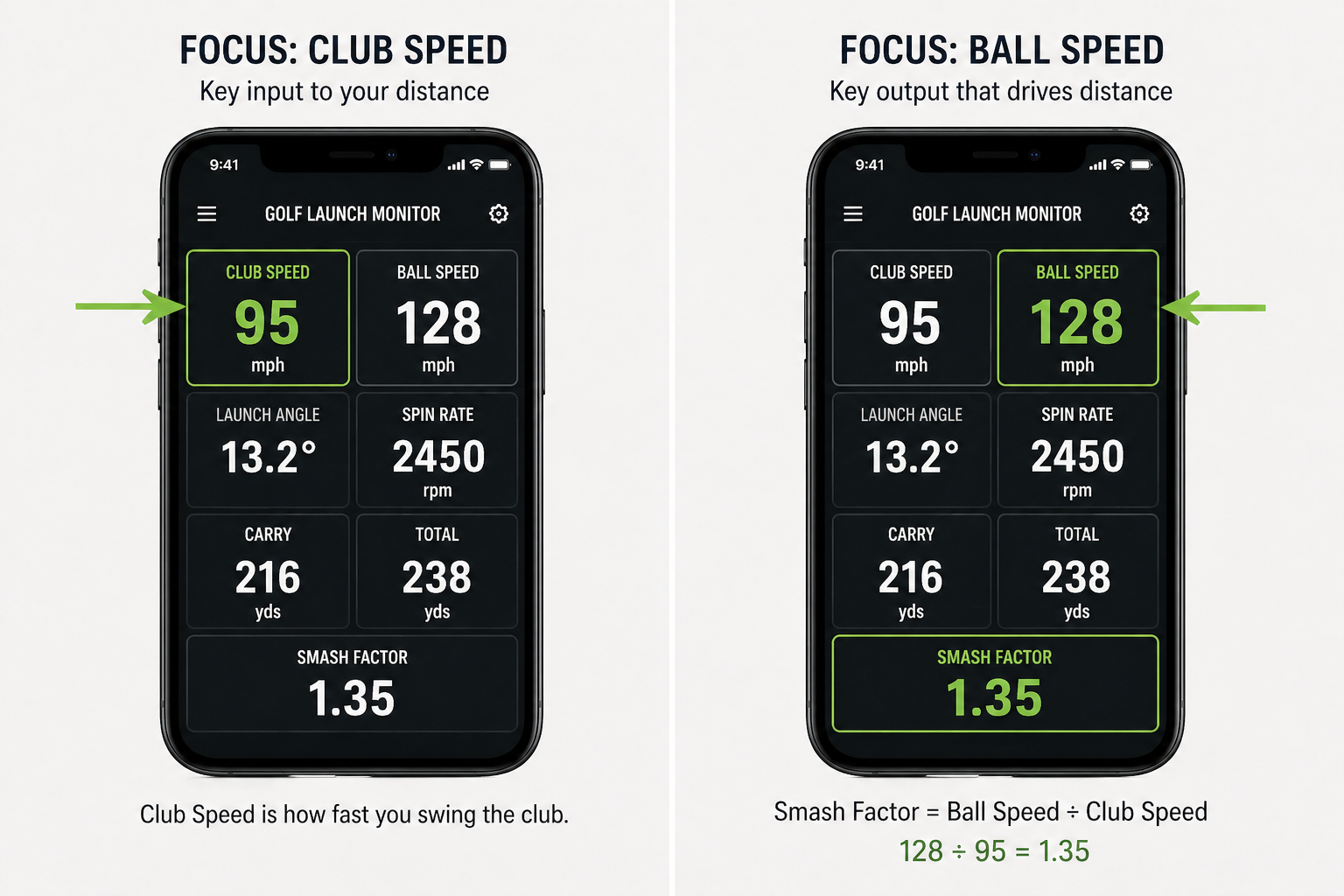
The ratio between ball speed and club head speed is called smash factor. It is the most useful single number for diagnosing whether your distance problem is a swing speed problem or a contact quality problem.
Smash Factor = Ball Speed ÷ Club Head Speed
The maximum smash factor for a legal driver is approximately 1.50 — meaning for every 1 mph of club head speed, the best possible impact produces 1.50 mph of ball speed. Tour professionals consistently hit 1.48–1.50. Most amateur golfers produce somewhere between 1.30 and 1.42, leaving meaningful distance behind through inefficient contact.
Here is why this matters practically: a golfer swinging at 95 mph with a smash factor of 1.35 produces 128 mph of ball speed — carrying roughly 210 yards. The same 95 mph swing with a smash factor of 1.48 produces 141 mph of ball speed — carrying roughly 238 yards. That is 28 yards of free distance from better contact alone, with zero increase in swing speed.
What is a good ball speed for an amateur golfer?
Ball speed benchmarks vary significantly by gender, age, and ability level. Here are realistic reference ranges for amateur golfers using a driver:
| Player profile | Typical club speed | Good ball speed target | Typical carry distance |
|---|---|---|---|
| Beginner (male) | 70–80 mph | 100–115 mph | 155–185 yards |
| Casual amateur (male) | 80–90 mph | 115–130 mph | 185–215 yards |
| Mid-handicap (male) | 90–100 mph | 130–145 mph | 215–240 yards |
| Low handicap (male) | 100–112 mph | 145–162 mph | 240–275 yards |
| Beginner (female) | 55–65 mph | 78–92 mph | 120–155 yards |
| Casual amateur (female) | 65–75 mph | 92–108 mph | 155–185 yards |
| Low handicap (female) | 75–90 mph | 108–128 mph | 185–215 yards |
| Tour professional (male) | 113–125 mph | 165–185 mph | 290–330 yards |
How to use this table: Find your profile, then measure your actual ball speed with the Golf Launch Monitor app. If your ball speed is at or above the target range for your club speed, your contact quality is good and swing speed is where to focus. If your ball speed is well below the target range despite your club speed, contact quality — smash factor — is the bigger opportunity.
Ball speed vs club speed: what good looks like by club
The relationship between ball speed and club speed is not constant across the bag. As loft increases, more energy is directed upward rather than forward, so ball speed as a fraction of club speed naturally decreases. Here are the expected ball speed to club speed ratios for solid contact across different clubs:
| Club | Good smash factor | Example: 90 mph club speed → | Expected ball speed |
|---|---|---|---|
| Driver | 1.44–1.50 | 90 mph | 130–135 mph |
| 3-wood | 1.40–1.46 | 85 mph | 119–124 mph |
| 5-iron | 1.32–1.38 | 78 mph | 103–108 mph |
| 7-iron | 1.28–1.34 | 72 mph | 92–97 mph |
| 9-iron | 1.22–1.28 | 65 mph | 79–83 mph |
| Pitching wedge | 1.18–1.26 | 60 mph | 71–76 mph |
The three distance scenarios — and what each one means
When you look at your ball speed and club speed together, they tell one of three stories. Knowing which story applies to you immediately tells you where to focus your practice.
Scenario 1 — Low club speed, ball speed proportionally in range
Your smash factor is healthy (1.43 or above for driver) but your absolute ball speed is low because your club speed is low. Your contact quality is not the problem — your swing speed is the ceiling.
What to do: Speed training is the appropriate focus. Programmes like SuperSpeed Golf use overspeed training with lighter clubs to teach your nervous system to recruit muscle fibres faster, increasing club speed over 4–8 weeks. Flexibility training, particularly hip and thoracic rotation, also contributes. This is the one scenario where working on swing mechanics specifically to add speed is the right call.
Scenario 2 — Decent club speed, ball speed well below the target range
Your swing is generating reasonable speed but it is not translating into ball speed efficiently. Smash factor is low — typically below 1.38 for a driver. This is a contact quality problem, not a speed problem.
What to do: Do not chase swing speed. More club speed with poor contact produces marginally more ball speed and is not the efficient path. Focus on centring contact — impact tape, tee height adjustment, path drills, and slow-motion contact training. Improving smash factor from 1.35 to 1.46 at 95 mph club speed adds 10 mph of ball speed and roughly 20 yards of carry. That is a better return than adding 5 mph of club speed with the same contact quality.
Scenario 3 — Both numbers look reasonable but carry distance is still short
Club speed and ball speed are in reasonable ranges but carry is below what the numbers suggest. This points to launch conditions — specifically a launch angle or spin rate that is outside the optimal window for your speed. High spin or too low a launch angle both rob carry distance even with adequate ball speed.
What to do: Look at your launch angle and spin rate data alongside ball speed. If spin is high, focus on shallowing your angle of attack and raising tee height. If launch is too low, move the ball forward and check tee height. The Golf Launch Monitor app shows all four numbers — club speed, ball speed, launch angle, and spin rate — simultaneously, making this diagnosis fast and direct.
How to increase ball speed: the priority order
There are three levers for improving ball speed, and they should be worked in this order — from highest return to lowest:
- Improve contact quality (smash factor). This is almost always the highest-return improvement for amateur golfers. Moving from 1.35 to 1.45 smash factor at 95 mph club speed adds 10 mph of ball speed — equivalent to adding roughly 7 mph of club speed. Contact improvement is faster to achieve and requires no physical training.
- Optimise launch conditions. Getting ball speed into the right launch angle and spin rate window maximises how efficiently that ball speed converts to carry distance. A well-struck shot with 140 mph ball speed launching at 8° with 3,500 rpm of spin will carry less than the same ball speed launching at 13° with 2,300 rpm. Launch and spin optimisation costs nothing — it is setup, tee height, and ball position.
- Increase club speed. Once contact quality and launch conditions are dialled in, increasing the raw input — club head speed — produces the largest absolute gains in distance. But without fixing the first two levers, adding swing speed simply amplifies inefficiency rather than adding meaningful carry.
The diagnostic shortcut: Measure your ball speed and club speed with the Golf Launch Monitor app. Divide ball speed by club speed. If the result is below 1.42, work on contact quality first — it is your fastest path to more distance. If it is above 1.44 and carry is still short, check your launch angle and spin rate. If both are in range and carry is still disappointing, swing speed is the right target.
A practical session for diagnosing your distance gap
Here is a 30-minute range session designed to tell you exactly which lever matters most for your game:
- Hit 10 drives, record everything. Note average club speed, ball speed, smash factor, launch angle, and carry distance. This is your baseline.
- Calculate your smash factor. Divide ball speed by club speed. Below 1.40 means contact quality is your priority. Above 1.44 means move to the next step.
- Check your launch angle against your speed bracket. Use the driver launch angle table from our launch angle guide. If launch is below your optimal window, raise tee height and move the ball forward one ball-width. Hit another 10 drives.
- Check your spin rate. If it is above 3,000 rpm at your swing speed, you are losing carry to excessive backspin. Focus on the angle of attack and tee height adjustments from our spin rate guide.
- Export the session. Save the data as a PDF or CSV. In four weeks, repeat the session and compare the numbers. The gap between your two sessions tells you whether your practice is moving the right metrics.
THE BOTTOM LINE
Most amateur golfers trying to hit it farther instinctively try to swing harder. But the data consistently shows that for golfers below a 10 handicap, contact quality and launch conditions account for far more distance loss than raw swing speed. Measure both numbers. Find your real gap. Work on the right lever. The distance gains from doing this correctly — without any increase in swing effort — routinely reach 20–30 yards for mid-handicap golfers who have never tracked their impact data before.
Measure your ball speed and club speed today — free.
Download the Golf Launch Monitor app and find out exactly where your distance is coming from — and where it is being lost. Ball speed, club head speed, smash factor, launch angle, spin rate, and carry distance on every shot, from your iPhone, no hardware needed.
Frequently asked questions
What is the difference between ball speed and club head speed in golf?
Club head speed is how fast the clubhead is moving at impact — the raw input of your swing. Ball speed is how fast the ball leaves the face — the output of the impact. Ball speed is always lower than club speed for irons and wedges due to loft, and close to 1.5 times club speed for a well-struck driver. The Golf Launch Monitor app shows both on every shot.
What is a good ball speed for an average amateur golfer?
For a male amateur golfer with a typical club speed of 85–95 mph, a good driver ball speed target is 125–140 mph. For female amateurs swinging at 65–75 mph, 92–108 mph is a good ball speed range. If your ball speed is significantly below these ranges for your club speed, contact quality is the issue — not lack of swing speed.
Does ball speed or club speed matter more for distance?
Ball speed is the more direct predictor of carry distance — every additional 1 mph of ball speed adds roughly 2 yards of carry with a driver. Club head speed matters because it is the input that generates ball speed, but the efficiency of that conversion (smash factor) determines how much of your club speed actually becomes ball speed. For most amateurs, improving that conversion efficiency delivers more distance than increasing club speed.
How do I know if my ball speed is limited by swing speed or contact quality?
Divide your ball speed by your club speed. If the result (smash factor) is above 1.44 with a driver, your contact is efficient and club speed is the ceiling. If it is below 1.40, contact quality is limiting your ball speed more than your swing speed is. The Golf Launch Monitor app calculates smash factor automatically on every shot.
How much ball speed do I need to hit a driver 250 yards?
To carry a driver 250 yards under calm conditions with an optimal launch angle and spin rate, you generally need around 148–152 mph of ball speed. At a smash factor of 1.46, that requires a club speed of approximately 101–104 mph. If your club speed is lower, optimising launch angle and spin rate can help recover some of that distance gap even before swing speed increases.
Can I increase ball speed without increasing club speed?
Yes, significantly. Improving contact quality — moving strikes closer to the centre of the face — directly increases ball speed at the same club speed. Moving from a smash factor of 1.36 to 1.46 at 90 mph club speed adds 9 mph of ball speed and approximately 18 yards of carry. Optimising launch angle and spin rate does not increase ball speed directly, but it makes the same ball speed produce more carry distance.
ball speed vs swing speed golfwhat is a good ball speed for amateur golfergolf ball speed vs club head speedball speed golf chartimprove ball speed golfclub speed vs ball speed differencegolf launch monitor ball speedaverage golf ball speed by handicap