Club Gapping Explained — How to Close Distance Gaps With Data

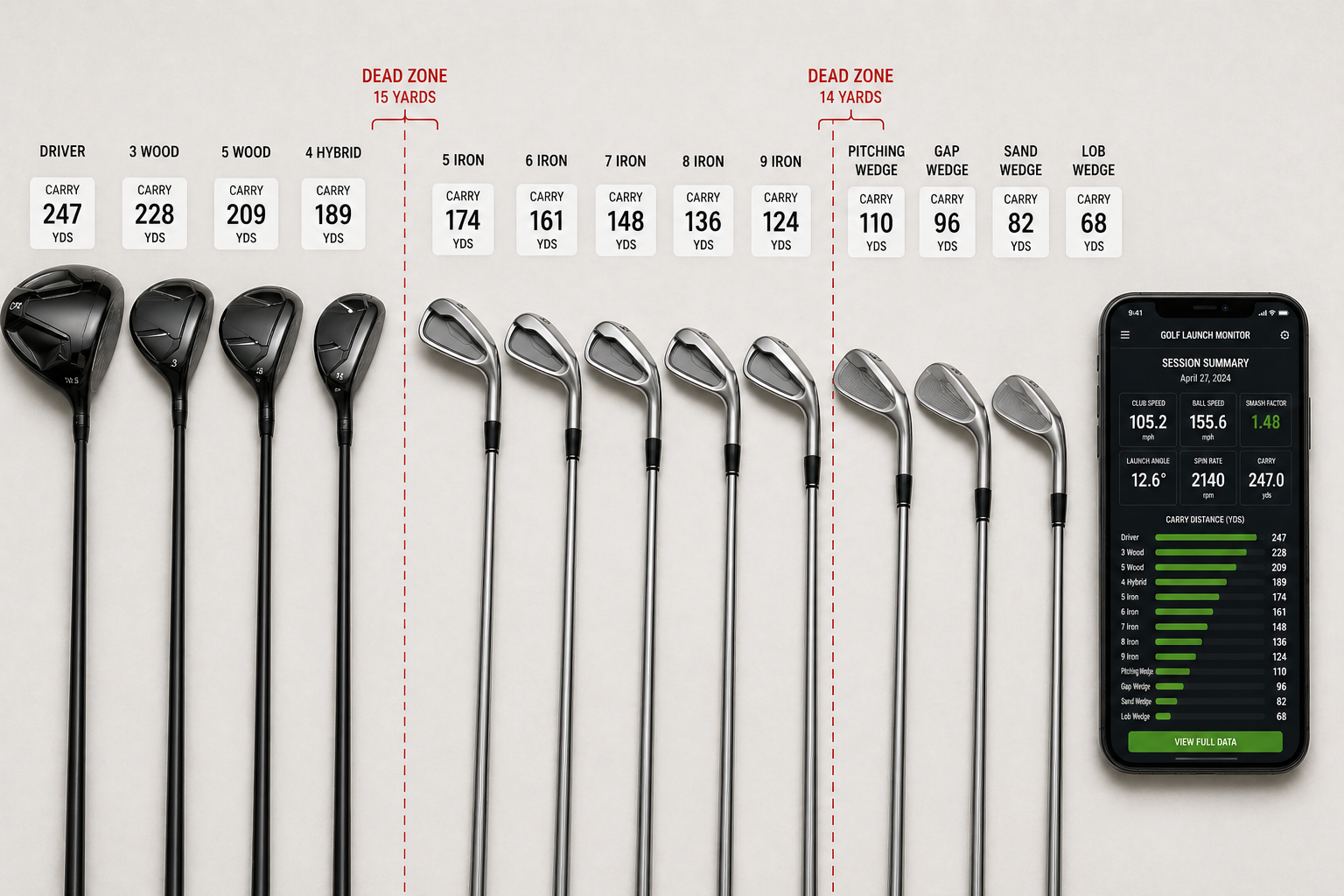
Club Gapping Explained — How to Close Distance Gaps With Data
By Asaru Labs | Golf Performance | 7 min read
Every golfer has experienced the uncomfortable in-between feeling — standing over a shot where a full swing with one club is too much and a full swing with the next one up is too little. That is a gapping problem. And for most amateur golfers, it is silently costing strokes on every single round by forcing forced half-swings, awkward in-between distances, and consistently poor distance control in the scoring zone.
This guide explains exactly what club gapping is, how to measure your gaps properly using launch monitor data, what good gapping looks like across the whole bag, and the specific steps to close any dead zones you find.
Measure your club gaps accurately — free.
The Golf Launch Monitor app records carry distance on every shot from your iPhone camera — no hardware needed. Hit 10–15 shots with each club and get your real average carry distances in a single session. Then lay them out and see exactly where your gaps are.
What is club gapping?
Club gapping is the carry distance difference between consecutive clubs in your bag. If your 8-iron carries 135 yards and your 9-iron carries 120 yards, the gap between those two clubs is 15 yards. If your 6-iron and 7-iron both carry 145 yards, the gap is zero — and you are effectively carrying a duplicate club.
The goal of proper gapping is to have a consistent, even spread of carry distances across your entire bag, so that you have a club for every realistic distance you face on the course. The standard target is a gap of roughly 10–15 yards between each consecutive club throughout the bag. When the spacing is even, you can stand over any yardage and reach for a specific club with confidence. When there are dead zones in your spacing, certain distances force you into uncomfortable compromises.
Gapping matters most in two parts of the bag:
- The transition zone — the gap between your shortest fairway wood or hybrid and your longest iron. This is the most common dead zone in amateur bags, often spanning 25–35 yards with nothing to fill it.
- The wedge zone — the scoring distances from roughly 50 to 130 yards. Most professional golfers carry three or four wedges specifically to ensure 10–15 yard spacing through this critical range. Many amateur golfers have only two and leave 30-yard dead zones in their wedge spacing.
Why most golfers do not know their real gaps
The fundamental problem with club gapping for amateur golfers is the same problem that affects all yardage estimation: they use their best shots rather than their average shots to measure distances. A golfer who hits one exceptional 4-iron 200 yards in a given round remembers that as their 4-iron distance — even if their average 4-iron carry is 182 yards. The following week they reach for the same club from 196 yards expecting to carry a bunker at 188, and it falls in.
The second problem is that most golfers measure total distance rather than carry distance — pacing to where the ball stopped rather than where it landed. On a firm range with a solid mat surface, a ball might run out 15–20 yards beyond its carry. Using total distance for club selection means systematically overestimating carry by that margin on shots that require a clean carry over a hazard.
Without a launch monitor, both of these problems are almost impossible to avoid. With the Golf Launch Monitor app, every session gives you an average carry distance for each club based on real data — not memory, not optimism, and not total distance inflated by roll.
How to measure your club gapping properly
What you need
- Your iPhone with the Golf Launch Monitor app downloaded
- A compact tripod placed 6–8 feet behind the ball
- A driving range with enough space for full shots with all clubs
- Your own golf balls where possible — consistent ball behaviour gives more reliable data
- Two or three range sessions to cover the full bag without fatigue
The protocol
Step 1 — Warm up before recording anything. Hit 15–20 balls before you start measuring. Cold-muscle distances are not representative of your real performance. Start recording only when you feel fully warmed up.
Step 2 — Hit 12–15 shots per club with your normal swing. Do not try harder or be more careful than usual — that would give you aspirational distances, not real ones. Include the inevitable mishits. They happen on the course too, and your average carry should reflect your real performance, not your best performance.
Step 3 — Record the average carry for each club. The app displays your session average after each set. Note this number. Also note the spread — the range between your shortest and longest carry in the set. A 7-iron that averages 145 yards but ranges from 125 to 165 yards is a very different story to one that averages 145 yards and ranges from 138 to 152 yards.
Step 4 — Split the bag across sessions to avoid fatigue.
- Session 1: Wedges and short irons (lob wedge, sand wedge, gap wedge, pitching wedge, 9-iron, 8-iron)
- Session 2: Mid and long irons (7-iron, 6-iron, 5-iron, 4-iron)
- Session 3: Fairway woods, hybrids, driver
Step 5 — Export and build your gap chart. Use the app's PDF or CSV export after each session. Then arrange your average carry distances from shortest to longest and calculate the gap between each consecutive pair of clubs. This is your gapping map.
What good gapping looks like across the bag
Here is an example of well-gapped bag for a male amateur golfer with an average swing speed of 90–95 mph with the driver:
| Club | Avg. carry | Gap to next club | Status |
|---|---|---|---|
| Driver | 228 yards | 22 yards | ✓ Good |
| 3-wood | 206 yards | 18 yards | ✓ Good |
| 5-wood | 188 yards | 14 yards | ✓ Good |
| 4-hybrid | 174 yards | 13 yards | ✓ Good |
| 5-iron | 161 yards | 13 yards | ✓ Good |
| 6-iron | 148 yards | 12 yards | ✓ Good |
| 7-iron | 136 yards | 12 yards | ✓ Good |
| 8-iron | 124 yards | 12 yards | ✓ Good |
| 9-iron | 112 yards | 12 yards | ✓ Good |
| Pitching wedge | 100 yards | 13 yards | ✓ Good |
| Gap wedge (52°) | 87 yards | 12 yards | ✓ Good |
| Sand wedge (56°) | 75 yards | 13 yards | ✓ Good |
| Lob wedge (60°) | 62 yards | — | ✓ Good |
Every gap in this bag falls between 12 and 22 yards — tight enough that there is never an awkward in-between distance, loose enough to accommodate natural swing variation.
The three most common gapping problems — and how to fix each one
Problem 1 — The long iron / fairway wood dead zone
This is the most frequently occurring gapping problem in amateur bags. It looks like this: 3-wood carries 200 yards, 5-iron carries 170 yards. That leaves a 30-yard dead zone between 170 and 200 yards — a range where no club fits cleanly on a full swing.
Why it happens: Most amateur golfers struggle to hit long irons (3-iron, 4-iron) consistently, so they carry a set that starts at 5-iron. But the gap between the 5-iron and the 3-wood or 5-wood is then too large to fill on full swings.
The fix:
- Add a 4-hybrid or 5-hybrid to bridge the gap. Hybrids are significantly easier to hit consistently than long irons and fill exactly this range.
- If you currently carry a 3-iron and 4-iron that are hard to hit, replace both with a 3-hybrid and 4-hybrid. The carry distances will be similar but the consistency — and therefore the effective gap coverage — will be much better.
- Measure your hybrid carries with the Golf Launch Monitor app to confirm they fill the target range before committing the club to your bag.
Problem 2 — The wedge dead zone
This problem costs more strokes than any other gapping issue because it affects the scoring distances — the range where approach shots are hit. It looks like this: pitching wedge carries 105 yards, sand wedge carries 70 yards. That is a 35-yard dead zone from 70 to 105 yards where no club produces a controlled full-swing distance.
Why it happens: Most starter sets include only a pitching wedge and sand wedge. The 35-yard gap between them is filled with half-swings and awkward compromises, producing inconsistent distances precisely when precision matters most.
The fix:
- Add a gap wedge (also called an approach wedge or AW) of 50–52° to fill the middle distance. Measure its carry with the Golf Launch Monitor app to confirm it lands near the midpoint between your PW and SW.
- If the gap is still large after adding a single wedge, consider adding a second one. Tour professionals commonly carry three or four wedges specifically to cover 60–130 yards in 10–15 yard increments.
- The goal is to have a full-swing carry distance for every 10–15 yards in the scoring zone. Half-swings are inherently inconsistent — having the right wedge for the distance on a full swing is always more reliable than a controlled partial swing with the wrong wedge.
Problem 3 — Duplicate clubs (zero gap)
This is less common but equally damaging to scoring. It looks like this: 6-iron and 7-iron both carry 142 yards. You are effectively carrying two clubs that do the same job, which means one of the 14 slots in your bag is wasted.
Why it happens: Modern game-improvement irons often have significantly stronger lofts than traditional irons. A current 7-iron from a game-improvement set may have the loft of a traditional 5-iron. If a golfer then adds a hybrid or fairway wood calibrated against traditional lofts, it can produce a carry distance that overlaps with a club already in the bag.
The fix:
- Have the lofts of your irons measured — any golf shop can do this with a loft gauge in a few minutes. Many golfers discover their irons are several degrees stronger than the manufacturer's stated specs.
- Consider loft bending if two consecutive irons are very close — a club fitter can adjust loft by 1–2° to restore the desired spacing.
- Replace a duplicate club with one that fills a genuine gap elsewhere in the bag.
A common variation: Some golfers discover that their 4-iron and 5-hybrid carry nearly the same distance. If the hybrid is easier to hit consistently (higher smash factor, tighter dispersion), the right move is to drop the 4-iron and keep the hybrid — even if the average carry is similar. Consistency across a set of shots matters more than the average of your best shots.
Wedge gapping in detail — the scoring zone
Because wedge distances are so critical to scoring, this section covers wedge gapping specifically and in more depth than the rest of the bag.
The standard wedge setup
Most golfers who take wedge gapping seriously end up with three or four wedges covering the following loft ranges:
| Wedge | Typical loft | Full carry (avg amateur) | Primary use |
|---|---|---|---|
| Pitching wedge | 44–48° | 88–120 yards | Full approach shots from 90–120 yards |
| Gap / approach wedge | 50–52° | 75–105 yards | Full approach shots from 75–100 yards |
| Sand wedge | 54–56° | 62–90 yards | Full approach shots, bunker play, chip shots |
| Lob wedge | 58–64° | 50–75 yards | Short approach shots, high trajectory over obstacles, tight lies |
How to gap your wedges precisely
After measuring your full-carry average for each wedge, check two things:
- Is there a dead zone between any two wedges? A gap larger than 18 yards between consecutive wedges means certain approach distances require a half-swing with the wrong club — the least reliable way to control distance in golf.
- Do you have coverage at the 50%, 75%, and 100% distances for your two most-used wedges? Many professional golfers know these three carry distances for their gap wedge and sand wedge by heart, because they represent the most common approach shot scenarios in the scoring zone.
Measure your 50% and 75% swing carries with the Golf Launch Monitor app the same way you measure full-swing carries — hit 10 shots at each swing length and record the average. Build a reference card that shows your carry distances at three swing lengths for each wedge. This card is one of the most valuable pieces of information you can carry in your bag.
How often to re-gap your bag
Your club distances change over time — through swing development, equipment wear, fitness changes, and lessons. A gapping analysis done twelve months ago may be meaningfully out of date today, particularly if any of the following have changed:
- You have taken lessons and changed your swing mechanics
- You have added or replaced any club in the bag
- Your ball speed has changed noticeably (common after speed training or fitness improvement)
- Your distances on the course feel different from your expectations
A full bag gapping session with the Golf Launch Monitor app takes two to three range sessions covering the full bag. Run this analysis every four to six months as a standard part of your practice schedule — it costs nothing extra beyond the range balls you would hit anyway and ensures your yardage book always reflects your real current performance.
THE SCORING PAYOFF
Golfers who identify and close gapping dead zones consistently report gaining 2–4 strokes per round in the scoring zone — not from any change in swing mechanics, but simply from no longer being forced into awkward half-swings at critical distances. Gapping is one of the highest-return equipment changes available to any golfer above a 10 handicap, and measuring it with a launch monitor makes it entirely data-driven rather than guesswork.
Map your club gaps accurately today — free.
Download the Golf Launch Monitor app and use it to measure your true carry distances for every club. Build your real gapping chart, identify your dead zones, and start making every distance work for you — from your iPhone, no hardware needed.
Frequently asked questions
What is club gapping in golf?
Club gapping is the carry distance difference between consecutive clubs in your bag. Ideal gapping means each club carries 10–15 yards further than the next shortest club, giving you a specific club for every distance you face on the course. When gaps are too large, certain distances have no good club for a full swing. When gaps are too small or zero, you are carrying duplicate clubs and wasting bag slots. The Golf Launch Monitor app measures your average carry distance per club so you can map your exact gaps.
How do I gap my golf clubs with a launch monitor?
Hit 12–15 shots with each club at the range using your normal swing, with the Golf Launch Monitor app recording carry distance on every shot. Note the average carry for each club. Lay out all your averages from shortest to longest and calculate the gap between each consecutive pair. Any gap larger than 18 yards is a dead zone worth addressing. Any gap smaller than 8 yards means two clubs are effectively duplicates.
What is the correct gap between golf clubs?
The standard target is 10–15 yards between each consecutive club throughout the bag. In practice, gaps can be slightly larger in the longer clubs (driver to 3-wood, for example) and should be tighter in the wedge zone (50–130 yards) where distance precision matters most. A gap larger than 18–20 yards anywhere in the bag represents a dead zone that will force uncomfortable half-swings when you face that distance on the course.
What is the most common gapping problem for amateur golfers?
Two problems are most common: the long iron / fairway wood dead zone (a 25–35 yard gap between the shortest fairway wood and the longest iron, most often filled by adding a hybrid), and the wedge dead zone (carrying only a pitching wedge and sand wedge leaves a 30+ yard gap in the most critical scoring distances). Both are straightforward to identify with launch monitor data and straightforward to fix with the right equipment addition.
Do I need a gap wedge?
For most amateur golfers, yes. If your pitching wedge carries more than 20 yards further than your sand wedge on a full swing, you have a dead zone that a gap wedge (typically 50–52°) can fill. Without it, distances in the 70–105 yard range require forced half-swings — the least reliable way to control distance in golf. Measure your pitching wedge and sand wedge carry averages with the Golf Launch Monitor app, calculate the gap, and if it exceeds 20 yards, a gap wedge is a high-value addition to your bag.
How often should I re-measure my club gapping?
Every four to six months as a baseline, plus any time you change a club, take a significant number of lessons, or notice your on-course distances diverging from your expectations. Your distances change as your swing evolves and as equipment ages, so gapping data more than 6–8 months old may no longer be accurate. A re-measurement session takes two to three range visits with the Golf Launch Monitor app and keeps your yardage data current.
golf club gappinghow to gap your golf clubs with a launch monitorclub gapping golfgolf bag gappingwedge gapping golffix golf club gapsclub distance gappinggolf launch monitor club fitting