Blood Sugar Log Sheet vs App: Which to Use? 2026

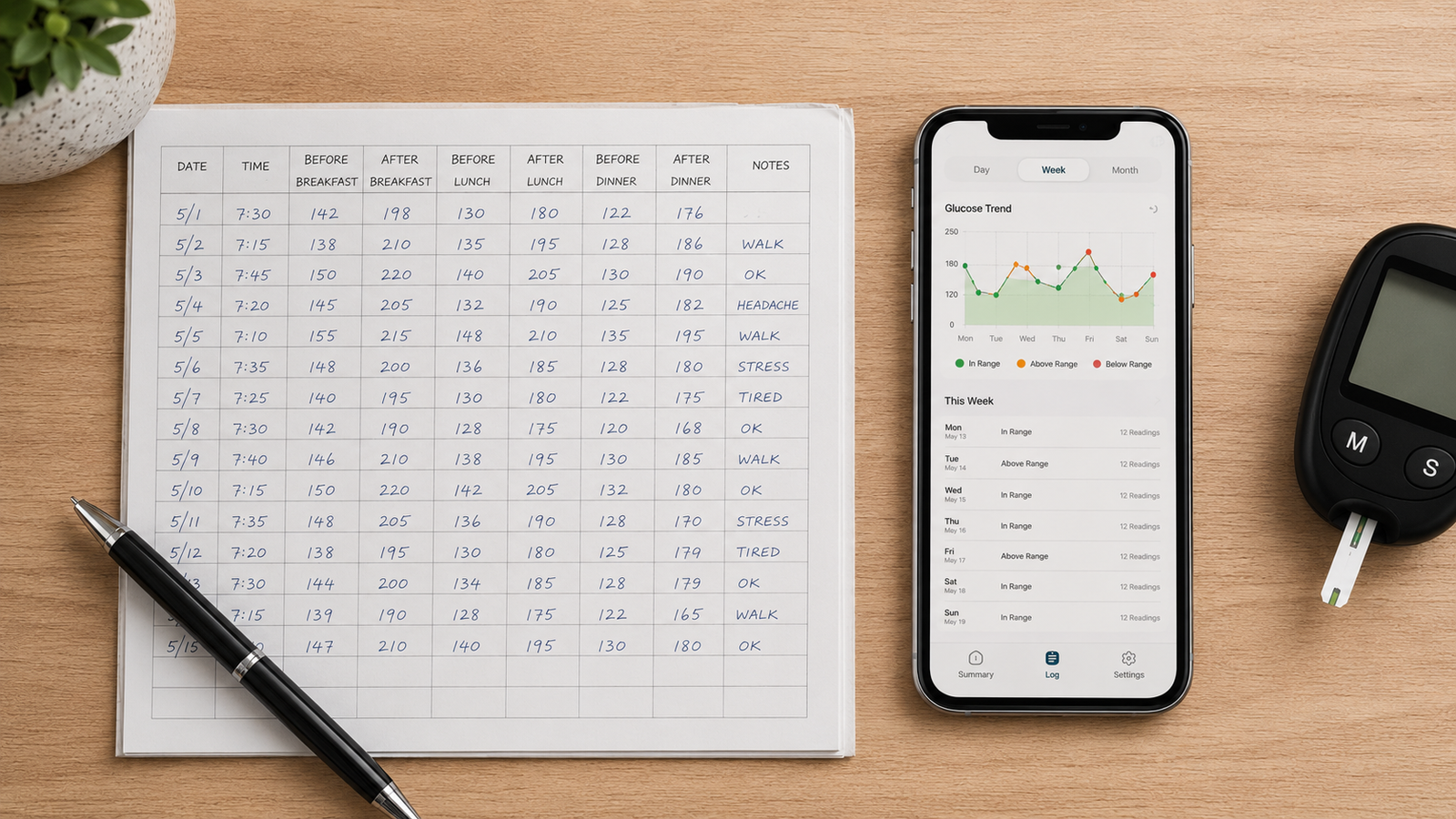
Blood Sugar Log Sheet vs App: Which Should You Use? (2026)
When you start tracking your blood sugar, you'll quickly face a simple choice: a printable blood sugar log sheet, or an app. The paper log sheet — a grid where you write in your readings by hand — has been the standard for decades and is still handed out by many clinics. Apps offer a digital alternative that charts your readings and reminds you to log. Both genuinely work, and the right one depends on how you like to manage things.
This is an honest head-to-head: what a log sheet does well, where an app pulls ahead, a full side-by-side comparison, and a clear recommendation based on the kind of tracker you are. Current for 2026.
Medical disclaimer: This article is for general information only and is not medical advice. Blood Sugar Monitor is a tracking tool, not a medical device — it logs the readings you take with your own glucose meter or CGM and does not diagnose or treat any condition. Always follow the guidance of your qualified healthcare provider.
Skip the paper grid
Blood Sugar Monitor gives you everything a log sheet does — plus automatic charts, reminders, and reports for your doctor — and tracks more than glucose. Free to start.
What is a blood sugar log sheet?
A blood sugar log sheet is a printable paper grid — typically columns for the date, time, your reading, and sometimes meals, medication, and notes. You can get them free from clinics or online and fill them in by hand. They're the simplest possible way to keep a record, which is exactly their appeal for some people. An app covers the same ground digitally, so the real question is which format suits you. If you'd rather not print and write, a tracking app does the job on your phone.
The case for a paper log sheet
Paper deserves a fair hearing — it has real advantages:
- It's free and instant. Print one and start; no download, no account.
- No phone or battery needed. It works anywhere, anytime, with zero technology.
- Some people simply prefer writing. The physical act of writing a reading can aid focus and memory.
- Dead simple. There's nothing to learn and no settings to configure.
If your needs are very basic and you like pen and paper, a log sheet can be perfectly adequate. The trade-offs show up over time — which is where an app starts to pull ahead.
The case for a blood sugar app
An app does everything a log sheet does, then adds what paper can't:
- It's always with you. Your phone is in your pocket; a printed sheet is often at home.
- Automatic charts. Your readings become trends you can see, instead of rows you have to interpret.
- Reminders. Prompts to log keep your record complete — paper can't nudge you.
- Nothing to lose. A misplaced sheet means lost records; an app keeps them safe with optional backup.
- Easy sharing. Export a clean report for your doctor instead of handing over a grid.
- More than glucose. Log insulin, blood pressure, weight, A1c, and cholesterol in one place.
For anyone tracking regularly or over the long term, those add up to a meaningfully easier experience. You can try the app side free.
Log sheet vs app: the full comparison
| Factor | Paper log sheet | App |
|---|---|---|
| Cost | Free to print | Often free to start |
| Always with you | Often left at home | On your phone |
| Trends & charts | Manual to spot | Automatic |
| Reminders | None | Built in |
| Averages & calculations | By hand | Done for you |
| Sharing with a doctor | Hand over the sheet | Export a report |
| Risk of loss | Gone if misplaced | Backed up |
| Needs no technology | Yes | Needs a phone |
| Tracks other metrics | Only what's on the page | Glucose, BP, weight, more |
Paper wins on simplicity and needing no technology; the app wins on nearly everything that matters over the long run. You can weigh it up here.
Which should you choose?
It comes down to how you track and what you need:
- Choose a paper log sheet if you prefer writing by hand, don't use a smartphone comfortably, or have very simple, short-term tracking needs.
- Choose an app if you want to see trends, value reminders to stay consistent, like having your log always on hand, want to share clean reports with your doctor, or track more than glucose.
For most people tracking over weeks and months, the app's consistency and trend features make it the easier long-term choice. If that's you, a free tracking app is the natural pick.
Can you use both?
You can — some people jot a quick paper note in the moment and enter it into an app later — but for most, doubling up just creates extra work. It's usually better to pick the one format you'll actually keep up with and commit to it. Whichever you choose, consistency matters more than the format itself. If you'd like trends and reminders doing the heavy lifting, an app makes staying consistent easier.
Everything a log sheet does — and more
Log your readings in seconds, see your trends on automatic charts, get reminders, track more than glucose, and export reports for your doctor. Free to start.
Frequently asked questions
Is a blood sugar log sheet or an app better?
Both work, but they suit different people. A paper log sheet is free, simple, and needs no technology, which is ideal for basic or short-term tracking. An app keeps your log on your phone, charts trends automatically, reminds you to log, and lets you share reports — usually the easier choice for long-term tracking.
What is a blood sugar log sheet?
It's a printable paper grid with columns for the date, time, and your readings, often with space for meals, medication, and notes. They're available free from clinics or online and filled in by hand. An app provides the same record digitally with added features like charts and reminders.
Why would I use an app instead of a paper log sheet?
An app is always with you, turns your readings into charts so trends are visible, reminds you to log, keeps your records safe from loss, lets you export reports for your doctor, and can track more than glucose. Those advantages add up over weeks and months of tracking.
When is a paper log sheet the better choice?
A paper sheet can be better if you prefer writing by hand, don't use a smartphone comfortably, or have very simple, short-term tracking needs. It's free, instant, and needs no technology, though it lacks charts, reminders, and easy sharing.
Can I use a log sheet and an app together?
You can, such as noting a reading on paper and entering it into an app later, but for most people doubling up just adds work. It's usually best to pick the single format you'll consistently keep up with, since consistency matters more than the format.
Does a blood sugar app cost money?
Many are free to start, with everyday logging, history, charts, and reminders available at no cost, and a paid tier for extras like advanced reports, cloud sync, and ad removal. Check what's included free versus premium before deciding, so you know what you're getting.
blood sugar log sheet vs apppaper vs app blood sugar logprintable blood sugar log sheetblood sugar tracking paper or appdiabetes log sheet vs appbest way to log blood sugardigital vs paper glucose logblood sugar logging methods