2700K vs 3000K: Which Color Temperature Is Warmer?

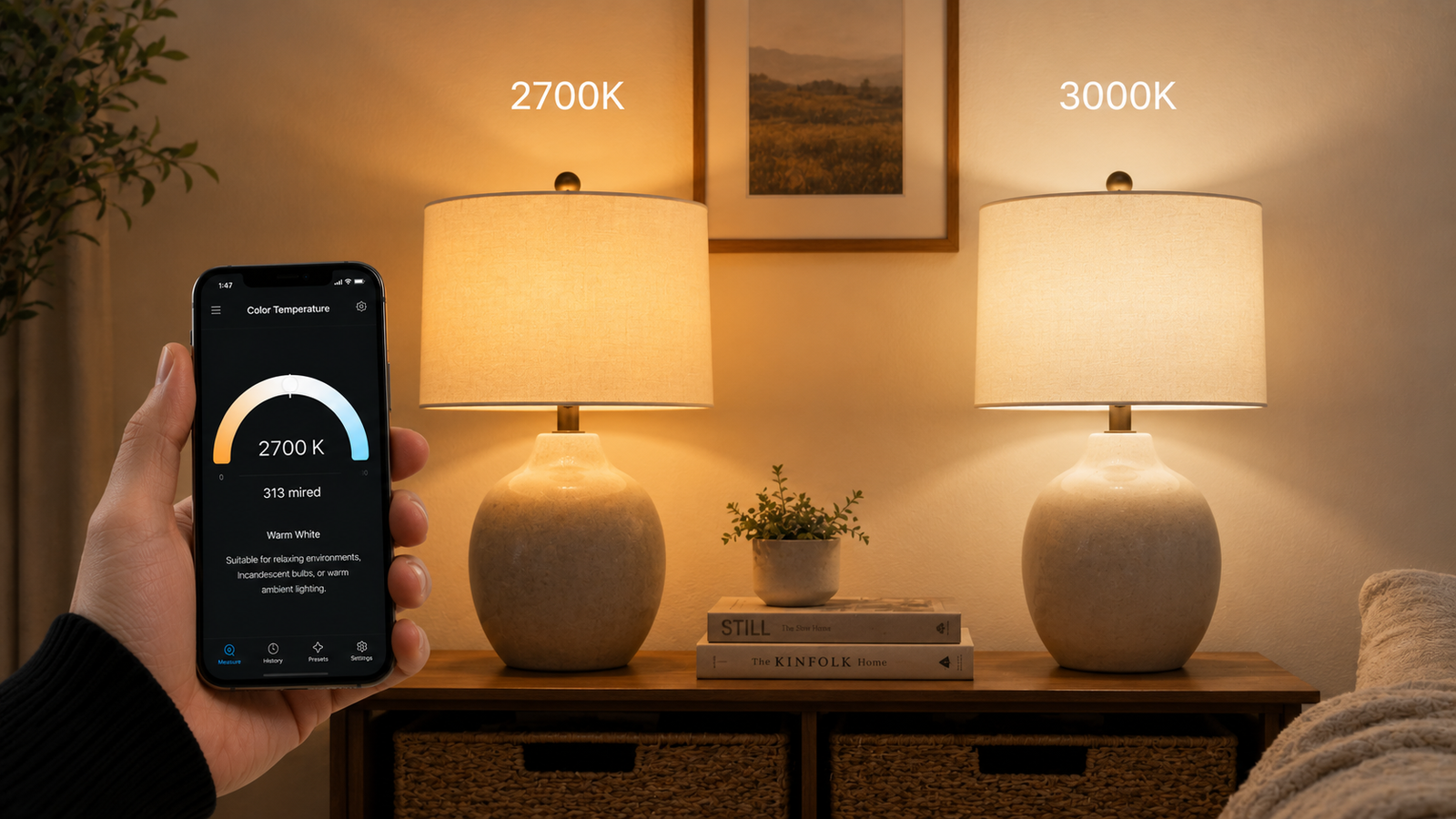
2700K vs 3000K: Which Color Temperature Is Warmer?
You're standing in the lighting aisle (or scrolling a product page) trying to decide between a 2700K bulb and a 3000K one, and the labels don't make it obvious which is the cozier, warmer choice. Here's the short answer right up front: 2700K is warmer than 3000K. On the Kelvin scale, lower numbers mean warmer, more golden light, so 2700K glows a touch more amber while 3000K is a slightly crisper, brighter-feeling white.
The difference is subtle but real, and it changes how a room feels. This guide breaks down exactly what each looks like, where to use them, and whether you can mix them. If you're trying to match a bulb you already own, you can measure its exact Kelvin with your phone to be sure.
📲 Not sure what your current bulbs are?
Kelvin Light Scale reads any bulb's color temperature from your iPhone, so you can tell 2700K from 3000K and match new bulbs exactly.
The quick answer
2700K is the warmer of the two. It produces a soft, golden glow very close to a traditional incandescent bulb. 3000K is still firmly in the “warm white” family but leans a little cleaner and whiter, with slightly less yellow. Neither is “cool” — both sit at the warm end of the scale — but if maximum coziness is your goal, 2700K wins. You can confirm which a bulb is by checking the label or taking a quick reading.
How the Kelvin scale works
Color temperature runs counterintuitively: lower Kelvin numbers are warmer, higher numbers are cooler. A candle is around 1,800K (very warm amber), daylight is around 5,500K (cool white), and the warm-white bulbs we use at home cluster between roughly 2,700K and 3,000K. So a 300K gap between 2700K and 3000K shifts you very slightly toward the cooler, whiter side — small, but visible when the two are side by side. Measuring removes any doubt about where a given bulb lands, which you can do with the app.
What 2700K looks like
2700K is the classic “warm white” or “soft white” glow. It's golden and relaxing, the color most people associate with a cozy living room or a restaurant in the evening. It flatters warm tones — wood, skin, earth colors — and signals comfort and winding down. If you want a space to feel intimate and homey, this is the temperature that does it.
What 3000K looks like
3000K is still warm but a step toward neutral. It keeps a welcoming feel while adding a bit more clarity and brightness perception, which helps in spaces where you need to see a little more crisply without going clinical. It's a popular “best of both worlds” choice — warm enough to feel pleasant, clean enough for tasks. You can compare a 3000K bulb's reading against a 2700K one to see the shift for yourself.
Side-by-side comparison
| 2700K | 3000K | |
|---|---|---|
| Warmth | Warmer, more golden | Slightly cooler, cleaner |
| Feel | Cozy, relaxing | Welcoming but crisper |
| Closest to | Traditional incandescent | Halogen / soft white |
| Best rooms | Living rooms, bedrooms | Kitchens, bathrooms |
| Label name | Soft white / warm white | Warm white |
Which should you choose for each room?
Choose 2700K for living rooms, bedrooms, dining rooms, and any space where relaxation and atmosphere matter most. It's the go-to for cozy, residential warmth.
Choose 3000K for kitchens, bathrooms, and hallways — spaces where you want warmth but also a bit more crispness for grooming, cooking, and seeing clearly. It's a common pick for bathrooms specifically, since it balances flattering light with practical visibility. Whichever you lean toward, you can verify existing fixtures before buying to keep a home consistent.
Can you mix 2700K and 3000K?
You can, but be thoughtful about it. A 300K difference is small enough that mixing across separate rooms is usually fine — few people would notice 2700K in the bedroom and 3000K in the kitchen. Within a single room or the same sightline, though, the difference becomes visible: one bulb will look subtly yellower than its neighbor, which can read as “something's off.” For a uniform look in one space, stick to a single temperature. Measuring each bulb is the surest way to avoid an accidental mismatch, and you can check them all in minutes.
💡 Pro tip
When replacing one bulb in a multi-bulb fixture, don't trust the label alone — brands vary, and a “2700K” from one maker can differ slightly from another's. Measure the existing bulbs and match the actual reading for a seamless result.
How to tell which one you have
If the bulb or box is labeled, look for “2700K” or “3000K,” or the terms “soft white” (usually 2700K) and “warm white” (often 3000K). If it's unlabeled or installed, the only reliable way to know is to measure: shine the bulb on white paper and read the color temperature with a phone app. That tells you exactly where it falls so you can match it. You can identify any bulb this way in under a minute.
✅ The verdict
2700K is warmer and cozier; 3000K is warm but cleaner and a touch brighter-feeling. Pick 2700K for relaxing living spaces and 3000K for kitchens and bathrooms — and keep a single temperature within any one room.
Both are warm, welcoming choices — it really comes down to how golden you want the glow. If maximum cozy is the goal, go 2700K; if you want warmth with a bit more crispness, 3000K is your bulb. And whenever you need to match what's already installed, just measure it first.
Match your bulbs with confidence
Kelvin Light Scale reads color temperature, lux, and exposure from your iPhone — tell 2700K from 3000K instantly and match every fixture. Free to start, with pro tools when you need them.
Frequently asked questions
Is 2700K or 3000K warmer?
2700K is warmer. On the Kelvin scale, lower numbers mean warmer light, so 2700K glows more golden and amber, while 3000K is still warm but slightly cleaner and whiter.
What's the difference between 2700K and 3000K?
It's a 300K shift toward cooler. 2700K looks like a traditional incandescent bulb — cozy and golden — while 3000K keeps a warm feel but adds a touch more brightness perception and clarity. The difference is subtle but visible side by side.
Which is better for a bedroom, 2700K or 3000K?
2700K is usually the better choice for bedrooms because its warmer, golden tone is more relaxing and helps signal winding down. 3000K can work too, but it's slightly crisper than ideal for a sleep space.
Is 3000K good for a kitchen or bathroom?
Yes. 3000K balances a welcoming warm feel with enough clarity for cooking and grooming, which makes it a popular pick for kitchens and bathrooms where you want both atmosphere and visibility.
Can I mix 2700K and 3000K bulbs in the same room?
It's best not to mix them within one room or sightline, since the difference becomes visible — one bulb looks yellower than the next. Mixing across separate rooms is generally fine. For a uniform look, use one temperature per space.
How can I tell if a bulb is 2700K or 3000K?
Check the box or base for the Kelvin rating, or the terms “soft white” (usually 2700K) and “warm white” (often 3000K). If it's unlabeled, measure the light with a color-temperature app to find the exact value.
2700k vs 3000kwhich is warmer 2700k or 3000k2700k vs 3000k bedroomwarm white vs soft white3000k kitchen lightingbest kelvin for living roommixing 2700k and 3000ksoft white color temperature